

Loading…
Loading…
Loading…
OCR GCSE Combined Science B · J260
OCR J260 · Reproductive Hormones and Technologies Check the specification (PDF) (opens in a new tab)
For a pregnancy to begin naturally, an egg must mature and be released from an ovary. Sperm must then reach and fertilise it, usually in an oviduct. The fertilised egg divides to form an embryo, which must implant in the lining of the uterus.
Infertility means difficulty conceiving naturally after a long period of trying. Treatment depends on which part of reproduction is not working. Hormones can help when the problem is insufficient stimulation of the ovaries, but they cannot remove a physical blockage in an oviduct.
Hormones are chemical messengers carried in the blood to target organs. Normally, the pituitary gland releases FSH, which stimulates ovarian follicles so that eggs mature, and LH, which triggers ovulation. A follicle is a structure in an ovary containing a developing egg. Too little FSH can mean that an egg does not mature; too little LH can mean that a mature egg is not released.
Fertility treatment can supply hormones that the body is not producing in sufficient amounts. FSH is given to stimulate eggs to mature, and LH can be given to trigger their release from the ovaries.
If ovulation is restored and there are no other barriers to conception, fertilisation can take place inside the body after intercourse. The drugs do not fertilise the egg themselves: they help make an egg available for fertilisation.
Hormone treatment may stimulate several follicles rather than just one. If several eggs are released and fertilised, twins or triplets may develop. Multiple pregnancies carry greater risks for the mother and babies, so releasing more eggs is not simply an advantage.
In vitro fertilisation, or IVF, is another way of treating infertility. It can help when natural conception is unsuccessful, including when a blocked oviduct prevents sperm and egg from meeting. IVF bypasses this meeting place by bringing eggs and sperm together in a laboratory.
The main stages are:
Progesterone may also be given to maintain the uterine lining and support implantation. Its role is different from FSH and LH: it supports the lining rather than stimulating egg maturation or release.
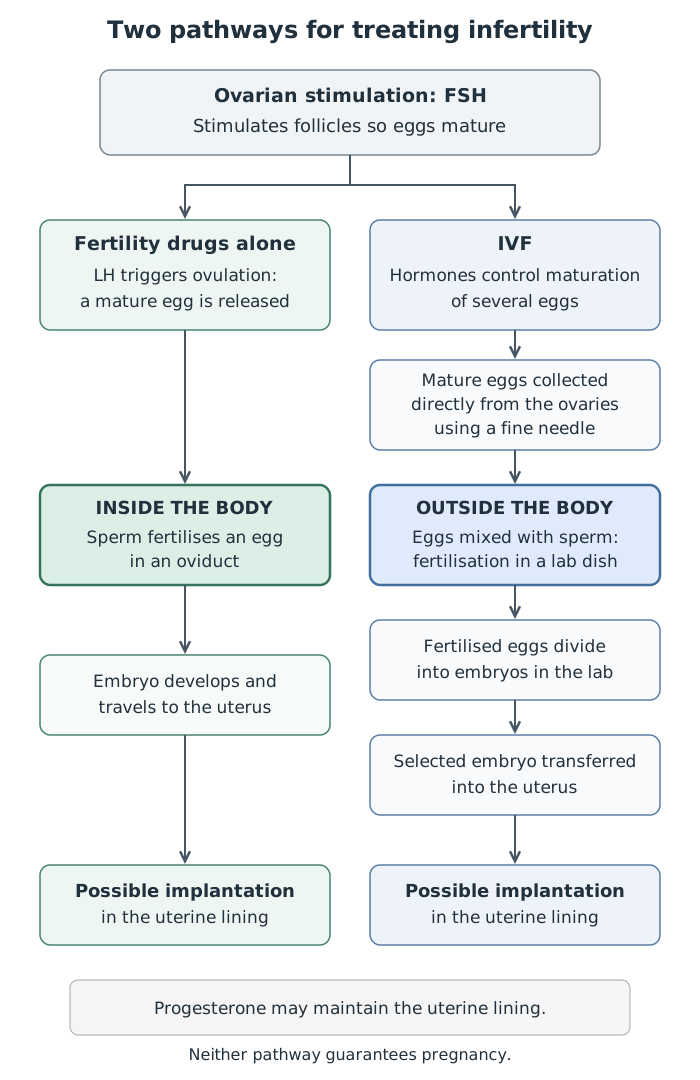
Fertility drugs can support fertilisation inside the body; IVF involves fertilisation in a laboratory before embryo transfer into the uterus.
Both fertility drugs and IVF use hormones to influence the reproductive cycle. The key difference is where fertilisation happens: inside the body with fertility drugs alone, but outside the body with IVF.
Neither treatment guarantees a pregnancy. With IVF, eggs may not fertilise or an embryo may not implant. Hormone treatment can cause side effects, and transferring more than one embryo increases the possibility of a multiple pregnancy. IVF offers a chance of pregnancy, rather than a certain outcome.
Fertility drugs alone: FSH and LH support egg maturation and ovulation → fertilisation can occur inside the body.
IVF: hormone treatment → eggs collected from ovaries → fertilisation with sperm in a laboratory → embryos develop → embryo transfer into the uterus → possible implantation.
Hormones cannot unblock oviducts; IVF can bypass them. Neither treatment guarantees pregnancy. Several eggs being released, or more than one embryo being transferred, increases the risk of a multiple pregnancy.
Link each hormone to its effect: FSH stimulates egg maturation; LH triggers ovulation.
Distinguish fertility drugs alone from IVF: in IVF, fertilisation takes place outside the body.
Describe embryos as being transferred into the uterus, not the ovaries. Transfer does not guarantee implantation or pregnancy.
It can see this note and what your specification asks for.
Answers are free with an account.
1 free note left this week
Get more free notesYour answer sets when this note comes back for review, or marks it complete.
Was this note helpful?
Log in to tell us whether it helped, or to report a problem.
Last updated
Infertility
Difficulty conceiving a child naturally after a long period of trying.
FSH
Follicle-stimulating hormone: a hormone normally released by the pituitary gland that stimulates follicles in the ovaries, allowing eggs to mature.
LH
Luteinising hormone: a hormone normally released by the pituitary gland that triggers the release of a mature egg from an ovary.
Ovulation
The release of a mature egg from an ovary.
IVF
In vitro fertilisation: a treatment in which eggs are fertilised by sperm outside the body and resulting embryos are transferred into the uterus.
Implantation
The attachment of an embryo to the lining of the uterus.
Put your knowledge into practice — try past paper questions for Combined Science B
Infertility
Difficulty conceiving a child naturally after a long period of trying.
FSH
Follicle-stimulating hormone: a hormone normally released by the pituitary gland that stimulates follicles in the ovaries, allowing eggs to mature.
LH
Luteinising hormone: a hormone normally released by the pituitary gland that triggers the release of a mature egg from an ovary.
Ovulation
The release of a mature egg from an ovary.
IVF
In vitro fertilisation: a treatment in which eggs are fertilised by sperm outside the body and resulting embryos are transferred into the uterus.
Implantation
The attachment of an embryo to the lining of the uterus.