

Loading…
Loading…
Loading…
OCR GCSE Combined Science B · J260
OCR J260 · Non-Communicable Diseases Check the specification (PDF) (opens in a new tab)
A pulse is the rhythmic pressure change felt in an artery as the heart pumps blood. Counting these pulses gives the pulse rate, measured in beats per minute. Exercise usually increases pulse rate: working muscles need more energy from respiration, and increased blood flow helps supply the oxygen they need.
After exercise stops, pulse rate gradually returns towards its resting value. We can investigate both the increase caused by exercise and the subsequent recovery. Recovery time is the time from stopping exercise until pulse rate returns to that person’s resting rate; a shorter recovery time indicates faster recovery.
You need a stopwatch, a way to record results and suitable exercise equipment, such as a stationary exercise bike. A heart-rate monitor can be used instead of counting the pulse manually.
Ask the participant to sit quietly until relaxed. Place the first two fingers of one hand on the inside of the other wrist, below the base of the thumb, and press gently until the pulse can be felt. Count the beats for one minute to obtain beats per minute directly. Alternatively, count for 30 seconds and multiply by two:
Take several resting readings. If they are reasonably stable, calculate their mean as the resting baseline. If they are still falling, allow more quiet rest before starting: a reading taken just after walking into the room may not represent a resting pulse.
One suitable investigation compares the same person before and after a standardised period of cycling. Using the same participant reduces the influence of differences between people.
Manual counting takes time, so it gives an average pulse rate over the counting period rather than an instantaneous reading. Use the same counting period each time and record consistently when each measurement begins. A monitor makes it easier to follow rapid changes immediately after exercise.
Keep the type, duration and intensity of exercise constant between repeat trials: use the same bike resistance and cycling pace. Also keep the pulse-measuring method, recovery posture and measurement intervals the same. These controls help ensure that differences are not simply caused by a different exercise task or measuring procedure.
If the investigation deliberately changes exercise duration, duration becomes the independent variable; keep the other conditions constant. Pulse rate and recovery time are the measured outcomes.
The teacher should assess the risks and supervise the activity. Participation must be voluntary, and anyone for whom exercise is unsuitable should not take part. Use a safe, manageable intensity rather than maximum effort. Check that equipment is secure and the surrounding area is clear. Stop immediately if a participant feels dizzy, unwell, unusually breathless or experiences pain, and tell the teacher. Never encourage someone to continue just to complete a result.
Record elapsed recovery time and pulse rate in a table, with units in the headings. Plot time since exercise stopped on the horizontal axis and pulse rate on the vertical axis. A horizontal line showing the resting baseline makes the return towards rest easier to identify.
Suppose a participant has a resting pulse of 72 beats per minute. The following constructed example shows how a recovery curve can be read.
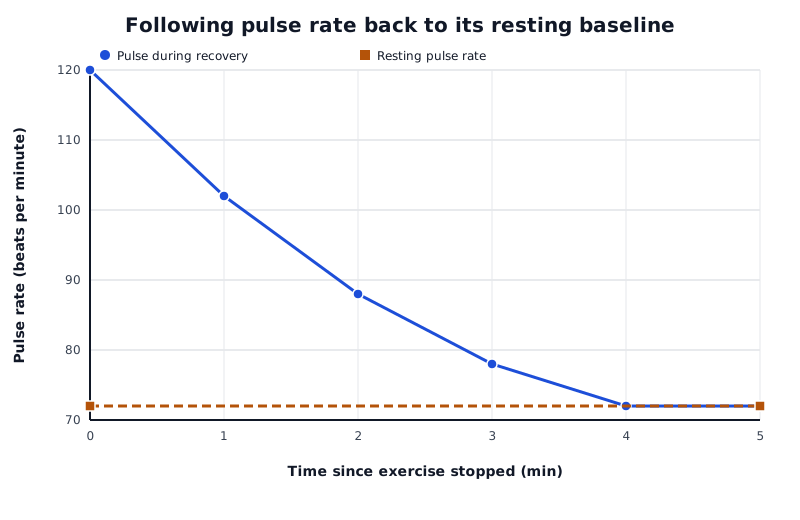
An example recovery curve. Pulse rate returns to the participant’s resting baseline at four minutes.
Data for Following pulse rate back to its resting baseline
| Series | Time since exercise stopped (min) | Pulse rate (beats per minute) |
|---|---|---|
| Pulse during recovery | 0 | 120 |
| Pulse during recovery | 1 | 102 |
| Pulse during recovery | 2 | 88 |
| Pulse during recovery | 3 | 78 |
| Pulse during recovery | 4 | 72 |
| Pulse during recovery | 5 | 72 |
| Resting pulse rate | 0 | 72 |
| Resting pulse rate | 5 | 72 |
The pulse is initially above the resting baseline and then falls. In this example it reaches the baseline at four minutes, giving a recovery time of four minutes. With measurements only once a minute, the exact return could have occurred between the final two readings; more frequent measurements would give a more precise estimate.
Compare the post-exercise rate with the resting rate to describe the effect of exercise. Compare recovery times under matched conditions to describe faster or slower recovery. Differences between participants may reflect fitness, but also other factors affecting pulse rate, so one short investigation cannot establish a person’s overall health.
Describe how pulse rate is measured, rather than just writing ‘measure the pulse’. Include the counting time and units.
Measure each participant’s resting pulse rate: recovery does not mean reaching a universal value such as 60 beats per minute.
Separate repeated measurements during recovery from repeat trials of the whole investigation.
Name specific control variables, such as exercise duration and cycling pace, and explain how they are kept constant.
Do not conclude that one person is healthier solely because they recover faster in one trial.
It can see this note and what your specification asks for.
Answers are free with an account.
1 free note left this week
Get more free notesYour answer sets when this note comes back for review, or marks it complete.
Was this note helpful?
Log in to tell us whether it helped, or to report a problem.
Last updated
Pulse rate
The number of heartbeats per minute, measured by counting pulses in an artery.
Resting pulse rate
A person’s pulse rate when they are relaxed and not exercising.
Recovery time
The time taken after exercise stops for pulse rate to return to the person’s resting rate.
Recovery rate
How quickly pulse rate returns towards its resting value after exercise. Faster recovery usually means a shorter recovery time.
Put your knowledge into practice — try past paper questions for Combined Science B
Pulse rate
The number of heartbeats per minute, measured by counting pulses in an artery.
Resting pulse rate
A person’s pulse rate when they are relaxed and not exercising.
Recovery time
The time taken after exercise stops for pulse rate to return to the person’s resting rate.
Recovery rate
How quickly pulse rate returns towards its resting value after exercise. Faster recovery usually means a shorter recovery time.
Unit: beats per minute.
Keep exercise type, duration and intensity constant unless one is deliberately changed. Keep the participant, measuring method and recovery conditions the same for repeat trials.