

Loading…
Loading…
Loading…
OCR GCSE Combined Science B · J260
OCR J260 · Cell Division and Differentiation Check the specification (PDF) (opens in a new tab)
A multicellular organism grows by increasing its number of cells. New cells come from existing cells: a parent cell grows and then divides to produce two daughter cells. Repeated divisions allow a single fertilised egg cell to develop into an organism containing many cells.
This process also continues after an organism has stopped growing. For example, damaged or worn-out skin cells need replacing. Cell division therefore supports both growth and the repair and replacement of tissues.
The cell cycle is the sequence of growth, copying genetic information and division that produces new cells. Its key parts are interphase, mitosis and division of the cytoplasm.
Before a cell divides, it needs enough cell material and genetic information for both daughter cells. During interphase, the cell grows and the number of sub-cellular structures, such as mitochondria and ribosomes, increases.
The cell also replicates its DNA. DNA carries genetic information and is organised into structures called chromosomes in the nucleus. Replication makes an identical copy of the DNA in each chromosome.
After replication, each chromosome consists of two identical copies called sister chromatids, joined together. When these copied chromosomes condense before separation, they can appear X-shaped. The two sides of the X are copies of the same chromosome, ready to be shared between the daughter cells.
Mitosis is division of the nucleus. Its role is to separate the chromosome copies so that each new nucleus receives a complete, identical set.
The chromosomes become condensed and visible, and the membrane around the nucleus breaks down. The copied chromosomes then line up across the centre of the cell. Spindle fibres pull the sister chromatids apart towards opposite ends, placing one copy of each chromosome at each end. New nuclear membranes form around the two sets.
The cytoplasm then divides in a process called cytokinesis, producing two separate daughter cells. Each daughter cell has the same genetic information and chromosome number as the parent cell. For example, a human body cell with 46 chromosomes produces two daughter cells, each with 46 chromosomes—not two cells with 23 each.
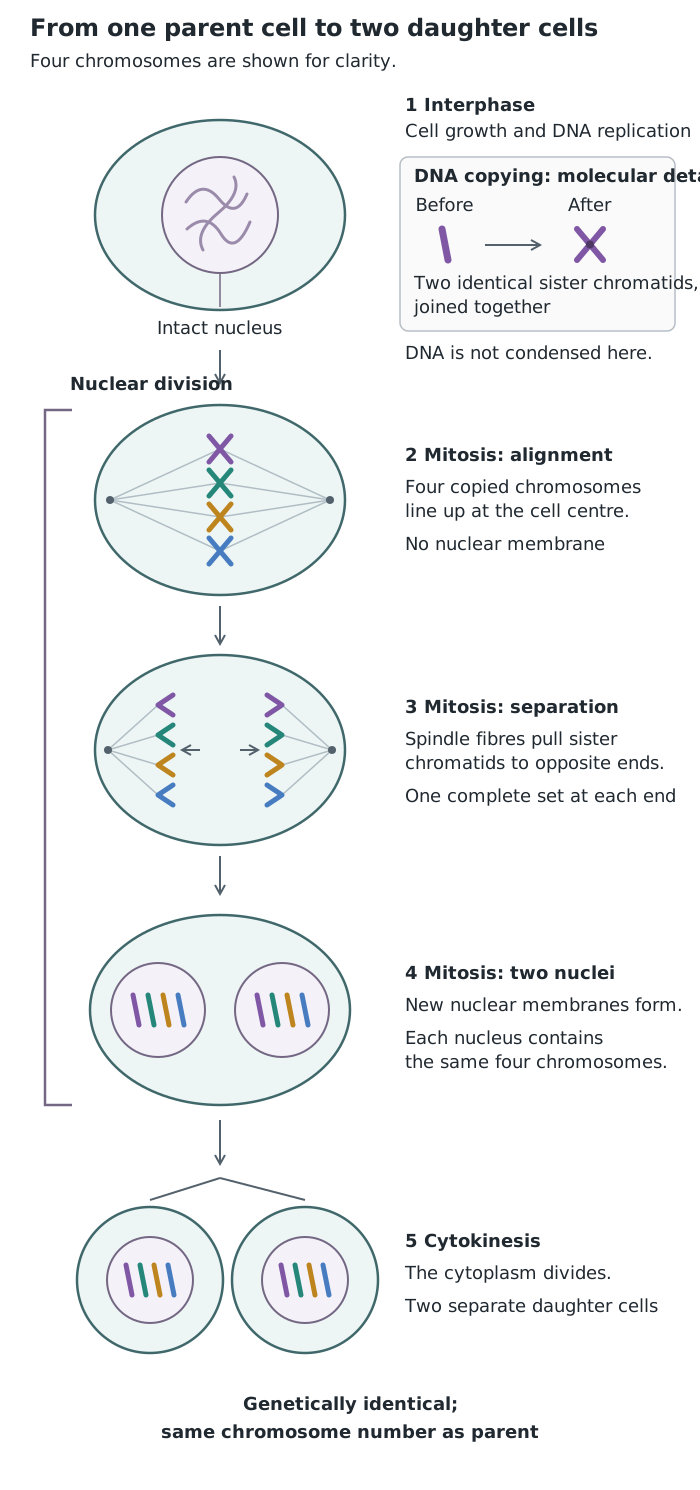
DNA is copied before mitosis, then the copies are shared equally. Division of the cytoplasm produces two daughter cells.
DNA replication and equal separation work together: replication supplies two copies, and mitosis distributes one complete set to each new nucleus.
Growing onion root tips are useful specimens because they contain many dividing cells. A prepared root-tip slide allows you to observe cells at different points in the cell cycle. You need a light microscope with low- and higher-power objective lenses, a light source and a prepared slide.
The eyepiece and objective lenses magnify the specimen. The stage holds the slide, while the coarse and fine focus controls bring the image into focus.
Handle the glass slide carefully, keep it away from the edge of the bench and report any broken glass rather than picking it up. Looking from the side when bringing the stage towards the lens helps prevent damage to both the slide and the lens.
Examine several cells rather than expecting every cell to look the same. In interphase, a cell has a visible nucleus, but individual chromosomes are not clearly distinguishable. DNA replication itself cannot be identified simply by seeing a nucleus.
In cells undergoing mitosis, look for condensed chromosomes. Their arrangement helps you interpret what is happening: chromosomes gathered across the middle indicate alignment before separation; two groups moving towards opposite ends indicate that the copies are being separated. Two newly forming nuclei show that nuclear division is reaching completion.
Record what you can actually see in labelled drawings, including the chromosome positions. A prepared slide provides a snapshot of many different cells, not a live sequence of one cell dividing.
Normally, cell growth and division are controlled. Cancer results from changes in a cell’s DNA that disrupt this control, leading to uncontrolled growth and division.
The important distinction is not that cancer cells divide—healthy cells also divide for growth and repair—but that their division is no longer properly controlled. Cancer is a non-communicable disease: it is not passed from one person to another by ordinary contact.
Distinguish DNA replication in interphase from the separation of chromosome copies during mitosis.
Explain growth as an increase in cell number, not just an increase in the size of existing cells.
For OCR Combined Science B, you do not need to recall the names of the intermediate phases of mitosis. Describe the visible changes instead.
In a microscope method, state that you start with the lowest-power objective and use coarse focus before fine focus.
Link cancer to changes in DNA that cause uncontrolled cell growth and division.
It can see this note and what your specification asks for.
Answers are free with an account.
1 free note left this week
Get more free notesYour answer sets when this note comes back for review, or marks it complete.
Was this note helpful?
Log in to tell us whether it helped, or to report a problem.
Last updated
Cell cycle
The sequence of growth, DNA replication and division through which a cell produces two daughter cells.
Interphase
The part of the cell cycle before mitosis in which a cell grows, increases its sub-cellular structures and replicates its DNA.
Chromosome
A structure made of DNA that carries genes.
DNA replication
The copying of DNA before cell division so that each daughter cell can receive a complete set of genetic information.
Mitosis
Division of a cell’s nucleus to produce two nuclei with genetically identical sets of chromosomes.
Cytokinesis
Division of the cytoplasm to form two separate daughter cells.
Daughter cell
One of the new cells produced when a parent cell divides.
Cancer
A non-communicable disease in which changes in a cell’s DNA lead to uncontrolled growth and division.
Put your knowledge into practice — try past paper questions for Combined Science B
Cell cycle
The sequence of growth, DNA replication and division through which a cell produces two daughter cells.
Interphase
The part of the cell cycle before mitosis in which a cell grows, increases its sub-cellular structures and replicates its DNA.
Chromosome
A structure made of DNA that carries genes.
DNA replication
The copying of DNA before cell division so that each daughter cell can receive a complete set of genetic information.
Mitosis
Division of a cell’s nucleus to produce two nuclei with genetically identical sets of chromosomes.
Cytokinesis
Division of the cytoplasm to form two separate daughter cells.
Daughter cell
One of the new cells produced when a parent cell divides.
Cancer
A non-communicable disease in which changes in a cell’s DNA lead to uncontrolled growth and division.
Use a prepared onion root-tip slide: growing root tips contain dividing cells.
Lowest-power objective → secure slide → illuminate → coarse focus → fine focus → centre cells → higher power and fine focus.
Keep the objective lens clear of the slide.
Visible clues:
Changes in DNA → loss of control of cell growth and division → cancer.
Cancer is non-communicable.