

Loading…
Loading…
Loading…
OCR GCSE Combined Science B · J260
OCR J260 · Cell Division and Differentiation Check the specification (PDF) (opens in a new tab)
Chromosomes are structures made of DNA that carry genetic information. In most body cells, chromosomes occur in pairs: one chromosome of each pair was inherited from the mother and the other from the father. A cell with these two sets of chromosomes is diploid.
Sexual reproduction involves gametes, or sex cells. In animals, these are sperm and egg cells. During fertilisation, their nuclei fuse to form the nucleus of a fertilised egg cell called a zygote.
If both gametes contained the full body-cell chromosome number, fertilisation would double it. Instead, gametes contain just one chromosome from each pair. They are haploid, meaning they have one set of chromosomes. Meiosis is the cell division that halves the chromosome number to make this possible.
For humans, a typical body cell has 46 chromosomes arranged in 23 pairs. A sperm or egg cell has 23 chromosomes. When their nuclei fuse, the zygote has 46 chromosomes again: 23 from each parent. Meiosis and fertilisation therefore maintain the chromosome number from one generation to the next.
Meiosis begins with a diploid cell in a reproductive organ. Before it divides, the cell passes through interphase, during which it grows and replicates its DNA.
After replication, each chromosome consists of two identical copies called chromatids, joined together. This is often drawn as an X-shaped chromosome, with each half of the X representing one chromatid. The DNA has been copied, but the joined copies still count as one chromosome.
This preparation supplies the DNA needed for the cells produced by the two divisions that follow.
The chromosomes arrange themselves in matching pairs. During the first meiotic division, the two chromosomes of each pair separate, moving to opposite ends of the cell. The cell then divides into two cells.
Each new cell receives only one chromosome from each original pair, so the chromosome number has now been halved. However, each chromosome still consists of two joined chromatids. In humans, each of these cells has 23 chromosomes, each still made of two chromatids.
There is no further DNA replication before the second meiotic division. In each of the two cells, the joined chromatids separate. Once separated, each becomes an individual chromosome. Both cells divide again, producing four haploid cells in total.
The sequence is therefore one starting cell, then two cells, then four cells. DNA is copied once, but the cell divides twice. Each final cell has half the chromosome number of the original diploid cell.
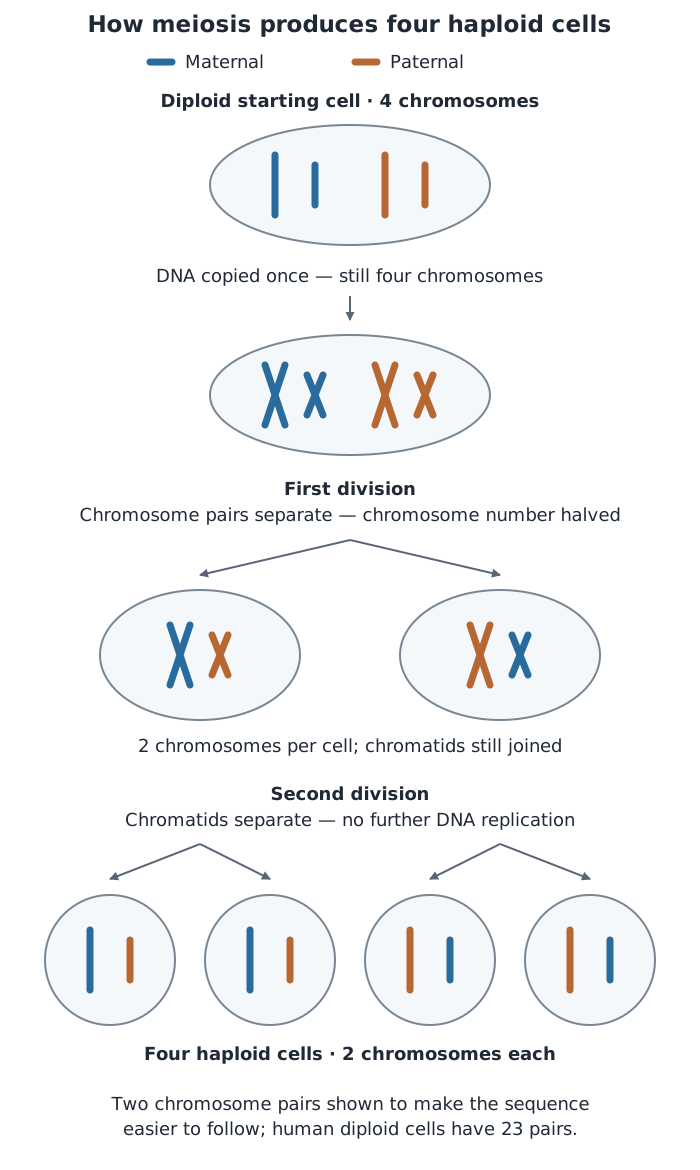
DNA is copied once before two divisions. The first division halves the chromosome number; the second separates the copied DNA.
Meiosis produces haploid cells for sexual reproduction rather than the diploid body cells needed for growth. It also produces new combinations of chromosomes inherited from the parents, contributing to genetic variation. The products of meiosis are therefore not all genetically identical, unlike the daughter cells normally produced by mitosis.
When haploid gamete nuclei fuse at fertilisation, the diploid chromosome number is restored. The zygote can then divide by mitosis as the new organism grows.
Meiosis halves the chromosome number to produce haploid cells for sexual reproduction.
Human chromosome numbers: body cell 46 → gamete 23; fertilisation restores 46 in the .
When explaining why meiosis is needed, link halving the chromosome number in gametes to restoring the normal number at fertilisation.
DNA is copied once, before the two divisions. Copying DNA does not double the chromosome number: each chromosome now consists of two joined copies.
Distinguish the divisions: the first separates chromosome pairs; the second separates the joined copies of each chromosome.
It can see this note and what your specification asks for.
Answers are free with an account.
1 free note left this week
Get more free notesYour answer sets when this note comes back for review, or marks it complete.
Was this note helpful?
Log in to tell us whether it helped, or to report a problem.
Last updated
Meiosis
Cell division that halves the chromosome number, producing haploid cells from a diploid cell. It involves one round of DNA replication followed by two divisions.
Gamete
A sex cell, such as a sperm or egg cell, whose nucleus fuses with another gamete nucleus during fertilisation.
Diploid
Having two sets of chromosomes in the nucleus, one inherited from each parent.
Haploid
Having one set of chromosomes in the nucleus, half the number found in a diploid cell.
Interphase
The stage before division during which a cell grows and copies its DNA.
Chromatid
One of the two identical copies of a replicated chromosome, joined together before they separate during cell division.
Fertilisation
The fusion of two gamete nuclei to form the nucleus of a zygote.
Zygote
The fertilised egg cell formed when two gametes fuse.
Put your knowledge into practice — try past paper questions for Combined Science B
Meiosis
Cell division that halves the chromosome number, producing haploid cells from a diploid cell. It involves one round of DNA replication followed by two divisions.
Gamete
A sex cell, such as a sperm or egg cell, whose nucleus fuses with another gamete nucleus during fertilisation.
Diploid
Having two sets of chromosomes in the nucleus, one inherited from each parent.
Haploid
Having one set of chromosomes in the nucleus, half the number found in a diploid cell.
Interphase
The stage before division during which a cell grows and copies its DNA.
Chromatid
One of the two identical copies of a replicated chromosome, joined together before they separate during cell division.
Fertilisation
The fusion of two gamete nuclei to form the nucleus of a zygote.
Zygote
The fertilised egg cell formed when two gametes fuse.
Meiosis: two divisions; halves the chromosome number; produces genetically different haploid cells.
Mitosis: one division; maintains the chromosome number; normally produces two genetically identical daughter cells.