

Loading…
Loading…
Loading…
OCR GCSE Combined Science B · J260
OCR J260 · Cell Division and Differentiation Check the specification (PDF) (opens in a new tab)
A multicellular organism develops from a single cell into an organism containing many kinds of cell. Cell division supplies more cells, but increasing cell number alone is not enough. Cells must also become suited to different jobs, such as carrying signals or absorbing substances.
Cell differentiation is the process by which a cell becomes specialised for a particular function. Differentiation allows cells to form tissues with particular functions, so that different parts of an organism can carry out different jobs.
Genes are sections of DNA containing instructions for making proteins. Almost all body cells in an organism contain the same genetic information, but they do not use all of those instructions in the same way.
During differentiation, particular genes are switched on and others are switched off. This changes which proteins the cell makes, affecting its structure and how it works. Different patterns of gene activity therefore allow cells with the same genetic information to develop into different cell types.
For example, a developing nerve cell becomes elongated, allowing it to make connections over long distances. Its specialised structure suits its role in carrying signals. Differentiation connects genetic instructions to cell structure and, ultimately, to the function of a tissue.
A stem cell is an unspecialised cell that can divide to produce more stem cells and can also give rise to specialised cells through differentiation. Maintaining a supply of stem cells matters: if every cell became specialised immediately, there would be no continuing source of unspecialised cells.
In animals, embryonic and adult stem cells have different roles and different ranges of possible cell types.
Embryonic stem cells are found in early embryos. They can give rise to any type of body cell. As an embryo develops, cell division increases the number of cells and differentiation produces the varied specialised cells needed to build its tissues. Together, these processes allow a complex organism to develop.
Adult stem cells remain in certain tissues, such as bone marrow. They can normally differentiate into only a limited range of cell types. Their main role is to maintain tissues by replacing cells and helping to repair damage. For example, stem cells in bone marrow produce new blood cells. Most specialised animal cells no longer have the broad ability to differentiate that embryonic stem cells have.
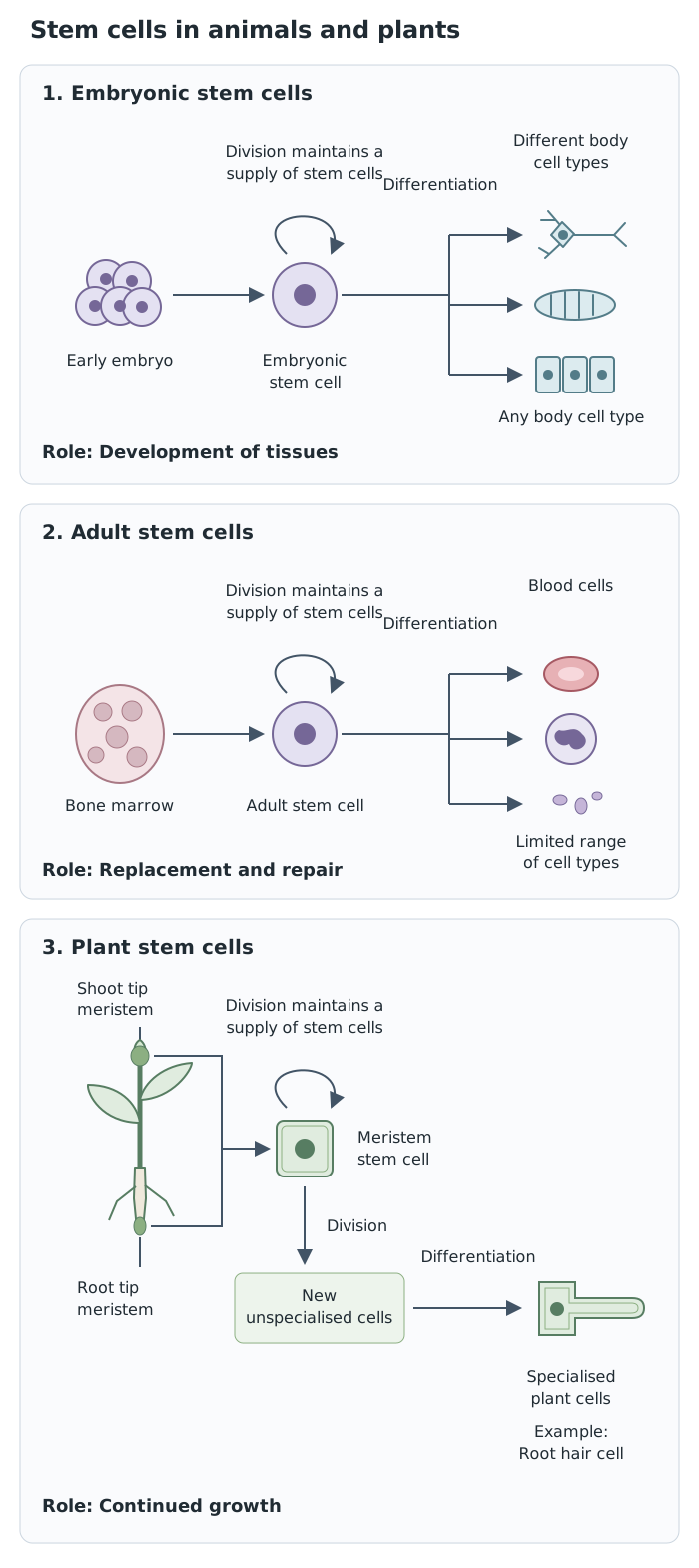
Stem cells maintain a supply of unspecialised cells and give rise to specialised cells for development, repair or continued plant growth.
A meristem is plant tissue containing stem cells. Meristems are found in growing regions, including root and shoot tips.
Cells in a meristem divide, supplying new unspecialised cells. These cells can then differentiate into the specialised cell types the plant needs. For example, cells produced near a root tip can differentiate into root hair cells, which help the plant absorb water and mineral ions.
Plant stem cells retain the ability to give rise to different types of plant cell throughout the plant's life. This continuing supply of cells allows roots and shoots to keep growing. As in animals, division supplies additional cells, while differentiation gives those cells the structures needed for their functions.
Distinguish cell division from differentiation: division increases cell number; differentiation produces specialised cells.
When explaining differentiation, link genes being switched on or off to specialised cell structures and the function of the tissue.
Compare the range of cell types produced: embryonic stem cells can form any body cell type, whereas adult stem cells normally form only a limited range.
Name root and shoot tips when describing where plant meristems are found.
It can see this note and what your specification asks for.
Answers are free with an account.
1 free note left this week
Get more free notesYour answer sets when this note comes back for review, or marks it complete.
Was this note helpful?
Log in to tell us whether it helped, or to report a problem.
Last updated
Cell differentiation
The process by which a cell becomes specialised for a particular function, involving genes being switched on and off.
Stem cell
An unspecialised cell that can divide to produce more stem cells and give rise to specialised cells through differentiation.
Embryonic stem cell
A stem cell found in an early embryo that can give rise to any type of body cell.
Adult stem cell
A stem cell found in certain tissues of an adult animal that can give rise to a limited range of specialised cells for maintenance and repair.
Meristem
Plant tissue containing stem cells that divide to supply new cells for growth, found in regions such as root and shoot tips.
Tissue
A group of cells working together to carry out a particular function.
Put your knowledge into practice — try past paper questions for Combined Science B
Cell differentiation
The process by which a cell becomes specialised for a particular function, involving genes being switched on and off.
Stem cell
An unspecialised cell that can divide to produce more stem cells and give rise to specialised cells through differentiation.
Embryonic stem cell
A stem cell found in an early embryo that can give rise to any type of body cell.
Adult stem cell
A stem cell found in certain tissues of an adult animal that can give rise to a limited range of specialised cells for maintenance and repair.
Meristem
Plant tissue containing stem cells that divide to supply new cells for growth, found in regions such as root and shoot tips.
Tissue
A group of cells working together to carry out a particular function.