

Loading…
Loading…
Loading…
OCR GCSE Combined Science B · J260
OCR J260 · Cellular Transport and Plant Vessels Check the specification (PDF) (opens in a new tab)
A plant needs to move substances between organs. Its roots absorb water and mineral ions, while its leaves make sugars by photosynthesis. Growing tissues and storage organs may be far from the leaves, so transport cannot rely only on substances moving between neighbouring cells.
Plants have two specialised transport tissues: xylem carries water and dissolved mineral ions from the roots towards the stems and leaves; phloem carries dissolved sugars, mainly sucrose, and amino acids to places where they are needed. These tissues occur in groups called vascular bundles in roots, stems and leaves.
Xylem vessels are formed from cells joined end to end. At maturity, these cells are dead and their contents have been lost. Their end walls break down, leaving a continuous hollow tube. The space inside the tube is called its lumen. With no cell contents or end walls blocking this pathway, water can flow through it.
The vessel walls are strengthened with lignin, a strong, woody material. This makes the walls stiff and helps prevent the vessels collapsing as water is drawn up the plant. It also helps support the plant.
Together, the hollow interior and strong walls make xylem suited to transporting water and dissolved mineral ions in the transpiration stream, from roots towards leaves.
Phloem tubes consist of living cells called sieve-tube elements, joined end to end. Unlike xylem vessels, they retain end walls. These walls have holes and are called sieve plates. The holes allow dissolved sugars and amino acids to pass between successive cells.
Sieve-tube elements have no nucleus and are supported by adjacent companion cells, which carry out functions needed to keep the tissue working. Translocation requires energy supplied by living cells; the plant does not simply move sugars through dead, empty pipes.
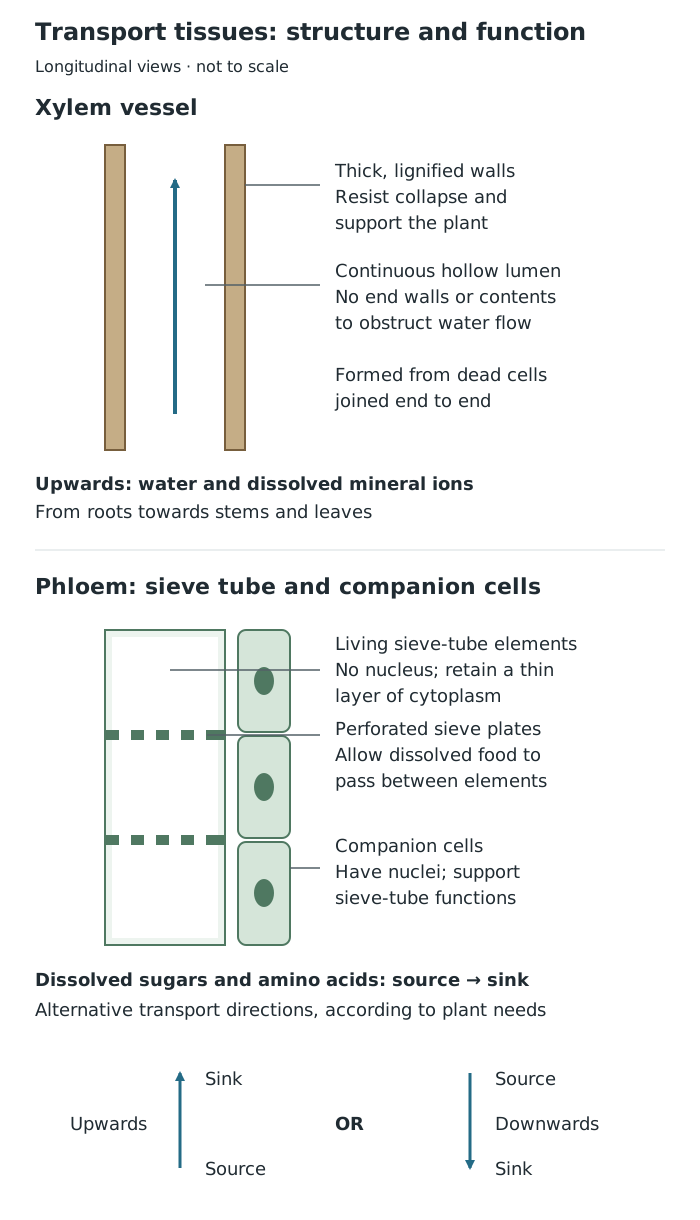
Xylem provides a strong, hollow water pathway; phloem uses living tissue to transport dissolved sugars and amino acids.
Translocation is the movement of dissolved sugars and amino acids through phloem. Substances move from a source, where they are supplied, to a sink, where they are used or stored. A photosynthesising leaf can supply sucrose to a growing root or a storage organ. The sugar can be used in respiration and growth, or converted into starch for storage.
Transport is not restricted to one direction. During early spring, stored reserves in roots can supply developing leaves; during summer, leaves can supply roots. Phloem transport can therefore occur upwards or downwards, according to the plant's needs.
Transpiration is the loss of water vapour from a plant, mainly through its leaves. Inside a leaf, water evaporates from moist cell surfaces into the air spaces. Water vapour then diffuses through open stomata into the surrounding air.
This loss of water causes more water to be drawn into the leaf through the xylem. Water moves up from the roots to replace it, and the roots absorb further water from the soil. This connected movement forms the transpiration stream.
The important sequence is therefore evaporation inside the leaf → diffusion of water vapour out → replacement of water through xylem. Mineral ions dissolved in the water are carried along with it.
A stoma is a small pore, usually in the surface of a leaf; the plural is stomata. Each pore is surrounded by two guard cells. Opening the pore allows carbon dioxide to diffuse into the leaf for photosynthesis and oxygen to diffuse out. It also allows water vapour to escape.
Guard cells control this trade-off. In many plants they are kidney-shaped, with thicker walls next to the pore and thinner outer walls. When they take in water by osmosis, they become turgid, meaning swollen and firm. Their uneven wall thickness makes them change shape so that the pore opens. When they lose water, they become flaccid, meaning less firm, and the pore closes.
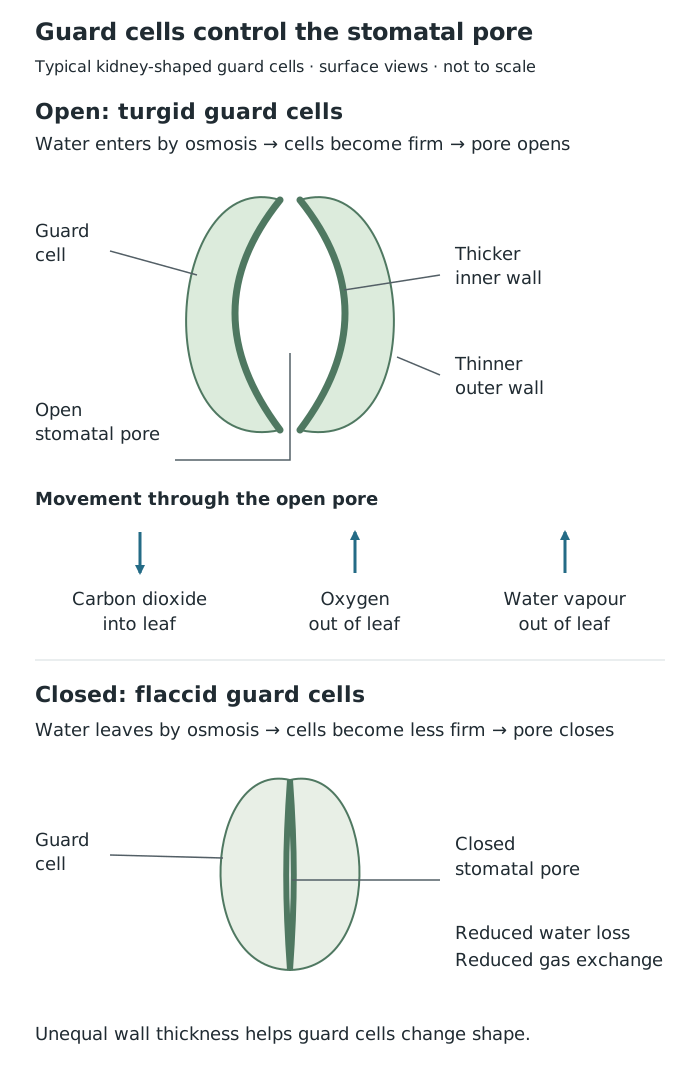
Guard cells change shape as their water content changes, controlling gas exchange and water loss.
Closing stomata reduces water loss when water is scarce, but also limits carbon dioxide entry. In many plants stomata normally open in daylight and close at night, conserving water when photosynthesis is not taking place.
A light microscope passes light through a specimen and uses lenses to produce a magnified image. The specimen must be thin enough for light to pass through; a thick piece of stem will hide rather than reveal its internal cells.
Use a prepared thin section of plant tissue, or a teacher-prepared section mounted in a drop of water on a glass slide. A suitable stain can improve contrast between tissues. Lower a coverslip gently from one edge to reduce trapped air bubbles. Handle slides and coverslips carefully, take care with sharp cutting tools, and avoid skin or eye contact with stains, following the teacher's precautions.
Place the slide on the stage and select the lowest-power objective. Use the coarse focus to locate the tissue, then the fine focus to sharpen the image. Centre the area of interest before changing to a higher-power objective. At higher power, use the fine focus and keep the objective clear of the slide.
Look for vascular bundles, then examine the cells within them. Xylem vessels have conspicuous thick walls around hollow spaces. Phloem contains living sieve-tube elements with associated companion cells. The section's direction matters: a cross-section shows the spaces inside vessels, while a suitable lengthways section can reveal their tube-like arrangement and end-wall features. Not every feature will be visible in every slide.
Record a clear labelled drawing of the structures you can distinguish. The observation is ready to record when the relevant tissue is sharply focused and its cell boundaries can be seen, rather than when the image is merely large.
To examine stomata, use a prepared slide of leaf epidermis, or use forceps to remove a thin piece of epidermis and lay it flat in a drop of water on a slide. Add a coverslip gently, avoiding folds and air bubbles. Keep the tissue moist so it does not dry out during observation.
Find the epidermis at low power, focus and centre a suitable area, then increase magnification using fine focus. Look for pairs of guard cells surrounding pores among the other epidermal cells. Identify and draw the guard cells and stomatal pore where visible.
A surface view is useful because it shows the two guard cells around the opening. A still slide shows their structure and the pore's appearance at that moment; observing one pore alone does not demonstrate its whole opening-and-closing process.
| Feature | Xylem | Phloem |
|---|---|---|
| Transported substances | Water and mineral ions | Dissolved sugars and amino acids |
| Direction | Roots towards stems and leaves | Source to sink; upwards or downwards |
| Cells | Dead at maturity | Living sieve-tube elements and companion cells |
| Adaptations | Hollow; no end walls; lignified walls | Perforated sieve plates; companion-cell support |
Link each adaptation to its function: for example, missing end walls form an uninterrupted pathway for water, while lignin strengthens xylem walls.
Distinguish evaporation from diffusion: water evaporates from moist cell surfaces inside the leaf, then water vapour diffuses out through stomata.
Phloem transports dissolved sugars such as sucrose, not starch. Transport can occur upwards or downwards depending on where substances are needed.
In microscope questions, explain why the specimen must be thin and why you start with the lowest-power objective.
Draw and label what is actually visible. A cross-section of a vessel does not show all the features that a lengthways section can reveal.
It can see this note and what your specification asks for.
Answers are free with an account.
1 free note left this week
Get more free notesYour answer sets when this note comes back for review, or marks it complete.
Was this note helpful?
Log in to tell us whether it helped, or to report a problem.
Last updated
Xylem
Plant transport tissue containing vessels that carry water and dissolved mineral ions from the roots towards the stems and leaves.
Phloem
Living plant transport tissue that carries dissolved sugars and amino acids between parts of a plant.
Lignin
A strong, woody material deposited in xylem cell walls that strengthens them and helps prevent collapse.
Sieve-tube element
A living cell joined to others to form a phloem tube, with perforated end walls that allow dissolved substances to pass through.
Companion cell
A living cell alongside a phloem sieve-tube element that supports its functions.
Transpiration
The loss of water vapour from a plant, mainly through stomata in its leaves.
Transpiration stream
The movement of water and dissolved mineral ions through xylem from the roots towards the leaves.
Translocation
The transport of dissolved sugars and amino acids through phloem to places where they are used or stored.
Stoma
A small pore in the plant epidermis, usually on a leaf, whose opening is controlled by two guard cells.
Guard cell
One of a pair of specialised cells that control the opening and closing of a stomatal pore.
Put your knowledge into practice — try past paper questions for Combined Science B
Xylem
Plant transport tissue containing vessels that carry water and dissolved mineral ions from the roots towards the stems and leaves.
Phloem
Living plant transport tissue that carries dissolved sugars and amino acids between parts of a plant.
Lignin
A strong, woody material deposited in xylem cell walls that strengthens them and helps prevent collapse.
Sieve-tube element
A living cell joined to others to form a phloem tube, with perforated end walls that allow dissolved substances to pass through.
Companion cell
A living cell alongside a phloem sieve-tube element that supports its functions.
Transpiration
The loss of water vapour from a plant, mainly through stomata in its leaves.
Transpiration stream
The movement of water and dissolved mineral ions through xylem from the roots towards the leaves.
Translocation
The transport of dissolved sugars and amino acids through phloem to places where they are used or stored.
Stoma
A small pore in the plant epidermis, usually on a leaf, whose opening is controlled by two guard cells.
Guard cell
One of a pair of specialised cells that control the opening and closing of a stomatal pore.