

Loading…
Loading…
Loading…
OCR GCSE Combined Science B · J260
OCR J260 · Cellular Transport and Plant Vessels Check the specification (PDF) (opens in a new tab)
Plants and other photosynthetic organisms need materials from their surroundings to build new cells and carry out life processes. Carbon dioxide and water are raw materials for photosynthesis, which produces glucose using light energy. Oxygen is also produced and can leave the organism.
Plants also respire. They use oxygen in aerobic respiration to release energy from glucose, producing carbon dioxide. Therefore, oxygen is not simply an unwanted substance: whether there is a net movement of oxygen into or out of a plant depends on the balance between photosynthesis and respiration.
Mineral ions supply elements needed for growth. For example, nitrogen-containing mineral ions are used to make amino acids, which are joined together to make proteins. Plants obtain these ions dissolved in soil water.
The cell membrane separates a cell’s contents from its surroundings. It is partially permeable: some substances can cross it, while others are restricted. This allows cells to exchange materials without their contents simply mixing with the environment.
Both plant cells and prokaryotic cells, such as bacteria, have cell membranes. A plant cell’s membrane regulates the entry of water and mineral ions and the exchange of gases. A prokaryotic cell also needs to take in materials for its reactions and remove waste products. Its membrane provides the boundary across which this exchange takes place. The small size of prokaryotic cells means substances have only short distances to travel within them.
Particles move randomly. When there is a difference in concentration between two regions, particles move in both directions, but more move from the higher-concentration region towards the lower-concentration region. This overall, or net, movement is diffusion.
The concentration difference is called a concentration gradient. Diffusion moves substances down this gradient and does not require the cell to supply energy from respiration.
In a photosynthesising leaf, carbon dioxide is used up in cells. This helps maintain a lower carbon dioxide concentration inside than outside, so carbon dioxide diffuses into the leaf. Oxygen produced by photosynthesis can diffuse out. Gases enter and leave leaves through pores called stomata and cross cell membranes by diffusion.
Osmosis is the net movement of water through a partially permeable membrane from higher water concentration to lower water concentration. Like diffusion, it does not require energy from respiration.
A dilute solution has relatively more water and less dissolved solute than a concentrated solution. If the two solutions are separated by a membrane that lets water through but restricts the solute, water moves overall from the dilute solution towards the concentrated solution.
This explains why plant cells can gain or lose water. When the surrounding solution has a higher water concentration than the cell contents, water enters by osmosis. When it has a lower water concentration, water leaves. Water entering plant cells helps keep them firm, or turgid; excessive water loss reduces this firmness and can cause a plant to wilt.
Diffusion cannot produce a net movement from lower to higher concentration. Cells use active transport when they need to move substances in this direction, against the concentration gradient.
Active transport requires energy from respiration. Root hair cells can use it to absorb mineral ions even when the ions are less concentrated in the soil water than inside the cells. This allows plants to obtain essential minerals from dilute soil solutions.
Root hair cells have long, narrow extensions that provide a large surface area in contact with soil water. This gives more surface across which water and mineral ions can enter.
Water enters root hair cells by osmosis when the soil water has a higher water concentration than the cell contents. Mineral ions can enter by active transport against their concentration gradient. These are different processes, even though both happen at the same root surface.
Root hair cells have many mitochondria, where aerobic respiration releases energy needed for active transport. Their thin boundary also provides a short distance for substances to cross.
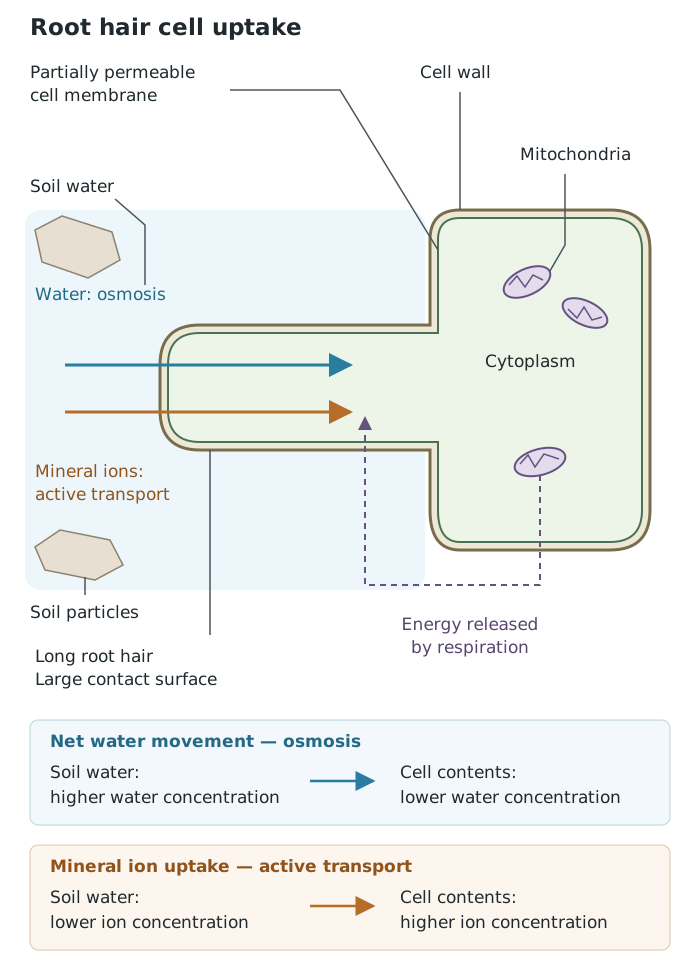
Root hair cells absorb water by osmosis and can absorb mineral ions against their concentration gradient using energy from respiration.
Diffusion can be made visible using agar containing an alkali and phenolphthalein indicator. The agar starts pink. When placed in dilute hydrochloric acid, acid diffuses into it and neutralises the alkali, making the indicator colourless. A colourless layer develops at the outside and extends towards the centre.
To investigate how cube size affects the time needed for acid to reach the whole cube, use prepared pink agar, a ruler, a cutting tile and blade, beakers, a measuring cylinder, dilute hydrochloric acid, a timer and a plastic spoon.
Change the cube size, but keep the agar composition, acid concentration and volume, temperature and any gentle swirling the same. Use the same observer and background to judge the endpoint consistently. Wear eye protection, rinse chemical splashes promptly and cut on a tile with fingers behind the blade under teacher supervision. Do not eat the agar.
Smaller cubes should become colourless sooner because acid has a shorter distance to travel to their centres. They also have more surface area relative to their volume. A larger cube cut in half during the investigation can reveal a colourless outer layer surrounding a pink core: acid has reached the outside but not yet the centre.
This is a model of diffusion into a material, not a living cell. Agar has no cell membrane, so this investigation does not demonstrate selective membrane permeability or active transport.
Potato cells have partially permeable membranes. Placing potato samples in solutions of different sugar concentrations lets us investigate how osmosis changes the mass of plant tissue.
Use fresh potato, a cork borer, a knife and cutting tile, a ruler, a balance, labelled test tubes and rack, a measuring cylinder, distilled water, a range of sucrose solutions, filter paper and a timer.
The independent variable is sucrose concentration; the dependent variable is the percentage change in tissue mass. Keep sample dimensions, tissue source, solution volume, temperature, immersion time and blotting method the same. Use sharp tools on a cutting tile under supervision, keeping fingers away from the blade, and do not eat the laboratory samples.
The measurement period ends after the chosen immersion time; there is no colour-change endpoint. A mass gain indicates that water has entered the cells overall. A mass loss indicates that water has left overall. More concentrated external solutions generally produce less mass gain or greater mass loss because their water concentration is lower.
A biological sample that gains water can increase in mass; one that loses water can decrease in mass. Percentage change lets you compare samples with different starting masses fairly.
Suppose a plant tissue sample initially has a mass of 5.0 g and later has a mass of 5.5 g. Its mass gain is 0.5 g, so its percentage mass change is . A second sample starting at 5.0 g and ending at 4.5 g has a percentage mass change of : it has lost 10% of its initial mass.
A positive result indicates net water uptake; a negative result indicates net water loss. No overall mass change is consistent with no net movement of water, rather than water molecules stopping moving.
For the potato investigation, plot solution concentration on the horizontal axis and mean percentage mass change on the vertical axis. Results above zero show net water uptake; those below zero show net water loss. Where a suitable line of best fit crosses zero, the surrounding solution causes no overall gain or loss of water from the tissue.
| Process | Net direction | Energy from respiration? |
|---|---|---|
| Diffusion | Higher to lower particle concentration | No |
| Osmosis | Higher to lower water concentration, through a partially permeable membrane |
Define diffusion as net movement: particles move in both directions, but more move from high to low concentration.
For osmosis, name water and a partially permeable membrane. State the direction using water concentration, not just ‘concentration’.
Active transport requires energy from respiration; diffusion and osmosis do not.
Link each root hair adaptation to its function rather than simply listing features.
Calculate percentage mass change using the initial mass as the denominator. A negative result indicates a loss.
Blot plant tissue before its final weighing so that solution on the surface does not distort the measured mass change.
In a practical answer, identify what is changed, what is measured and which relevant variables are kept constant.
It can see this note and what your specification asks for.
Answers are free with an account.
1 free note left this week
Get more free notesYour answer sets when this note comes back for review, or marks it complete.
Was this note helpful?
Log in to tell us whether it helped, or to report a problem.
Last updated
Diffusion
The net movement of particles from a region of higher concentration to a region of lower concentration.
Osmosis
The net movement of water molecules through a partially permeable membrane from a region of higher water concentration to a region of lower water concentration.
Active transport
The movement of substances across a cell membrane from lower to higher concentration, against their concentration gradient, using energy from respiration.
Partially permeable membrane
A membrane that allows some substances to pass through but restricts others.
Concentration gradient
A difference in the concentration of a substance between two regions.
Root hair cell
A specialised cell on a plant root with a long extension that increases its surface area for absorbing water and mineral ions.
Put your knowledge into practice — try past paper questions for Combined Science B
Diffusion
The net movement of particles from a region of higher concentration to a region of lower concentration.
Osmosis
The net movement of water molecules through a partially permeable membrane from a region of higher water concentration to a region of lower water concentration.
Active transport
The movement of substances across a cell membrane from lower to higher concentration, against their concentration gradient, using energy from respiration.
Partially permeable membrane
A membrane that allows some substances to pass through but restricts others.
Concentration gradient
A difference in the concentration of a substance between two regions.
Root hair cell
A specialised cell on a plant root with a long extension that increases its surface area for absorbing water and mineral ions.
| No |
| Active transport | Lower to higher concentration | Yes |
Plant and prokaryotic cell membranes regulate exchange between the cell and its surroundings.
Positive: net water gain. Negative: net water loss. Zero: no overall mass change, not no molecular movement.