

Loading…
Loading…
Loading…
OCR GCSE Combined Science B · J260
OCR J260 · Processes and Products of Electrolysis Check the specification (PDF) (opens in a new tab)
Electrolysis is the decomposition of an electrolyte by an electric current. It uses electrical energy to drive chemical reactions, separating a compound into simpler substances.
An ionic compound contains positively and negatively charged ions. In a solid, these ions are held in fixed positions in a lattice, so they cannot move through the substance to carry charge. When the compound melts, its ions become free to move and it can conduct electricity. Dissolving an ionic compound in water can also release moving ions, although water introduces additional possible electrode reactions.
The conducting liquid is the electrolyte. Two conducting electrodes dip into it and connect to a direct-current power supply. Charge is carried by moving ions within the electrolyte and by electrons in the external wires.
The cathode is the negative electrode. It attracts positive ions, which gain electrons at its surface. Gain of electrons is reduction. Metal ions become neutral metal atoms; hydrogen can also form at the cathode when suitable hydrogen-containing ions are present.
The anode is the positive electrode. It attracts negative ions, which lose electrons at its surface. Loss of electrons is oxidation. With inert electrodes, the products at the anode are non-metals.
An inert electrode conducts electricity without taking part in the chemical reactions under the conditions used. Platinum or graphite can serve this purpose in suitable electrolytes. Remember the electron-transfer distinction as OIL RIG: Oxidation Is Loss, Reduction Is Gain.
A binary ionic compound contains only two elements. When it is molten, there is no water to introduce competing reactions. Identify its positive and negative ions: the metal forms at the cathode and the non-metal forms at the anode, provided the electrodes do not react with the products.
For example, molten lead(II) bromide, , contains ions and ions. Lead ions move towards the cathode and gain electrons to form lead. Bromide ions move towards the anode and lose electrons to form bromine, .
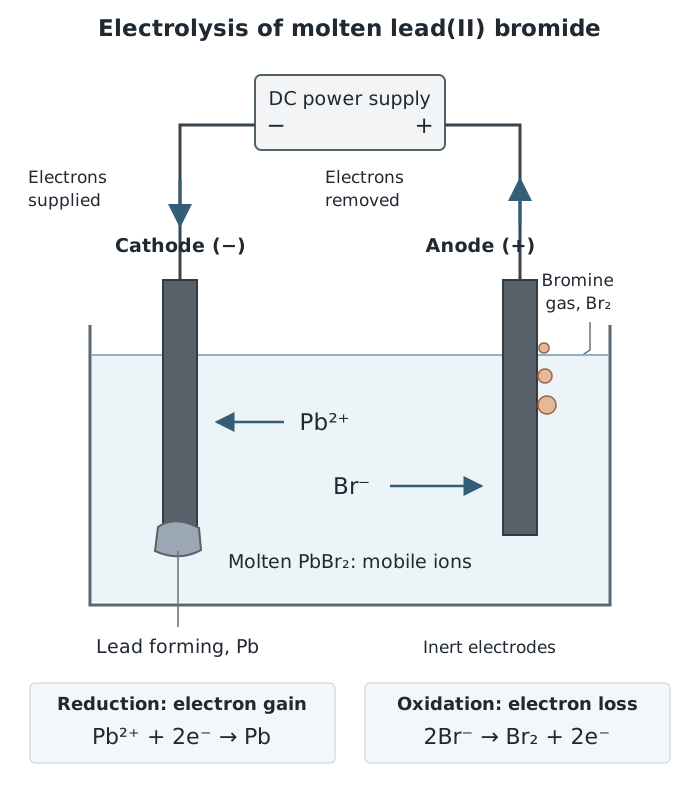
Positive and negative ions move to opposite electrodes, where electron transfer forms lead and bromine.
The overall decomposition is:
The same method applies to other molten binary salts: molten sodium chloride produces sodium and chlorine, while molten aluminium oxide produces aluminium and oxygen at the electrode surfaces.
A half-equation describes the electron transfer at one electrode. It must conserve both the number of atoms of each element and the total electrical charge.
At the cathode, each lead ion has a charge of . It needs two electrons to become a neutral lead atom:
There is one lead atom on each side. The total charge on the left is , matching the neutral product. Lead ions are reduced because they gain electrons.
At the anode, bromine forms molecules containing two bromine atoms. Start with two bromide ions to supply those atoms, then place the electrons lost on the right:
Both sides contain two bromine atoms and have a total charge of . Bromide ions are oxidised because they lose electrons.
To construct a half-equation, write the ion and product, balance the atoms, then add electrons to balance charge. Finally, check that electron gain or loss matches the reaction you are describing. Change coefficients, not the chemical formulae of substances.
Aluminium is more reactive than carbon, so carbon cannot be used to reduce aluminium oxide to aluminium. Instead, electrical energy is used to reduce aluminium ions by electrolysis.
The aluminium ore bauxite is first purified to obtain aluminium oxide, . Pure aluminium oxide melts above , making it expensive to melt. It is therefore dissolved in . This allows the to remain liquid at a lower temperature, reducing the energy needed to keep the ions mobile.
The industrial cell has a steel shell lined with graphite. The graphite lining is the negative cathode, while large graphite blocks dipping into the electrolyte are the positive anodes.
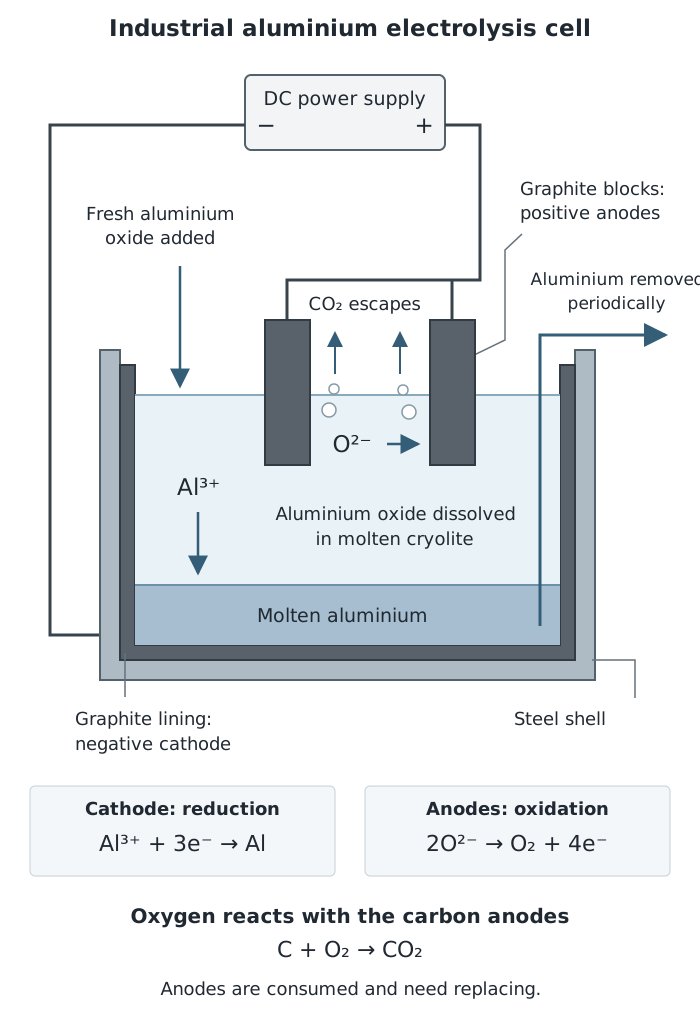
Aluminium forms at the graphite-lined cathode; oxygen formed at the anodes reacts with their carbon.
Aluminium ions gain three electrons each at the cathode:
The aluminium ions are reduced. Molten aluminium collects at the bottom of the cell and is removed periodically. Fresh aluminium oxide is added to replace that used up.
Oxide ions lose electrons at the anode, forming oxygen:
The oxide ions are oxidised. Each loses two electrons, so two oxide ions release four electrons altogether.
The graphite anodes are not completely inert in the hot industrial cell. Oxygen formed at their surfaces reacts with the carbon:
This consumes the anodes, so they must be replaced regularly. It also releases carbon dioxide. Aluminium extraction uses large amounts of electricity, which is a major cost: cryolite reduces the heating requirement but does not remove the need for electrical energy to drive electrolysis.
Identify the ions and their charges before predicting electrode products. A molten binary ionic compound contains ions from only its two elements.
Check both atoms and total charge in every half-equation. Electrons go on the left for reduction and on the right for oxidation.
Remember that bromine, chlorine and oxygen form diatomic molecules: Br₂, Cl₂ and O₂.
Name the species gaining or losing electrons: lead ions are reduced, while bromide ions are oxidised.
In aluminium extraction, distinguish the oxygen formed by the electrode reaction from the carbon dioxide formed when that oxygen reacts with the carbon anodes.
It can see this note and what your specification asks for.
Answers are free with an account.
1 free note left this week
Get more free notesYour answer sets when this note comes back for review, or marks it complete.
Was this note helpful?
Log in to tell us whether it helped, or to report a problem.
Last updated
Electrolysis
The decomposition of an electrolyte by an electric current.
Electrolyte
A substance that conducts electricity through moving ions when molten or dissolved in solution.
Electrode
A conductor through which electrons enter or leave an electrolyte at its surface.
Cathode
The negative electrode in electrolysis, where positive ions gain electrons and reduction occurs.
Anode
The positive electrode in electrolysis, where negative ions lose electrons and oxidation occurs.
Inert electrode
An electrode that does not chemically react with the electrolyte or products under the conditions used.
Binary ionic compound
A compound containing just two elements joined by ionic bonding.
Reduction
Gain of electrons by a chemical species.
Oxidation
Loss of electrons by a chemical species.
Half-equation
An equation showing the electron transfer in one oxidation or reduction reaction, with atoms and charge balanced.
Cryolite
A substance in which aluminium oxide is dissolved during aluminium extraction, allowing electrolysis at a lower temperature than melting pure aluminium oxide.
Put your knowledge into practice — try past paper questions for Combined Science B
Electrolysis
The decomposition of an electrolyte by an electric current.
Electrolyte
A substance that conducts electricity through moving ions when molten or dissolved in solution.
Electrode
A conductor through which electrons enter or leave an electrolyte at its surface.
Cathode
The negative electrode in electrolysis, where positive ions gain electrons and reduction occurs.
Anode
The positive electrode in electrolysis, where negative ions lose electrons and oxidation occurs.
Inert electrode
An electrode that does not chemically react with the electrolyte or products under the conditions used.
Binary ionic compound
A compound containing just two elements joined by ionic bonding.
Reduction
Gain of electrons by a chemical species.
Oxidation
Loss of electrons by a chemical species.
Half-equation
An equation showing the electron transfer in one oxidation or reduction reaction, with atoms and charge balanced.
Cryolite
A substance in which aluminium oxide is dissolved during aluminium extraction, allowing electrolysis at a lower temperature than melting pure aluminium oxide.
Identify the two ions: metal at the cathode, non-metal at the anode.
For molten lead(II) bromide:
Half-equations must balance atoms and total charge. OIL RIG: oxidation is loss; reduction is gain of electrons.
Molten aluminium collects at the bottom. Oxygen reacts with carbon anodes to form carbon dioxide, so the anodes need replacing. Electricity is a major expense.