

Loading…
Loading…
Loading…
OCR GCSE Combined Science B · J260
OCR J260 · Processes and Products of Electrolysis Check the specification (PDF) (opens in a new tab)
Electrolysis uses an electric current to decompose an electrolyte. When an ionic compound dissolves in water, its ions become free to move and carry charge through the solution. Electrons carry charge through the connecting wires; moving ions carry charge through the electrolyte.
An aqueous solution has water as its solvent. Unlike a molten binary ionic compound, it contains more than just the ions from the salt. Water also supplies small amounts of hydrogen ions, , and hydroxide ions, . These can take part in the electrode reactions, so there are competing possibilities at each electrode.
The negative cathode attracts positive ions, called cations. The positive anode attracts negative ions, called anions. Attraction alone does not tell us which product forms: we must decide which ions are discharged. The following predictions assume inert electrodes, such as graphite, which provide conducting surfaces without reacting chemically themselves.
Metal ions and hydrogen ions are attracted to the cathode, where reduction takes place by gain of electrons. The product depends on the metal’s position relative to hydrogen in the reactivity series.
For example, aqueous sodium chloride produces hydrogen rather than sodium at the cathode. Copper(II) sulfate solution produces copper rather than hydrogen. The presence of water therefore makes a crucial difference to the prediction.
Negative ions compete to lose electrons at the anode. Hydroxide ions from water can be discharged to produce oxygen. Chloride ions can instead be discharged to produce chlorine.
In concentrated sodium chloride solution, commonly called brine, chlorine forms at the anode. Concentration matters: in sufficiently dilute chloride solutions, oxygen can form instead. Therefore, the presence of chloride ions does not mean chlorine must form under every condition.
When no halide ions are present, oxygen normally forms at an inert anode. For example, sulfate ions in copper(II) sulfate solution remain in solution; hydroxide ions are discharged to produce oxygen. Sulfate ions are not converted into sulfur at the electrode.
Consider these two aqueous electrolytes with graphite electrodes:
| Electrolyte | Ions present | Cathode product | Anode product |
|---|---|---|---|
| Concentrated sodium chloride solution | , , , | Hydrogen | Chlorine |
| Copper(II) sulfate solution | , , , | Copper | Oxygen |
With brine, bubbles appear at both electrodes. Sodium ions remain in solution, and hydroxide ions accumulate as hydrogen is produced, leaving an alkaline sodium hydroxide solution.
With copper(II) sulfate, a pink-brown copper deposit builds up on the cathode, while oxygen bubbles form at the anode. The blue solution becomes paler as copper ions are removed. These observations connect the visible changes to the competing electrode reactions.
A school investigation uses an electrolysis cell or beaker, the salt solution, two graphite electrodes, a direct-current power supply or battery, connecting wires and crocodile clips. Small test tubes can collect gases, supported securely with a stand and clamps.
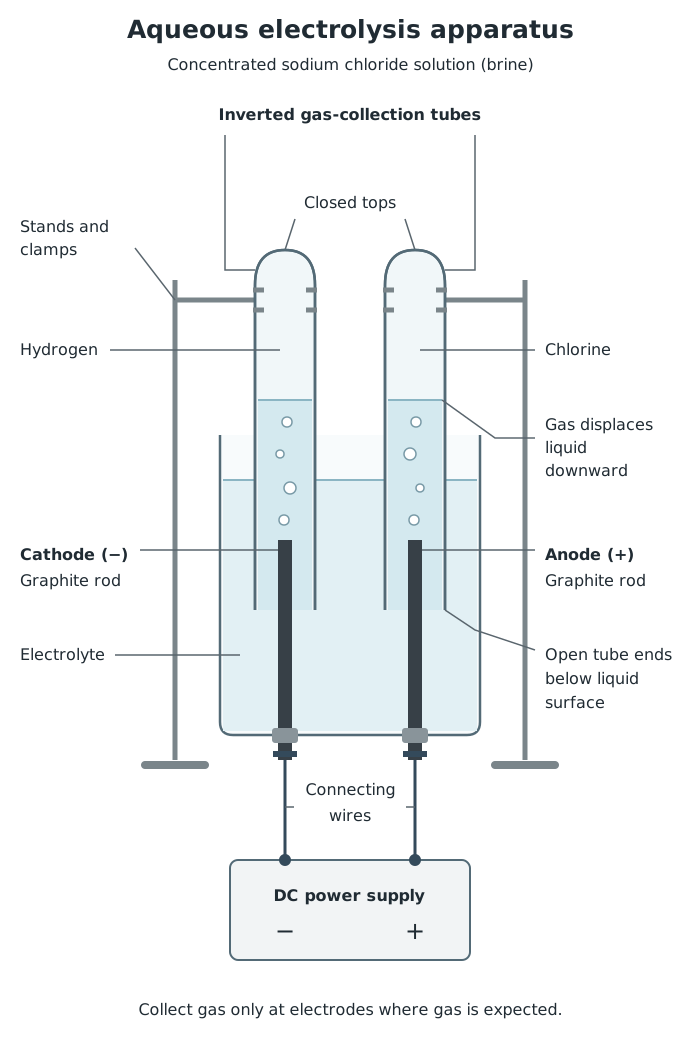
Inert electrodes connected to a DC supply. Inverted tubes collect gases by displacement of the electrolyte; use them only where gas is expected.
Wear eye protection and avoid skin contact with the solutions. Copper(II) sulfate solution is harmful, and the sodium hydroxide formed from brine can be corrosive. Chlorine is toxic, so brine electrolysis should be carried out in a fume cupboard or a suitably well-ventilated area under teacher supervision. Never identify a gas by deliberately smelling it.
Hydrogen is flammable: keep flames away from the working apparatus. After switching off the supply, test only a small collected sample using the teacher’s instructions.
The gas tests provide evidence for the predicted products. A visible deposit, rather than bubbles, is the evidence to look for when a metal forms at the cathode.
Include ions from both the salt and water: and .
Cathode (−): cations gain electrons.
Anode (+), with inert electrodes:
| Aqueous electrolyte, inert electrodes | Cathode | Anode |
|---|---|---|
| Concentrated sodium chloride | Hydrogen | Chlorine |
| Copper(II) sulfate | Copper | Oxygen |
Salt solution + separated graphite electrodes + DC supply. Collect gases in electrolyte-filled inverted tubes; switch off before testing.
Wear eye protection. Use suitable ventilation for chlorine; keep flames away from the working apparatus.
List all the ions present, including H⁺ and OH⁻ from water, before predicting the products of an aqueous electrolyte.
Compare the metal with hydrogen in the reactivity series to predict the cathode product. Do not apply the molten-electrolyte rule to an aqueous solution.
Check whether the question specifies a concentrated or dilute chloride solution: concentration can affect the anode product.
Give observations as well as product names: for example, a pink-brown copper deposit or a gas that relights a glowing splint.
It can see this note and what your specification asks for.
Answers are free with an account.
1 free note left this week
Get more free notesYour answer sets when this note comes back for review, or marks it complete.
Was this note helpful?
Log in to tell us whether it helped, or to report a problem.
Last updated
Electrolysis
The decomposition of an electrolyte by an electric current.
Electrolyte
A liquid or solution containing mobile ions that carry an electric current.
Aqueous solution
A solution in which water is the solvent.
Cathode
The negative electrode in electrolysis, where positive ions gain electrons.
Anode
The positive electrode in electrolysis, where oxidation occurs and electrons are lost.
Inert electrode
An electrode that conducts electricity and provides a surface for electrode reactions without taking part chemically in those reactions.
Cation
A positively charged ion, attracted to the cathode during electrolysis.
Anion
A negatively charged ion, attracted to the anode during electrolysis.
Discharge
The process in which an ion gains or loses electrons at an electrode to form a neutral product.
Put your knowledge into practice — try past paper questions for Combined Science B
Electrolysis
The decomposition of an electrolyte by an electric current.
Electrolyte
A liquid or solution containing mobile ions that carry an electric current.
Aqueous solution
A solution in which water is the solvent.
Cathode
The negative electrode in electrolysis, where positive ions gain electrons.
Anode
The positive electrode in electrolysis, where oxidation occurs and electrons are lost.
Inert electrode
An electrode that conducts electricity and provides a surface for electrode reactions without taking part chemically in those reactions.
Cation
A positively charged ion, attracted to the cathode during electrolysis.
Anion
A negatively charged ion, attracted to the anode during electrolysis.
Discharge
The process in which an ion gains or loses electrons at an electrode to form a neutral product.