

Loading…
Loading…
Loading…
OCR GCSE Combined Science B · J260
OCR J260 · Reactivity Series and Extraction Methods Check the specification (PDF) (opens in a new tab)
Most metals in the Earth's crust are combined with other elements in compounds. Mining brings metal-containing rock to the surface, but it does not usually produce the metal itself. Chemical extraction is needed to turn the metal compound into a useful metal.
An ore is a rock containing enough of a useful metal or metal compound for extraction to be economically worthwhile. A low-grade ore contains a relatively small proportion of the useful material, so processing a large mass of rock may yield only a little metal. Whether extraction is worthwhile depends on processing costs as well as the value of the metal recovered.
The reactivity series helps explain which extraction method will work. Reactive metals readily lose electrons to form positive ions. Extracting them reverses this change: their positive ions must gain electrons to become metal atoms again.
Although carbon is a non-metal, it can be included in the reactivity series to compare its reactivity with that of metals. Carbon lies below aluminium but above zinc. Iron and copper are also below carbon.
For metals below carbon, heating their oxides with carbon can remove the oxygen and leave the metal. Carbon is more reactive than these metals, so it can displace them from their oxides. The metal oxide is reduced because it loses oxygen, while carbon is oxidised because it gains oxygen.
For metals above carbon, such as aluminium and magnesium, carbon is not reactive enough to extract them from their oxides. Heating these oxides with carbon is therefore not a suitable extraction method. Electrolysis is used instead.
This is a chemical distinction, not just a choice between a cheap method and an expensive one: carbon reduction must first be able to work for the metal concerned.
Zinc is below carbon in the reactivity series, so zinc can be extracted by heating zinc oxide with carbon in an industrial furnace. The furnace supplies the high temperature needed for the reaction.
The reaction can be represented as:
Zinc oxide loses its oxygen and becomes zinc metal. Carbon combines with that oxygen to form carbon monoxide. The equation conserves atoms: there is one zinc atom, one oxygen atom and one carbon atom on each side.
Carbon reduction allows large quantities of suitable metals to be produced. However, furnaces require energy, and carbon-based extraction produces gases containing carbon. Fuel use and carbon dioxide emissions contribute to its environmental cost.
Aluminium is more reactive than carbon, so carbon cannot remove oxygen from aluminium oxide to extract aluminium. Electrical energy is used to drive the chemical change instead.
In electrolysis, an electric current passes through an ionic material whose ions can move. For highly reactive metal extraction, the material is molten rather than simply a solid ore. Positive metal ions gain electrons at the negative electrode and become metal atoms.
Electrolysis requires substantial electrical energy, alongside energy to keep the material molten. This makes extraction costly, and its environmental impact depends partly on how the electricity is generated. Nevertheless, the lower cost of carbon reduction is irrelevant if carbon cannot extract the required metal.
Biological methods are particularly useful for recovering metals such as copper from low-grade materials, mining waste or contaminated land. They do not directly turn all the metal compounds into pure metal. Instead, they release or concentrate the metal so that a further extraction step becomes possible.
Bioleaching uses bacteria to help break down metal-containing ores and release metal ions into solution. The resulting solution is called a leachate. Copper ions can then be recovered as copper metal by displacement with a more reactive metal, such as iron, or by electrolysis.
In displacement, iron atoms become iron ions while copper ions become copper atoms:
Phytoextraction uses plants that absorb metal ions through their roots. The ions become concentrated in plant tissue, including stems and leaves. The plants are harvested, dried and burned. Their ash contains concentrated metal compounds, from which the metal can be recovered by further processing, such as displacement or electrolysis.
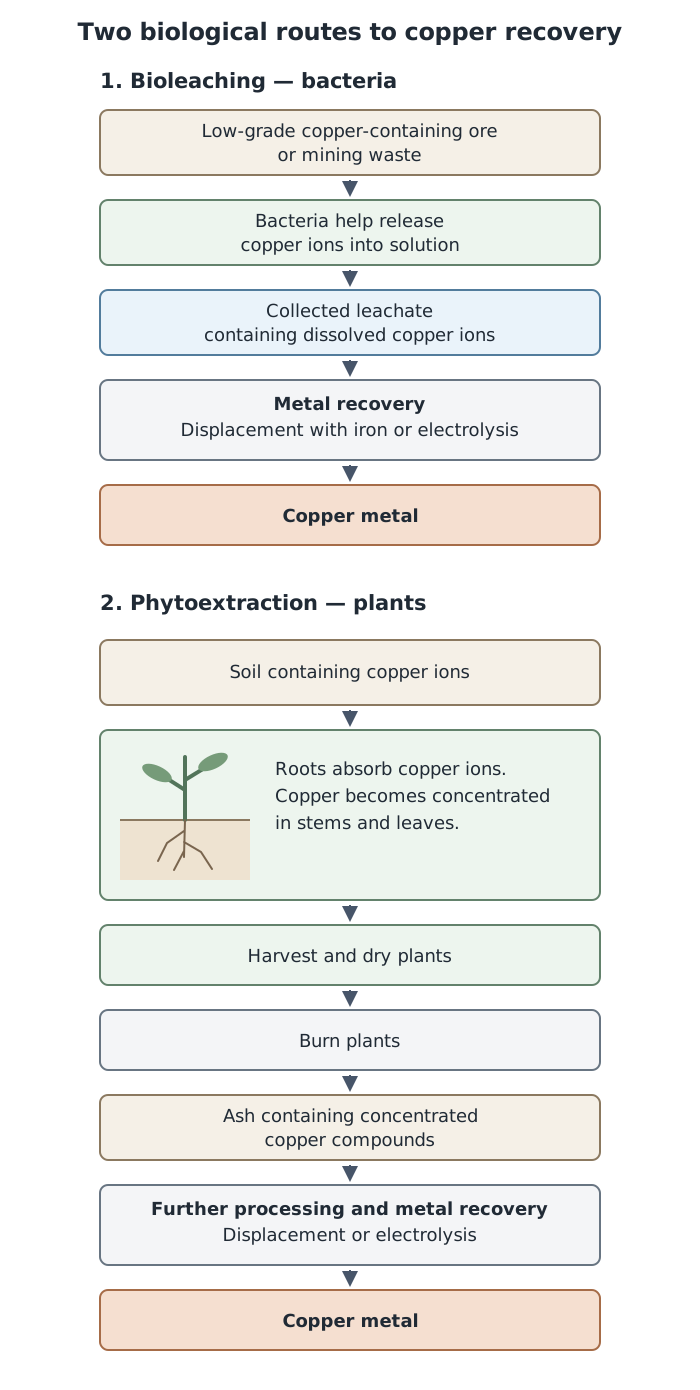
Bacteria produce a metal-ion solution; plants concentrate metal in tissue and then ash. Both pathways need a further step to recover the metal.
The important distinction is where the metal is collected: bioleaching produces a solution containing metal ions, whereas phytoextraction first collects the metal in plant tissue and then in ash.
Traditional mining can remove large amounts of rock, destroy habitats and produce dust, noise and waste. Biological methods can make use of material that would otherwise be discarded, reducing the need to mine new ores. Recovering metals from waste or contaminated soil can also reduce the amount of toxic metal left in the environment.
Bioleaching does not require a high-temperature extraction furnace, so it can reduce energy costs. However, its acidic, metal-containing solutions can pollute water if they escape. Collecting and treating these solutions is essential: using bacteria does not automatically make a process harmless.
Phytoextraction can reduce the need to excavate contaminated land, but suitable plants need time and appropriate growing conditions. Harvesting and burning the plants, followed by recovering the metal from the ash, still require processing and energy.
Both methods are slow and do not produce large quantities of metal quickly. Further displacement or electrolysis is also needed to obtain the metal, adding costs and resource use.
A justified choice therefore depends on the circumstances. Biological extraction may be worthwhile when metal concentrations are low, waste can be reused and rapid production is not essential. For producing large quantities quickly from a suitable concentrated ore, conventional extraction may be more practical. The best conclusion weighs the amount and value of metal recovered against energy use, time, land disturbance and pollution control.
Zinc oxide loses oxygen: reduction. Carbon gains oxygen: .
Explain the extraction choice using relative reactivity: zinc is below carbon, whereas aluminium is above carbon.
In carbon reduction, the metal oxide loses oxygen and is reduced; carbon gains oxygen and is oxidised.
Plants and bacteria concentrate or release metal compounds or ions. A further step is needed to obtain the metal itself.
For an evaluation, link each advantage or disadvantage to a consequence, then give a conclusion suited to the ore, the timescale and the environmental risks.
It can see this note and what your specification asks for.
Answers are free with an account.
1 free note left this week
Get more free notesYour answer sets when this note comes back for review, or marks it complete.
Was this note helpful?
Log in to tell us whether it helped, or to report a problem.
Last updated
Ore
A rock containing enough of a useful metal or metal compound for extraction to be economically worthwhile.
Low-grade ore
An ore containing a relatively small proportion of the useful metal or its compounds.
Carbon reduction
Extraction of a metal from its oxide by heating it with carbon, which removes oxygen from the oxide.
Reduction
Loss of oxygen, or gain of electrons, by a substance.
Oxidation
Gain of oxygen, or loss of electrons, by a substance.
Electrolysis
The breakdown of an ionic compound using an electric current.
Bioleaching
The use of bacteria to help release metal ions from ores into a solution, from which the metal can be recovered.
Leachate
A solution formed by leaching material; in metal extraction, it contains dissolved metal ions.
Phytoextraction
The use of plants to absorb metal ions through their roots and concentrate them in plant tissue, which is harvested and processed to recover the metal.
Put your knowledge into practice — try past paper questions for Combined Science B
Ore
A rock containing enough of a useful metal or metal compound for extraction to be economically worthwhile.
Low-grade ore
An ore containing a relatively small proportion of the useful metal or its compounds.
Carbon reduction
Extraction of a metal from its oxide by heating it with carbon, which removes oxygen from the oxide.
Reduction
Loss of oxygen, or gain of electrons, by a substance.
Oxidation
Gain of oxygen, or loss of electrons, by a substance.
Electrolysis
The breakdown of an ionic compound using an electric current.
Bioleaching
The use of bacteria to help release metal ions from ores into a solution, from which the metal can be recovered.
Leachate
A solution formed by leaching material; in metal extraction, it contains dissolved metal ions.
Phytoextraction
The use of plants to absorb metal ions through their roots and concentrate them in plant tissue, which is harvested and processed to recover the metal.
Electrolysis uses electrical energy. Mobile positive metal ions gain electrons to form metal atoms. Highly reactive metal extraction uses molten ionic material and requires substantial energy.
Benefits: use low-grade material and waste; reduce new mining and land disturbance; potentially lower energy costs; remove toxic metals from contaminated material.
Limitations: slow production; further extraction needed; bioleaching solutions require pollution control; phytoextraction depends on plant growth and requires processing.
Conclusion: weigh yield, speed, cost, energy use and environmental risks for the particular situation.