

Loading…
Loading…
Loading…
OCR GCSE Combined Science B · J260
OCR J260 · Fractional Distillation and Alkanes Check the specification (PDF) (opens in a new tab)
Crude oil is a mixture of many different hydrocarbons: compounds containing carbon and hydrogen atoms only. It is extracted from rocks beneath the land and seabed and is a main source of the hydrocarbons used in modern life.
Crude oil has two important roles. It supplies fuels, such as petrol and diesel for vehicles and kerosene for aircraft. It is also a feedstock for the petrochemical industry: a raw material that is processed to make other substances. These include polymers used in plastics, solvents, detergents and many medicines. Our dependence on oil therefore extends beyond transport and heating to the materials used in packaging, clothing and everyday products.
Crude oil formed over millions of years from the remains of living organisms exposed to heat and pressure. We use it much faster than new oil forms, so it is a finite resource. It cannot be replenished on the timescale of human use. Its importance as both a fuel source and a source of materials makes this limited supply significant.
The hydrocarbons in crude oil vary greatly in molecular size. Its fractions contain mainly alkanes, hydrocarbons with only single covalent bonds. They are described as saturated because their carbon atoms carry the maximum possible number of hydrogen atoms for that carbon framework.
Alkanes form a homologous series: a family with a common general formula and similar chemical properties. Each successive member differs by one unit. Their general formula is:
Here, is the number of carbon atoms in one molecule. Methane is , ethane is and propane is . For octane, , so the number of hydrogen atoms is : its formula is .
Crude oil is not one alkane, and it does not have one chemical formula. It contains many different compounds mixed together.
There are two types of attraction to distinguish. Strong covalent bonds hold the carbon and hydrogen atoms together within each molecule. Much weaker intermolecular forces attract separate molecules to one another.
When a liquid boils, energy is transferred to it by heating. Molecules become separated as the intermolecular attractions are overcome, allowing them to move freely as a gas. The covalent bonds inside each molecule remain intact: a hydrocarbon molecule in the vapour is still the same compound as it was in the liquid.
Larger, longer-chain hydrocarbon molecules have stronger intermolecular attractions than smaller molecules. More energy is needed to overcome these attractions, so larger molecules generally have higher boiling points. Smaller molecules have weaker attractions and lower boiling points.
The same distinction between bonds and forces matters in other changes of state. Melting requires energy to overcome enough intermolecular attraction for molecules to move past one another; it does not break their covalent bonds. During condensation or freezing, energy is transferred to the surroundings as molecules become more closely held together. Changes of state are physical changes, not chemical reactions.
Different uses need hydrocarbons with different properties. Rather than separating every individual compound, a refinery separates crude oil into fractions. Each fraction is still a mixture, but its molecules have similar sizes and a similar range of boiling points.
Fractional distillation uses these differences in boiling point:
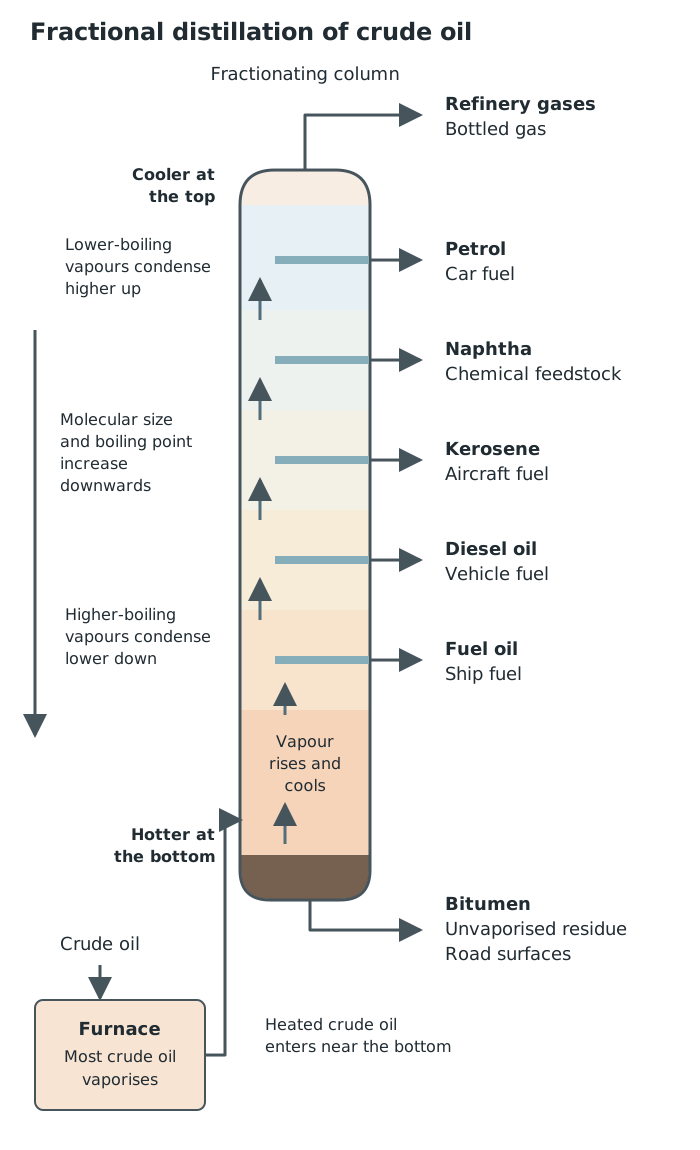
The column is cooler higher up. Smaller hydrocarbons travel further before condensing; larger hydrocarbons have higher boiling points and are collected lower down.
For example, petrol is collected above kerosene and diesel because its hydrocarbons are generally smaller and have lower boiling points. Naphtha provides a chemical feedstock, fuel oil is used by ships, and the heavy bitumen residue is used for road surfaces.
Industrial fractional distillation operates continuously: heated crude oil enters while fractions are collected. It separates existing compounds without changing them chemically. The whole process connects molecular size to intermolecular forces, boiling point and finally the height at which a fraction is collected.
Define a hydrocarbon as a compound containing carbon and hydrogen atoms only.
A fraction is still a mixture: its hydrocarbons have similar, not identical, boiling points.
For a boiling-point explanation, link larger molecules → stronger intermolecular forces → more energy needed → higher boiling point.
During fractional distillation, intermolecular forces are overcome; covalent bonds within the molecules do not break.
Distinguish the temperature of the column from a fraction’s boiling point: high-boiling fractions condense lower down, where the column is hotter.
It can see this note and what your specification asks for.
Answers are free with an account.
1 free note left this week
Get more free notesYour answer sets when this note comes back for review, or marks it complete.
Was this note helpful?
Log in to tell us whether it helped, or to report a problem.
Last updated
Crude oil
A naturally occurring mixture of many hydrocarbons, extracted from rocks in the Earth's crust.
Hydrocarbon
A compound containing carbon and hydrogen atoms only.
Feedstock
A raw material used in an industrial process to make other useful substances.
Finite resource
A resource with a limited supply that is not replaced quickly enough to keep up with its use.
Alkane
A saturated hydrocarbon containing only single covalent bonds. The alkanes in this series have the general formula .
Homologous series
A family of compounds with the same general formula and similar chemical properties, in which successive members differ by a unit.
Fraction
A mixture of hydrocarbons with similar molecular sizes and boiling points, collected during the fractional distillation of crude oil.
Fractional distillation
The separation of a mixture into fractions using differences in boiling point, through vaporisation and condensation.
Intermolecular force
An attraction between separate molecules, rather than a chemical bond between atoms within a molecule.
Put your knowledge into practice — try past paper questions for Combined Science B
Crude oil
A naturally occurring mixture of many hydrocarbons, extracted from rocks in the Earth's crust.
Hydrocarbon
A compound containing carbon and hydrogen atoms only.
Feedstock
A raw material used in an industrial process to make other useful substances.
Finite resource
A resource with a limited supply that is not replaced quickly enough to keep up with its use.
Alkane
A saturated hydrocarbon containing only single covalent bonds. The alkanes in this series have the general formula .
Homologous series
A family of compounds with the same general formula and similar chemical properties, in which successive members differ by a unit.
Fraction
A mixture of hydrocarbons with similar molecular sizes and boiling points, collected during the fractional distillation of crude oil.
Fractional distillation
The separation of a mixture into fractions using differences in boiling point, through vaporisation and condensation.
Intermolecular force
An attraction between separate molecules, rather than a chemical bond between atoms within a molecule.
= number of carbon atoms. Successive members differ by .
Heat crude oil → most vaporises → vapours enter the column → rise and cool → condense at different heights → fractions are collected.
Longer molecules → stronger intermolecular forces → more energy needed to separate molecules → higher boiling points.
Boiling and melting take in energy; condensation and freezing release energy. Changes of state do not break covalent bonds within molecules.