

Loading…
Loading…
Loading…
OCR GCSE Combined Science B · J260
OCR J260 · Purification and Chromatography Techniques Check the specification (PDF) (opens in a new tab)
A mixture contains substances that can be separated using differences in their physical properties. Sand does not dissolve in water, whereas salt does. Different liquids may have different boiling points. These differences let us choose a suitable separation method.
Filtration, crystallisation and distillation are physical processes: they separate substances already present rather than making new substances through a chemical reaction. The best choice also depends on what you want to collect. From salt water, for example, collecting solid salt requires a different method from collecting water.
Filtration separates an insoluble solid from a liquid or solution. For a mixture of sand and water, fold filter paper into a cone, place it inside a filter funnel and position the funnel above a beaker. Pour the mixture slowly into the paper.
Filter paper contains tiny pores. Water molecules pass through these pores, but the much larger sand grains are trapped. The sand left on the paper is the residue; the water collected underneath is the filtrate. Allow the liquid to drain through before collecting the products.
Dissolved substances also pass through the paper. Filtering salt water therefore does not remove the salt: the salt remains dissolved in the filtrate. A tea bag works similarly, retaining solid tea leaves while water and dissolved substances responsible for the tea’s flavour pass through.
Crystallisation separates a dissolved solid from its solution. The dissolved substance is the solute, and the liquid in which it dissolves is the solvent. Copper(II) sulphate dissolved in water is a useful example because it is much more soluble in hot water than in cold water.
Put the solution in an evaporating basin and heat it gently. Some water evaporates, leaving the solute in a smaller volume of solvent: the solution becomes more concentrated. Eventually it becomes saturated, meaning that no more solute can dissolve at that temperature.
To check the endpoint, dip a clean, dry, cold glass rod into the solution. Crystals forming on the rod show that it is ready to crystallise. Stop heating rather than boiling the solution dry, and leave it to cool slowly. As it cools, less copper(II) sulphate can remain dissolved, so crystals grow.
Filter off the crystals, wash them with a little cold distilled water to remove solution containing impurities, then allow them to dry. Using only a little cold water limits how much of the product dissolves during washing.
Salt can also be recovered from salt water by evaporating solvent until crystals begin to form, then allowing further evaporation.
Wear eye protection during practical work and allow hot apparatus to cool before handling it.
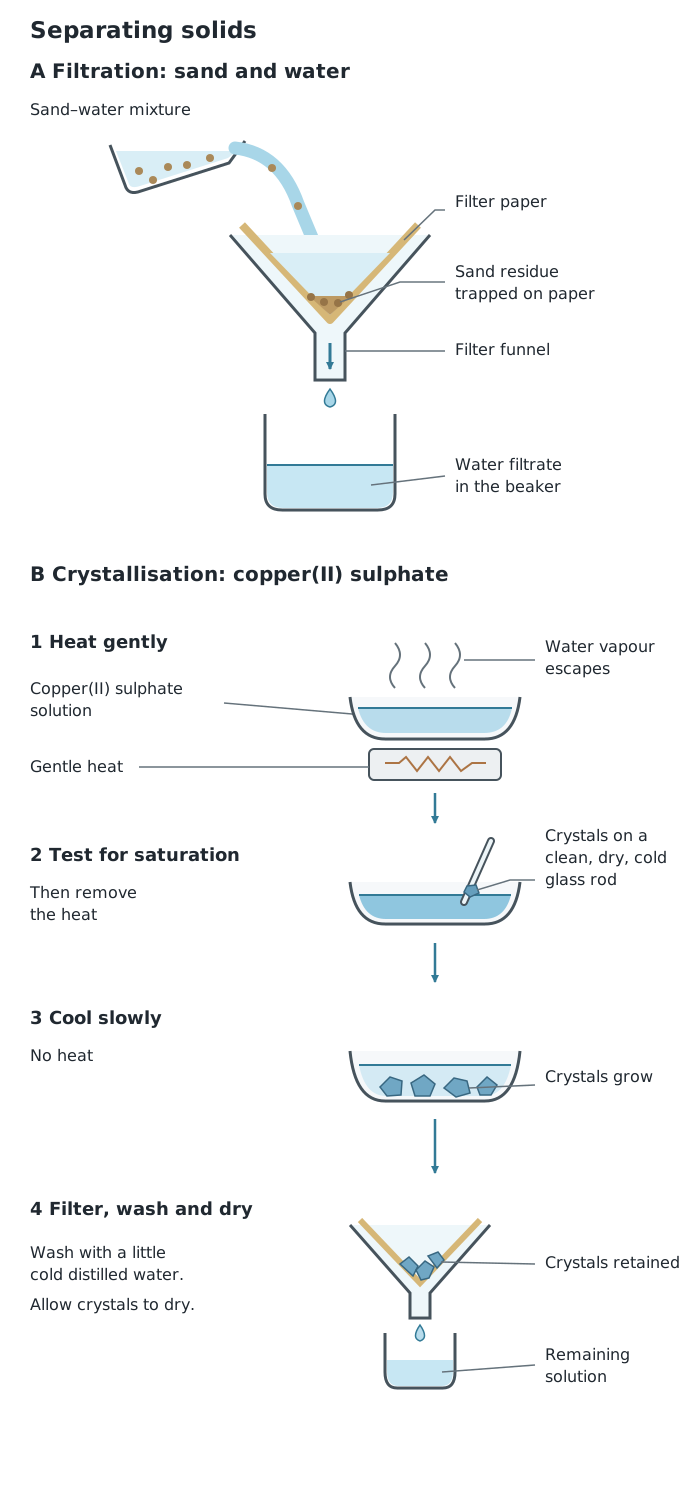
Filtration traps an undissolved solid; crystallisation recovers a dissolved solid after the solution is concentrated.
If you want the water from salt water, use simple distillation. Unlike crystallisation, this method captures the solvent instead of letting it escape into the room.
Heat the salt solution in a distillation flask. Water vaporises and travels into a condenser, while the salt remains in the flask. Cold water flowing through the condenser’s outer jacket cools the vapour in its inner tube. The vapour condenses into liquid water, which runs into a receiving vessel as the distillate. Cooling water and the collected water stay separate.
Simple distillation can also separate a liquid from a mixture of liquids when their boiling points are sufficiently different. When boiling points are closer together, a fractionating column gives better separation.
Fractional distillation separates liquids with different boiling points, such as ethanol and water. Its apparatus includes a fractionating column between the heated flask and the condenser.
As the mixture is heated, the vapour is richer in the liquid with the lower boiling point. In an ethanol–water mixture, this is ethanol, which boils at about .
The column is hotter at the bottom and cooler towards the top. Vapour condenses on surfaces inside the column, and heat from the rising vapour allows some of this liquid to vaporise again. These repeated condensation and vaporisation stages act like several successive distillations: each stage makes the rising vapour richer in the lower-boiling component.
Water, the higher-boiling component, is more likely to condense and run back towards the flask. Ethanol-rich vapour continues upwards into the condenser, where it cools and becomes liquid. The first liquid collected is therefore ethanol-rich, rather than necessarily pure ethanol. The thermometer at the top of the column measures the temperature of vapour entering the condenser.
For distillation, clamp the flask securely without overtightening the clamp, wear eye protection and add anti-bumping granules before heating. Heat gently. Run cooling water into the lower end of the condenser’s outer jacket and out of the upper end for effective cooling. Use an electric heater rather than a naked flame for flammable liquids such as ethanol. Once the required sample has been collected, stop heating and allow hot glassware to cool before handling it.
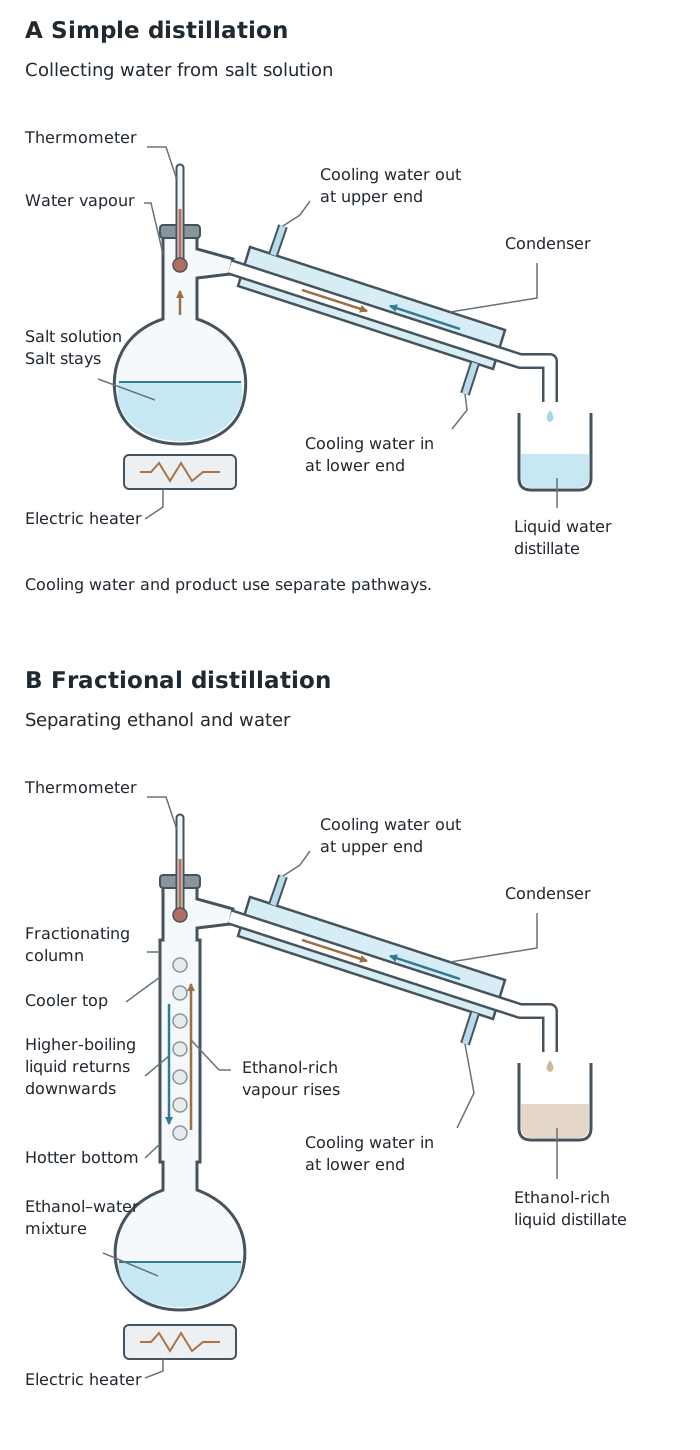
Both methods collect condensed vapour. Fractional distillation adds a column to improve the separation of mixed liquids. Cooling water flows through a separate outer jacket.
Start with two questions: which properties differ, and which substance do you want? An undissolved solid suggests filtration. A dissolved solid suggests crystallisation. Collecting a solvent suggests simple distillation. Separating mixed liquids with relatively close boiling points suggests fractional distillation.
A mixture containing sand, salt and water needs more than one stage to recover the salt. First filter it: sand stays on the paper, while the salt solution passes through. Then crystallise the filtrate to collect solid salt. Crystallising before removing the sand would leave the salt crystals mixed with sand. If the aim were to collect water instead, simply distil the filtered salt solution.
| What needs separating? | Method | Property used |
|---|---|---|
| Insoluble solid from a liquid | Filtration | Solid particles cannot pass through filter pores |
| Dissolved solid from a solution | Crystallisation | Solvent evaporation and, often, reduced solubility on cooling |
Choose a method using the substances’ properties and the substance you want to collect, not just the name of the mixture.
Filtration removes an insoluble solid; dissolved substances pass through with the solvent.
In distillation, explain both vaporisation and condensation. Heating alone does not collect the liquid.
For fractional distillation, link the order of collection to boiling points and explain the role of the fractionating column.
When several methods are needed, state their order and identify what is collected at each stage.
It can see this note and what your specification asks for.
Answers are free with an account.
1 free note left this week
Get more free notesYour answer sets when this note comes back for review, or marks it complete.
Was this note helpful?
Log in to tell us whether it helped, or to report a problem.
Last updated
Solute
A substance that dissolves in a solvent to form a solution.
Solvent
A liquid in which a solute dissolves.
Insoluble
Unable to dissolve in a particular solvent.
Filtration
Separation of an insoluble solid from a liquid using a filter.
Residue
The solid left on the filter paper after filtration.
Filtrate
The liquid or solution that passes through a filter.
Saturated solution
A solution containing the maximum amount of dissolved solute at a particular temperature.
Crystallisation
Separation of a dissolved solid from a solution by forming solid crystals.
Simple distillation
Separation that collects a liquid by vaporising it and then condensing its vapour.
Fractional distillation
Separation of a mixture of liquids with different boiling points using repeated vaporisation and condensation in a fractionating column.
Condenser
Apparatus that cools a vapour so that it changes into a liquid.
Distillate
The liquid collected after a vapour has condensed during distillation.
Put your knowledge into practice — try past paper questions for Combined Science B
Solute
A substance that dissolves in a solvent to form a solution.
Solvent
A liquid in which a solute dissolves.
Insoluble
Unable to dissolve in a particular solvent.
Filtration
Separation of an insoluble solid from a liquid using a filter.
Residue
The solid left on the filter paper after filtration.
Filtrate
The liquid or solution that passes through a filter.
Saturated solution
A solution containing the maximum amount of dissolved solute at a particular temperature.
Crystallisation
Separation of a dissolved solid from a solution by forming solid crystals.
Simple distillation
Separation that collects a liquid by vaporising it and then condensing its vapour.
Fractional distillation
Separation of a mixture of liquids with different boiling points using repeated vaporisation and condensation in a fractionating column.
Condenser
Apparatus that cools a vapour so that it changes into a liquid.
Distillate
The liquid collected after a vapour has condensed during distillation.
| Solvent from a solution | Simple distillation | Solvent vaporises; dissolved solid remains |
| Mixed liquids with relatively close boiling points | Fractional distillation | Different boiling points |
All four are physical processes: no new substances are made.
Remove insoluble impurities by filtration before crystallising a dissolved solid. Choose distillation instead if the liquid is the required product.