

Loading…
Loading…
Loading…
OCR GCSE Combined Science B · J260
OCR J260 · Conservation of Mass and Molar Calculations Check the specification (PDF) (opens in a new tab)
In a chemical reaction, reactants become products because their atoms are rearranged. Bonds between atoms change, but the atoms themselves are neither created nor destroyed. Because all the original atoms are still present, their total mass stays the same. This is the law of conservation of mass:
The word total matters: every substance involved must be included, even a gas that is difficult to see or collect. If 10 g of reactants form two products and one product has a mass of 6 g, the other must have a mass of 4 g, provided these are the only products.
A closed system allows no substances to enter or leave. If a reaction takes place in a closed container, the mass of the container and its contents remains constant, even if a gas or a solid forms.
A balance measures the container and the substances remaining on it, not necessarily every substance involved in the reaction. In a non-enclosed system, matter can move between the reaction mixture and its surroundings.
When magnesium reacts with hydrochloric acid, hydrogen gas is produced:
In an open flask, the hydrogen particles move freely and escape into the air. They carry mass away from the flask, so the balance reading decreases. No atoms have disappeared: some are now outside the system being weighed. Including the escaped hydrogen would give the same total mass as before.
The opposite happens when a metal reacts with oxygen from the air. For example, magnesium forms magnesium oxide:
Oxygen particles enter from the surroundings, and their atoms become part of the solid oxide. The oxide therefore has a greater mass than the magnesium alone. The increase is the mass of oxygen added; it is not newly created matter.
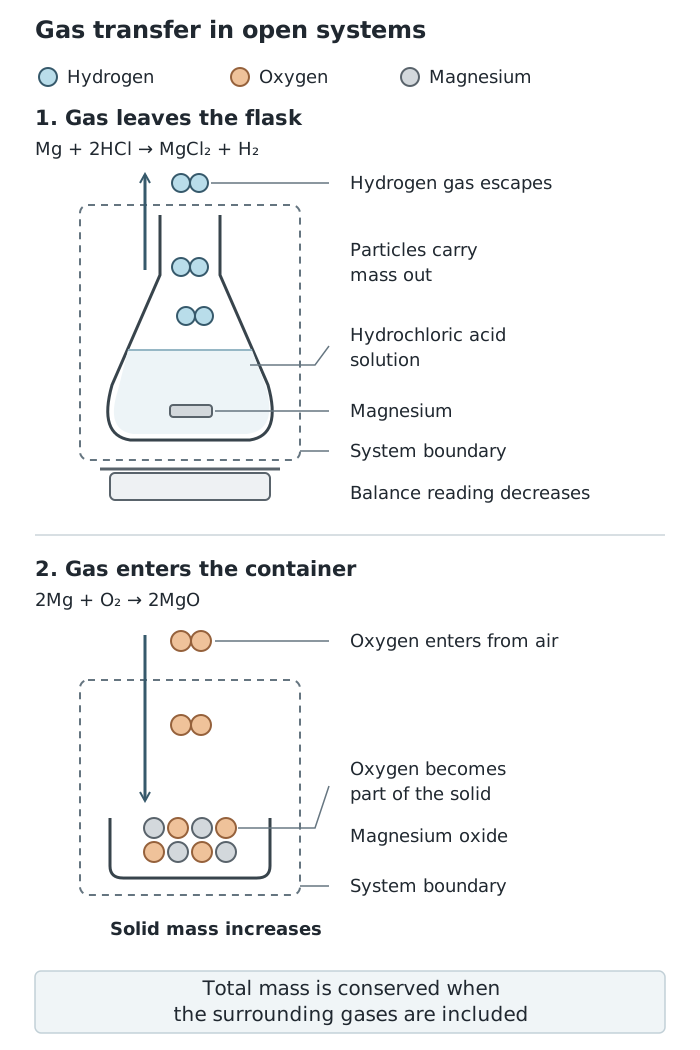
An open system can exchange gas particles with its surroundings, changing the mass being measured without breaking conservation of mass.
The particle model explains both observations: gases consist of particles that have mass and can move across the boundary of an open system. Mass is still conserved when the substances in the surroundings are included.
Chemists use relative atomic mass, , to compare the masses of atoms. These values are found in the periodic table. To find relative formula mass, , add the relative atomic masses of every atom shown in the formula:
The formula tells you how many atoms of each element to count. For calcium chloride, , there is one calcium atom for every two chlorine atoms. Using and :
For nitrogen gas, , using gives . An element can therefore have a formula mass different from its atomic mass if its particles contain more than one atom.
Neither nor has units: each is a relative comparison, not a mass measured in grams.
A balanced equation contains the same number of each type of atom on both sides. Consequently, the total relative masses also match, once the balancing numbers are included.
For , use and . The relative masses are 24 for Mg, 32 for and 40 for MgO. Including the balancing numbers:
The two sides agree because the same atoms are present. The 2 before MgO counts two lots of MgO; the of MgO itself remains 40.
Atoms are too small and numerous to count individually in an ordinary sample. Chemists therefore measure amount of substance in moles, symbol mol. A mole is a counting unit, rather like a dozen, but represents an enormously larger number.
One mole contains approximately specified particles. The number of particles per mole is the Avogadro constant, approximately . A more precise rounded value commonly used is ; use the value supplied in a calculation.
It matters which particles are being counted. One mole of sodium contains one mole of sodium atoms; one mole of hydrogen gas contains one mole of molecules. For an ionic compound such as sodium chloride, we count formula units: each NaCl formula unit represents one sodium ion and one chloride ion.
Equal amounts in moles contain equal numbers of the specified particles. They need not have equal masses, because the particles of different substances have different masses.
The mass of one mole in grams is numerically equal to the substance’s relative formula mass. For individual atoms of an element, use its relative atomic mass. For example, one mole of iron atoms has a mass of 56 g, whereas one mole of nitrogen molecules has a mass of 28 g.
This mass per mole is called molar mass, measured in . Dividing a sample’s mass by its mass per mole tells you how many moles it contains. The GCSE relationship is:
For example, carbon has , so each mole of carbon atoms has a mass of 12 g. A 42 g sample contains:
The sample contains three and a half times the number of atoms in one mole.
Writing mass as and amount in moles as , the GCSE numerical relationship is , with mass in grams. Multiply both sides by to make mass the subject:
For example, of nitrogen gas, with , has a mass of .
To make the subject, divide by :
For the same substance, mass and amount in moles are directly proportional: doubling the mass doubles the number of moles.
Standard form writes a number as , where and is an integer. For example, . Positive powers of ten represent large numbers; negative powers represent small numbers, such as .
To convert moles to a number of particles, multiply by the Avogadro constant:
Here is the number of specified particles and is the Avogadro constant. Suppose a sample contains of sodium atoms. Using :
To work in the opposite direction, rearrange to . A sample containing sodium atoms therefore contains:
When dividing powers of ten, subtract their exponents: . The final answer means the sample contains twice the number of atoms in one mole.
For an apparent mass change, identify the gas and explain whether its particles enter or leave the system being weighed.
Multiply each relative atomic mass by the number of that atom in the formula. A bracket subscript multiplies everything inside the brackets.
A balancing number multiplies the contribution of the whole formula; it does not change that substance’s Mᵣ.
Mᵣ has no units. Mass is measured in g and amount of substance in mol; convert kg to g before using the mole equation.
Use the value of the Avogadro constant given in the question, and use your calculator’s standard-form key for powers of ten.
Show substitutions and working, and round only the final answer.
It can see this note and what your specification asks for.
Answers are free with an account.
1 free note left this week
Get more free notesYour answer sets when this note comes back for review, or marks it complete.
Was this note helpful?
Log in to tell us whether it helped, or to report a problem.
Last updated
Conservation of mass
The rule that atoms are neither created nor destroyed in a chemical reaction, so the total mass of all reactants equals the total mass of all products.
Closed system
A system in which substances cannot enter or leave.
Non-enclosed system
A system in which substances can enter or leave, for example through the open neck of a flask.
Relative atomic mass, Aᵣ
The average mass of an atom of an element compared with one-twelfth of the mass of a carbon-12 atom. It has no units.
Relative formula mass, Mᵣ
The sum of the relative atomic masses of all the atoms shown in a chemical formula. It has no units.
Mole
The unit of amount of substance, symbol mol. One mole contains approximately specified particles, such as atoms, molecules or formula units.
Avogadro constant
The number of specified particles per mole of substance, approximately .
Molar mass
The mass per mole of a substance, measured in . Its numerical value equals the substance’s relative formula mass.
Standard form
A way of writing a number as , where and is an integer.
Put your knowledge into practice — try past paper questions for Combined Science B
Conservation of mass
The rule that atoms are neither created nor destroyed in a chemical reaction, so the total mass of all reactants equals the total mass of all products.
Closed system
A system in which substances cannot enter or leave.
Non-enclosed system
A system in which substances can enter or leave, for example through the open neck of a flask.
Relative atomic mass, Aᵣ
The average mass of an atom of an element compared with one-twelfth of the mass of a carbon-12 atom. It has no units.
Relative formula mass, Mᵣ
The sum of the relative atomic masses of all the atoms shown in a chemical formula. It has no units.
Mole
The unit of amount of substance, symbol mol. One mole contains approximately specified particles, such as atoms, molecules or formula units.
Avogadro constant
The number of specified particles per mole of substance, approximately .
Molar mass
The mass per mole of a substance, measured in . Its numerical value equals the substance’s relative formula mass.
Standard form
A way of writing a number as , where and is an integer.
Count formula subscripts and brackets. In a balanced equation, multiply each relative mass by its balancing number; totals on both sides agree. and have no units.
One mole contains approximately specified particles. Its mass in grams is numerically equal to (or for individual atoms).
Using mass in grams and amount in mol:
Equal moles mean equal particle numbers, not necessarily equal masses.
; use the supplied value. State which particles are counted.
Standard form: , with . Add exponents when multiplying powers of ten; subtract them when dividing.