

Loading…
Loading…
Loading…
OCR GCSE Combined Science B · J260
OCR J260 · Conservation of Mass and Molar Calculations Check the specification (PDF) (opens in a new tab)
A balanced chemical equation describes atoms being rearranged into new substances. Its coefficients, the numbers before the formulae, also tell us the relative amounts of substances that react and form. These relationships are called stoichiometry.
For example:
Two hydrogen molecules react with one oxygen molecule to form two water molecules. Scaling up, 2 mol of hydrogen react with 1 mol of oxygen to form 2 mol of water. The mole ratio is therefore .
This is not a mass ratio. Different substances have different masses per mole. To connect an equation to measured masses, we use relative formula mass, , which is the sum of the relative atomic masses in a formula. With mass in grams and amount in moles:
For an element represented by single atoms, use its relative atomic mass, , in the same way.
If we know the substances involved and the masses that actually react or form, we can work backwards to find their mole ratio. Masses supplied initially cannot all be used for this purpose if some reactant remains unreacted.
Consider a reaction in which 1.2 g of carbon reacts with 16.2 g of zinc oxide, producing 4.4 g of carbon dioxide and 13 g of zinc. Using , and :
| Substance | Relative mass | Mass / g | Amount / mol |
|---|---|---|---|
| Carbon, C | 12 | 1.2 | |
| Zinc oxide, ZnO | 16.2 |
In the order shown, the amounts are in the ratio . Dividing every value by the smallest, 0.10, gives . These numbers become the equation's coefficients:
The equation has one carbon atom, two zinc atoms and two oxygen atoms on each side. The masses also agree with conservation of mass: .
When the equation is already known, the calculation runs in the opposite direction:
known mass → known amount in moles → required amount using the mole ratio → required mass.
For example, aluminium can be obtained from aluminium oxide according to:
Using and , aluminium oxide has . The equation therefore connects g of aluminium oxide with g of aluminium.
This mass ratio can be scaled using any consistent mass unit. For 51 tonnes of aluminium oxide, the maximum mass of aluminium is:
The calculation assumes that all the aluminium oxide is converted into the stated products. It gives a theoretical maximum, rather than a guarantee of the mass collected.
The same ratio calculates a reactant requirement. To obtain 108 g of aluminium, 204 g of aluminium oxide is required; any other target mass scales in the same proportion.
We can also express the aluminium content as a percentage by mass:
So about 52.9% of the mass of aluminium oxide is aluminium. This is consistent with the reacting-mass result: 27 tonnes is about 52.9% of 51 tonnes.
Reactants must combine in the proportions fixed by the equation. Having plenty of one reactant does not compensate for running out of another.
A limiting reactant is completely used up and restricts the maximum amount of product. An excess reactant is supplied in more than the required proportion, so some remains in the final mixture.
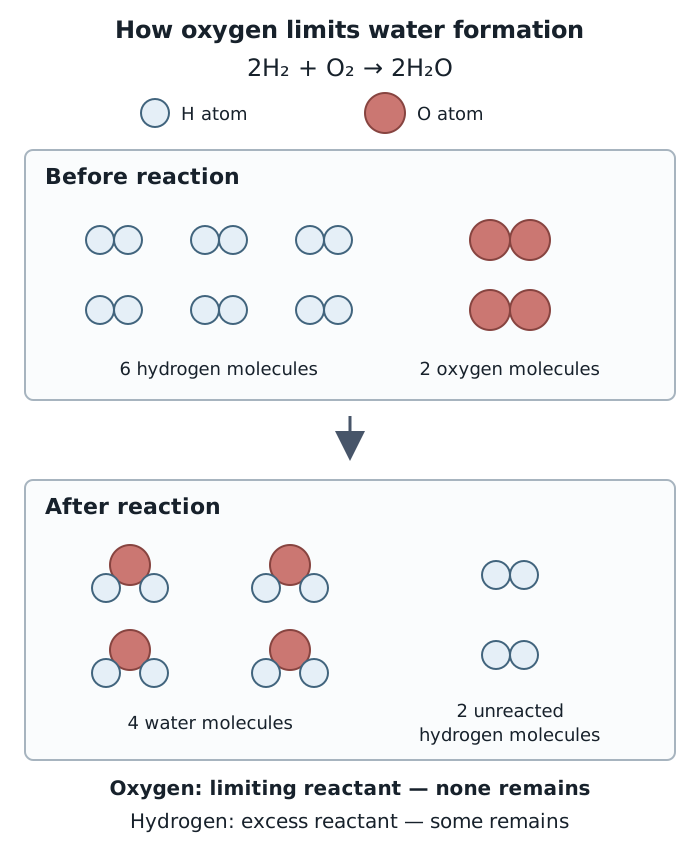
Oxygen runs out first: four water molecules form, while two hydrogen molecules remain unreacted.
Each reaction group in the water equation needs two hydrogen molecules and one oxygen molecule. In the diagram, the two oxygen molecules can react with only four of the six hydrogen molecules. Four water molecules form and two hydrogen molecules remain. Oxygen is limiting; hydrogen is in excess.
The same reasoning applies to moles. Once the limiting reactant has been consumed, further product cannot form through that reaction, even though excess reactant remains.
First convert any given masses into moles. Then compare the available amounts with the balanced equation's required ratio.
For methane combustion:
Suppose 6 mol of methane is supplied with 4 mol of oxygen. All 6 mol of methane would need 12 mol of oxygen, but only 4 mol is available. Oxygen is therefore limiting.
The available 4 mol of oxygen can react with mol of methane. This forms 2 mol of carbon dioxide and leaves mol of methane unreacted. Since carbon dioxide has , its theoretical maximum mass is g.
The product calculation must use the limiting amount, not all the methane supplied. Adding more methane alone would not increase the product. Increasing the amount of the limiting reactant increases the theoretical product in direct proportion, provided the other reactant remains in excess: doubling the limiting amount doubles the maximum product.
Equation coefficients give mole ratios, not mass ratios. Convert masses to moles before deducing coefficients.
When simplifying a mole ratio, divide every value by the smallest. If fractions remain, multiply the whole ratio to obtain whole numbers.
Check a deduced equation by counting atoms of each element on both sides; change coefficients, not chemical formulae.
Identify the limiting reactant using the equation's ratio, not simply the smaller mass or smaller number of moles.
Keep intermediate calculations unrounded and use consistent mass units. Relative formula mass has no unit.
It can see this note and what your specification asks for.
Answers are free with an account.
1 free note left this week
Get more free notesYour answer sets when this note comes back for review, or marks it complete.
Was this note helpful?
Log in to tell us whether it helped, or to report a problem.
Last updated
Stoichiometry
The relative amounts, in moles, of reactants and products in a chemical reaction, represented by the coefficients in its balanced equation.
Coefficient
A number placed before a chemical formula in an equation to show its relative number of particles or moles.
Limiting reactant
A reactant that is completely used up and therefore restricts the maximum amount of product that can form.
Excess reactant
A reactant supplied in a greater amount than needed to react completely with the limiting reactant, so some remains afterwards.
Theoretical yield
The maximum calculated mass of product obtainable from the available reactants, assuming complete reaction.
Put your knowledge into practice — try past paper questions for Combined Science B
Stoichiometry
The relative amounts, in moles, of reactants and products in a chemical reaction, represented by the coefficients in its balanced equation.
Coefficient
A number placed before a chemical formula in an equation to show its relative number of particles or moles.
Limiting reactant
A reactant that is completely used up and therefore restricts the maximum amount of product that can form.
Excess reactant
A reactant supplied in a greater amount than needed to react completely with the limiting reactant, so some remains afterwards.
Theoretical yield
The maximum calculated mass of product obtainable from the available reactants, assuming complete reaction.
| Carbon dioxide, CO₂ | 4.4 |
| Zinc, Zn | 65 | 13 |
Mass → moles → equation ratio → moles → mass.
Alternatively, scale the mass ratio given by coefficient × relative mass for each substance. Keep mass units consistent.