

Loading…
Loading…
Loading…
OCR GCSE Combined Science B · J260
OCR J260 · Pollution Mitigation and Chemical Formulae Check the specification (PDF) (opens in a new tab)
Chemical symbols let chemists describe substances precisely without writing their names each time. An element contains only one type of atom. Each element has its own symbol: H is hydrogen, O is oxygen, C is carbon and N is nitrogen. Symbols begin with a capital letter; any second letter is lower case. Sodium is Na, magnesium is Mg and chlorine is Cl.
A symbol identifies an element, but the formula of the elemental substance also depends on how its atoms are arranged. Metals such as magnesium are written Mg. Noble gases exist as individual atoms, so helium is written He.
Several non-metal elements consist of molecules containing two atoms. Their formulae are , , , , , and . These are diatomic molecules. The small 2 is a subscript: it means there are two atoms in each molecule. A molecule can therefore be an element, provided all its atoms are of the same element.
A compound contains different elements chemically bonded together in fixed proportions. Its properties can be very different from those of the elements that formed it. For example, sodium and chlorine form sodium chloride, NaCl, a white crystalline solid.
Simple covalent compounds consist of molecules whose atoms are joined by covalent bonds, in which atoms share electrons. Their formulae show the actual numbers of each kind of atom in one molecule.
In water, , each molecule contains two hydrogen atoms and one oxygen atom. No subscript means one atom. Ammonia, , contains one nitrogen atom and three hydrogen atoms per molecule.
To deduce a formula from a labelled molecular model, identify the elements and count the atoms of each within one molecule. A central nitrogen atom joined to three hydrogen atoms gives . Do not count several separate molecules as though they were one.
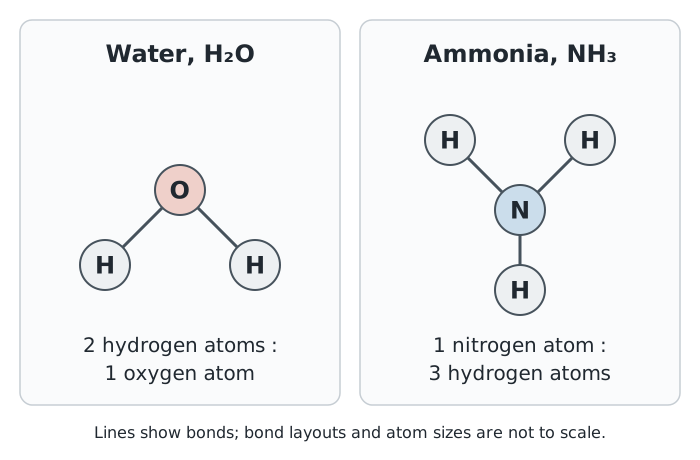
Count each type of atom within one molecule to read or deduce its formula.
Formulae are fixed descriptions of substances. Changing to a formula with a different number of oxygen atoms would describe a different substance, not more water.
A chemical reaction changes starting substances, called reactants, into new substances, called products. A word equation names them, with reactants on the left and products on the right. The arrow means ‘react to form’.
For hydrogen reacting with oxygen:
hydrogen + oxygen → water
Replacing the names with their correct formulae gives:
This identifies the substances correctly, but it is not yet balanced: there are two oxygen atoms on the left and only one on the right.
During a chemical reaction, atoms are rearranged. They are not created or destroyed, so the total mass of the reactants equals the total mass of the products when all substances are accounted for. This is conservation of mass.
A balanced equation represents that conservation by having equal numbers of atoms of every element on both sides. To achieve this, change the coefficients, the numbers in front of formulae. A coefficient multiplies every atom in the formula: represents two water , containing four hydrogen atoms and two oxygen atoms altogether.
Start by balancing oxygen in the water equation. Putting 2 before water gives two oxygen atoms on the right. It also gives four hydrogen atoms, so put 2 before hydrogen:
The final check is four hydrogen atoms and two oxygen atoms on each side. The coefficients give the molecule ratio hydrogen : oxygen : water as 2 : 1 : 2. For example, four hydrogen molecules would react with two oxygen molecules to form four water molecules. This is a ratio of particles, not a ratio of masses.
A reliable method is to write the correct formulae first, count each element on both sides, adjust coefficients and then recount. Finish with the smallest whole-number ratio.
Gas appearance alone is often unhelpful: oxygen, hydrogen and carbon dioxide are all colourless. A chemical test uses a characteristic response to identify the gas.
| Gas | What to do | Positive result |
|---|---|---|
| Oxygen | Light a wooden splint, blow out the flame, then place the glowing end inside a test tube containing the gas. | The glowing splint relights. |
| Hydrogen | Hold a burning splint at the mouth of a test tube containing a small sample of gas. | The gas burns with a squeaky pop. |
| Carbon dioxide | Pass the gas through limewater using a delivery tube whose outlet dips into the liquid. | The limewater turns milky or cloudy. |
Oxygen supports combustion, allowing the glowing splint to relight. Hydrogen burns rapidly when it meets oxygen from the air, producing water and the characteristic pop. Hold the burning splint at the tube mouth rather than pushing it deep inside.
Carbon dioxide reacts with limewater to form a fine white solid, causing cloudiness. Once that change is visible, the positive result has been obtained; there is no need to keep bubbling gas through it.
For school gas tests, wear eye protection, use small samples under teacher supervision and point test tubes away from people. Keep flames away from the gas-generating apparatus and test hydrogen only in a separate small sample. Avoid limewater splashes, and never identify gases by deliberately smelling them.
Oxidation means that a substance gains oxygen. Look for oxygen becoming chemically combined with that substance in the product, rather than merely being present somewhere in the equation.
For example:
Carbon starts as C and becomes carbon monoxide, CO. It has gained oxygen, so carbon is oxidised. The oxygen has come from zinc oxide; oxidation does not require oxygen gas to be a reactant.
The same reasoning connects oxidation with hydrogen burning. In , hydrogen combines with oxygen to form water, so hydrogen is oxidised.
Use a capital letter followed by a lower-case letter where needed: chlorine is Cl, not CL.
Balance equations by changing coefficients in front of formulae, never the subscripts within them.
Check the number of atoms of every element on both sides, and give coefficients in the smallest whole-number ratio.
For a gas test, state both the method and the positive result. Distinguish a glowing splint for oxygen from a burning splint for hydrogen.
A gas extinguishing a flame does not uniquely identify carbon dioxide. Use limewater.
Explain oxidation by naming the substance that gains oxygen.
It can see this note and what your specification asks for.
Answers are free with an account.
1 free note left this week
Get more free notesYour answer sets when this note comes back for review, or marks it complete.
Was this note helpful?
Log in to tell us whether it helped, or to report a problem.
Last updated
Element
A substance containing only one type of atom; all its atoms have the same number of protons.
Compound
A substance containing two or more different elements chemically bonded together in fixed proportions.
Molecule
A group of two or more atoms chemically bonded together.
Chemical formula
A representation using chemical symbols and subscripts to show which elements a substance contains and their relative numbers of atoms.
Coefficient
A number written in front of a chemical formula in an equation, multiplying the whole formula.
Conservation of mass
The principle that total mass remains unchanged during a chemical reaction because atoms are rearranged, not created or destroyed.
Balanced equation
A chemical equation containing the same number of atoms of each element on both sides.
Limewater
An aqueous solution of calcium hydroxide that turns milky when carbon dioxide is bubbled through it.
Oxidation
The gain of oxygen by a substance.
Put your knowledge into practice — try past paper questions for Combined Science B
Element
A substance containing only one type of atom; all its atoms have the same number of protons.
Compound
A substance containing two or more different elements chemically bonded together in fixed proportions.
Molecule
A group of two or more atoms chemically bonded together.
Chemical formula
A representation using chemical symbols and subscripts to show which elements a substance contains and their relative numbers of atoms.
Coefficient
A number written in front of a chemical formula in an equation, multiplying the whole formula.
Conservation of mass
The principle that total mass remains unchanged during a chemical reaction because atoms are rearranged, not created or destroyed.
Balanced equation
A chemical equation containing the same number of atoms of each element on both sides.
Limewater
An aqueous solution of calcium hydroxide that turns milky when carbon dioxide is bubbled through it.
Oxidation
The gain of oxygen by a substance.
Correct formulae → count atoms → adjust coefficients → recount → simplify the whole-number ratio.
| Gas | Test | Positive result |
|---|---|---|
| Oxygen | Glowing splint inside the gas | Relights |
| Hydrogen | Burning splint at the tube mouth | Squeaky pop |
| Carbon dioxide | Bubble through limewater | Turns milky/cloudy |
Gain of oxygen. Identify which substance becomes combined with oxygen in the product.