

Loading…
Loading…
Loading…
Eduqas GCSE History · C100
Eduqas C100 · Cold War Rivalry Check the specification (PDF) (opens in a new tab)
The USA and the USSR cooperated during the Second World War because they shared an enemy: Nazi Germany. Germany’s defeat in May 1945 removed that common purpose. The two countries emerged as superpowers, with the strength to influence events far beyond their own borders, but with very different ideas about how societies should be organised.
The USA supported capitalism, including private ownership of businesses and production for profit. The USSR was governed by the Communist Party, with state control of the economy. Each feared that the other’s influence would spread. Their rivalry became a Cold War: they competed through threats, economic policies, military alliances and support for opposing sides in other countries, rather than fighting a direct war against each other.
Soviet forces had driven German armies out of much of Eastern Europe. Stalin wanted countries there to remain under Soviet influence, creating a protective buffer between the USSR and the West. Communist governments were established in satellite states: countries that were formally separate but heavily controlled by the Soviet Union.
To Stalin, this offered security. To American leaders, it looked like communist expansion, particularly because Stalin opposed genuinely free elections that might remove Soviet-backed governments. The same developments could therefore be presented as defensive by one side and threatening by the other.
Atomic weapons added to this mistrust. Secrecy surrounding the American development of the atomic bomb, and the USA’s use of atomic bombs against Japan in 1945, made Stalin fear that American nuclear power could be used to threaten the USSR. He wanted Soviet atomic weapons of his own.
In March 1946, Winston Churchill’s ‘Iron Curtain’ speech drew attention to Europe’s division between the Soviet-controlled East and the West. The Iron Curtain was a metaphor, not a single physical barrier. It expressed the growing political divide between the former allies.
President Harry Truman believed that the USA should prevent communism from spreading to more countries. This policy was called containment. Its aim was to stop further expansion, rather than necessarily remove communist governments wherever they already existed.
In March 1947, Truman announced the Truman Doctrine, committing the USA to support countries threatened by communist takeover or outside pressure. Greece and Turkey were important immediate concerns. The doctrine marked a commitment to active involvement abroad rather than withdrawal from European affairs.
American leaders feared a knock-on effect: if one country became communist, others might follow. This became known as the Domino Theory. It helps explain why the USA regarded events in other countries as matters affecting its own security.
Containment also had an economic side. War-damaged countries faced poverty and disruption, which Truman believed could make communism more attractive. The Marshall Plan, announced in June 1947, offered economic assistance for European recovery. Marshall Aid helped countries rebuild and was intended to make communist takeovers less likely.
However, assistance that Americans regarded as protection could look like interference to Stalin. He described the Marshall Plan as ‘dollar imperialism’, arguing that the USA was using money to extend its power. Economic recovery therefore also reinforced the division between countries linked to the USA and those controlled by the USSR.
After the Second World War, Germany was divided into four occupation zones controlled by the USA, Britain, France and the USSR. Berlin was also divided into four sectors, even though the whole city lay deep inside the Soviet occupation zone. This left the Western sectors of Berlin separated from the Western occupation zones of Germany.
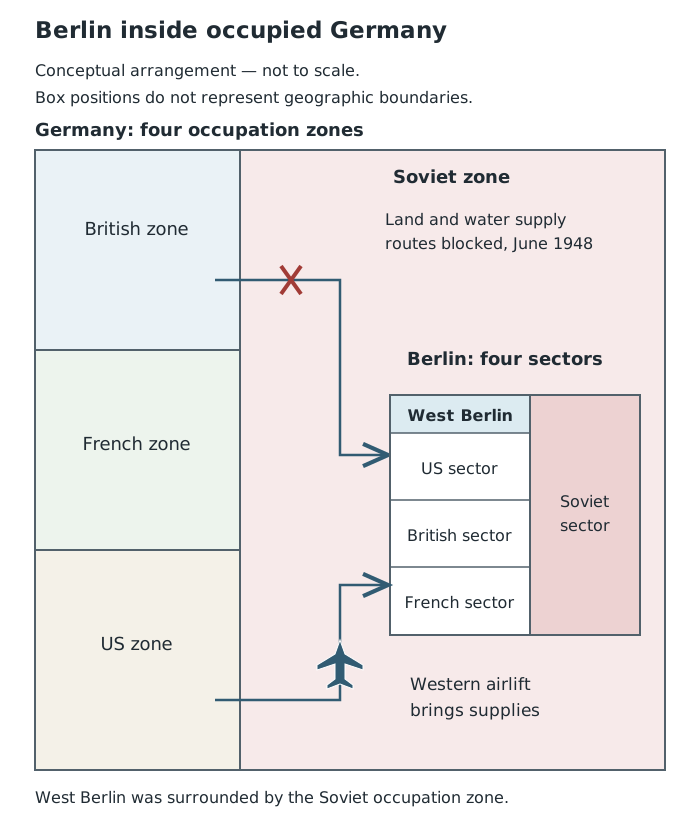
Berlin had its own four occupation sectors despite lying inside the Soviet zone of Germany. The airlift supplied West Berlin when its land and water supply routes were blocked.
As the Western powers developed economic cooperation between their zones, disagreement grew over Germany’s future. Berlin became a test of whether the Western powers could maintain their position in an area surrounded by Soviet-controlled territory.
On 24 June 1948, Stalin blocked the land and water routes supplying West Berlin from the Western zones. Cutting off supplies put pressure on the Western powers to abandon their sectors of the city.
The Western response was the Berlin Airlift. Aircraft brought in food, fuel and other necessities. This maintained West Berlin without forcing a military convoy through the blockade, which could have led to direct fighting with Soviet forces.
In May 1949, Stalin lifted the blockade and the routes reopened. The West had demonstrated its determination to remain in Berlin, while the USSR had failed to force it out. Although war had been avoided, the crisis deepened distrust: each side had tested the other’s willingness to resist.
The Berlin Crisis strengthened the Western argument for collective security: countries would be safer if they agreed to defend one another. In 1949, the USA and eleven other countries formed NATO, a defensive military alliance.
In 1955, the USSR established the Warsaw Pact with its Eastern European allies. Europe was now divided between two powerful military blocs. Each alliance offered protection to its members, but appeared threatening to its opponents. This made the Cold War divide more organised and enduring.
In January 1959, rebels led by Fidel Castro overthrew Cuba’s US-backed leader. Castro strengthened trading links with the USSR as relations with the USA deteriorated. Cuba was only about 90 miles from the US mainland, so American leaders regarded a Soviet-aligned government there as a serious security threat.
In April 1961, President John F. Kennedy supported an invasion by Cuban exiles at the Bay of Pigs. The invasion failed. It damaged American prestige and increased Castro’s fear of another US attack, encouraging him to seek Soviet protection. An attempt to weaken Castro therefore helped draw Cuba closer to the USSR.
On 14 October 1962, an American U-2 spy plane photographed Soviet missile sites in Cuba. Nuclear missiles there could threaten US cities, turning Cuba’s relationship with the USSR into an immediate military danger.
Kennedy faced a difficult choice. Doing nothing would leave the threat in place, but attacking Cuba could provoke war with the USSR. He imposed a naval blockade to prevent further Soviet military supplies reaching the island. Soviet ships approaching Cuba created a tense stand-off: enforcing the blockade against them could bring the superpowers into direct conflict.
Kennedy and Soviet leader Nikita Khrushchev were practising brinkmanship, taking the confrontation close to war to make the other side retreat. Nuclear weapons made the consequences of a misjudgement potentially catastrophic.
The crisis ended through compromise. Khrushchev agreed to remove Soviet missiles from Cuba, while the settlement also involved removing American missiles from Turkey. Kennedy appeared to have won because the Soviet withdrawal was public, whereas the agreement concerning Turkey was not publicly known at the time. The outcome was therefore more complicated than a simple American victory.
The Cuban Missile Crisis demonstrated how Cold War rivalry could bring the world close to nuclear war. It intensified fear, but also gave both governments a reason to reduce the risk of another crisis.
In 1963, a direct communications hotline was established between Washington and Moscow to improve communication in emergencies. The Partial Test Ban Treaty, also agreed in 1963, restricted nuclear testing; it did not end nuclear weapons or the arms rivalry.
Relations did not deteriorate in a straight line. Ideological differences and competing security policies produced confrontation, yet fear of nuclear destruction encouraged limited cooperation. Rivalry continued through alliances and proxy conflicts, including Vietnam, rather than becoming a direct war between the USA and the USSR.
Ideological opposition + mutual suspicion + competing security policies → containment, rival alliances and crises. Nuclear danger sometimes encouraged cooperation as well as confrontation.
Explain the link between an event and worsening relations: identify what happened, why the other superpower saw it as threatening, and how it responded.
Distinguish the Truman Doctrine, a commitment to resist communist expansion, from Marshall Aid, the economic assistance that supported containment.
Do not confuse the Berlin blockade of 1948–49 with the building of the Berlin Wall in 1961.
Date the Bay of Pigs invasion to April 1961 and the Cuban Missile Crisis to October 1962.
Distinguish appearances from outcomes: Kennedy appeared victorious, but the Cuban settlement also involved removing US missiles from Turkey.
Avoid claiming that relations only worsened: the hotline and Partial Test Ban Treaty show that the danger of confrontation also encouraged cooperation.
It can see this note and what your specification asks for.
Answers are free with an account.
1 free note left this week
Get more free notesYour answer sets when this note comes back for review, or marks it complete.
Was this note helpful?
Log in to tell us whether it helped, or to report a problem.
Last updated
Cold War
A prolonged rivalry between the USA and the USSR involving political, economic and military competition, but not a direct war between the two superpowers.
Superpower
A country with enough economic, political and military power to influence events across the world.
Capitalism
An economic system in which individuals and businesses can privately own property and produce goods for profit.
Communism
An ideology aiming for a classless society and common ownership of productive resources. In the USSR, the Communist Party controlled government and the state controlled the economy.
Satellite state
A country formally separate from another power but heavily controlled or influenced by it, such as the Eastern European countries under Soviet control.
Iron Curtain
A metaphor for the division between Soviet-controlled Eastern Europe and the West, popularised by Winston Churchill in his March 1946 speech.
Containment
The US policy of preventing communism from spreading to additional countries.
Truman Doctrine
President Truman’s March 1947 commitment to support countries threatened by communist takeover or outside pressure.
Marshall Aid
US economic assistance to help European countries recover after the Second World War, also intended to reduce the appeal of communism.
Domino Theory
The belief that one country becoming communist could encourage neighbouring countries to become communist in turn.
NATO
The North Atlantic Treaty Organisation: a Western defensive alliance established in 1949 by the USA and eleven other countries.
Warsaw Pact
A military alliance established in 1955 by the USSR and its Eastern European allies.
Brinkmanship
The policy of pushing a confrontation close to war to force an opponent to back down.
Proxy war
A conflict in which rival powers support opposing sides rather than fight each other directly.
Put your knowledge into practice — try past paper questions for History
Cold War
A prolonged rivalry between the USA and the USSR involving political, economic and military competition, but not a direct war between the two superpowers.
Superpower
A country with enough economic, political and military power to influence events across the world.
Capitalism
An economic system in which individuals and businesses can privately own property and produce goods for profit.
Communism
An ideology aiming for a classless society and common ownership of productive resources. In the USSR, the Communist Party controlled government and the state controlled the economy.
Satellite state
A country formally separate from another power but heavily controlled or influenced by it, such as the Eastern European countries under Soviet control.
Iron Curtain
A metaphor for the division between Soviet-controlled Eastern Europe and the West, popularised by Winston Churchill in his March 1946 speech.
Containment
The US policy of preventing communism from spreading to additional countries.
Truman Doctrine
President Truman’s March 1947 commitment to support countries threatened by communist takeover or outside pressure.
Marshall Aid
US economic assistance to help European countries recover after the Second World War, also intended to reduce the appeal of communism.
Domino Theory
The belief that one country becoming communist could encourage neighbouring countries to become communist in turn.
NATO
The North Atlantic Treaty Organisation: a Western defensive alliance established in 1949 by the USA and eleven other countries.
Warsaw Pact
A military alliance established in 1955 by the USSR and its Eastern European allies.
Brinkmanship
The policy of pushing a confrontation close to war to force an opponent to back down.
Proxy war
A conflict in which rival powers support opposing sides rather than fight each other directly.