

Loading…
Loading…
Loading…
Eduqas GCSE Geography B · C112
Eduqas C112 · 3.3.3 Challenges in Water Management Check the specification (PDF) (opens in a new tab)
A transboundary water resource crosses a national boundary. Rivers flow between countries, while aquifers—rocks that store groundwater—can extend beneath borders. Each government makes decisions within its own territory, but the effects on water may travel beyond it. This makes international water management different from managing supply within one country: countries must negotiate rather than rely on a single national authority.
On a river, upstream means towards the source and downstream means towards the mouth. An upstream country can influence the water reaching countries farther downstream. The central challenge is therefore not simply who controls the river, but how its benefits and risks should be shared.
Three activities can create international disputes:
These changes matter because downstream communities need water for drinking, growing food and industrial production. Less irrigation can reduce crop yields; unreliable industrial supplies can reduce output and income. Unsafe water can cause illness. A decision that benefits one country may therefore impose costs on another.
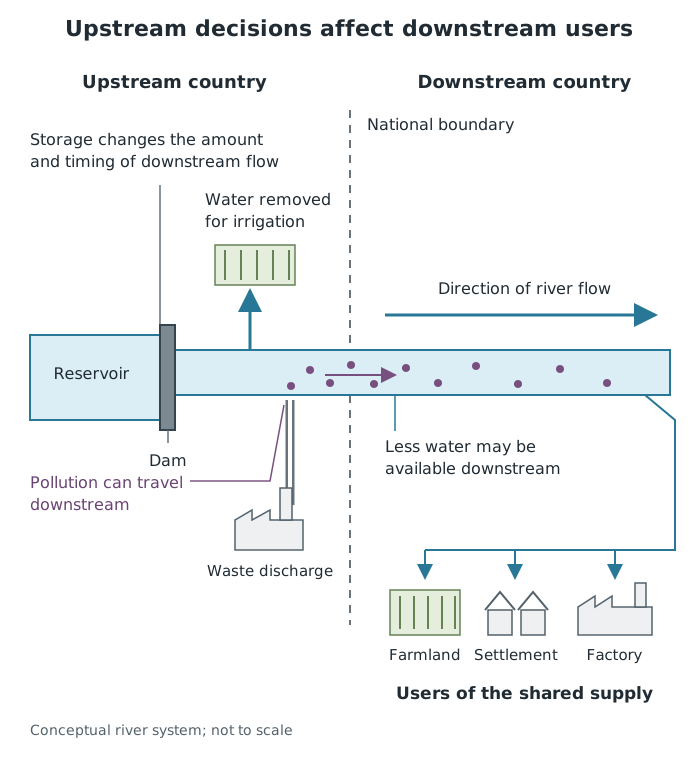
Upstream storage, abstraction and pollution can affect the quantity and quality of water reaching another country.
Follow the direction of flow in the diagram. The national boundary does not stop either the river or pollution carried by it. This explains why protecting a country’s water supply may require action outside that country.
Dams on the Tigris and Euphrates rivers in Turkey have affected water flowing into Syria and Iraq. During the filling of Turkey’s Ilisu Dam in 2019, water flow into Iraq decreased by 50%. This shows how reservoir filling in an upstream country can sharply reduce supply downstream.
From the upstream perspective, dams can store water, regulate flow and generate electricity. From the downstream perspective, reduced flow threatens supplies already needed by farms, businesses and households. The issue is not that dams have no benefits, but that their benefits and costs are distributed unevenly across national boundaries.
The Nile is shared by 11 countries, so negotiations involve more than one upstream and one downstream government. In 2011, Ethiopia began constructing the Grand Ethiopian Renaissance Dam, which Egypt contested because of concerns over its downstream water supply.
In March 2015, Egypt, Ethiopia and Sudan signed an agreement concerning the dam. This was a step towards cooperation, but it did not settle the water rights of all the other countries sharing the Nile. The example illustrates an important difficulty: an agreement between some countries may leave other users’ interests unresolved.
Growing populations, urbanisation and agricultural demand can increase pressure on shared supplies. Drought can reduce the water available, making competing demands harder to meet. Future arrangements therefore need to address shortages as well as normal conditions.
Cooperation can involve agreeing how water is shared, coordinating upstream developments and protecting water quality across the whole drainage basin—the area drained by a river and its tributaries. Considering the whole basin helps governments recognise that their decisions are connected.
The UNECE Water Convention, adopted in 1992 and entering into force in 1996, aims to protect the quantity and quality of transboundary waters and improve cooperation. Such agreements provide a framework for joint management, but an agreement alone does not create extra water or remove competing demands.
The strongest approach combines development with protection of downstream supplies. Preventing every upstream project would restrict useful development; allowing countries to act without considering their neighbours could deepen water insecurity. Cooperation is most effective when all affected countries are included and agreed rules can respond to changing demand and drought.
Countries control activities within their territory, but shared rivers and aquifers connect their water supplies.
Rising demand and drought intensify competition. Cooperation should address water sharing, pollution and upstream developments across the whole basin.
UNECE Water Convention: adopted 1992, in force 1996; aims to protect shared water quantity and quality and improve cooperation.
Judgement: dams can support development, but sustainable international management must also protect downstream users. Agreements need broad participation and arrangements that remain workable during shortages.
Develop a causal chain: upstream abstraction reduces downstream supply, which can reduce irrigation and crop yields, creating disputes over water.
Distinguish water quantity from water quality: a river may still flow across a border but carry water that is unsafe to use.
When assessing management, consider both upstream development needs and downstream dependence, then explain the conditions needed for cooperation to succeed.
Conflict can mean diplomatic disagreement or competition over resources; it does not automatically mean war.
It can see this note and what your specification asks for.
Answers are free with an account.
1 free note left this week
Get more free notesYour answer sets when this note comes back for review, or marks it complete.
Was this note helpful?
Log in to tell us whether it helped, or to report a problem.
Last updated
Transboundary water resource
A water resource, such as a river or groundwater store, that crosses a national boundary and is shared by countries.
Upstream
Towards a river’s source, opposite to the direction in which its water flows.
Downstream
Towards a river’s mouth, in the direction in which its water flows.
Abstraction
The removal of water from a river, lake or underground store for human use.
Water insecurity
A lack of reliable access to enough safe water to meet people’s needs.
Treaty
An agreement between countries establishing rules or commitments, such as how shared water resources should be managed.
Put your knowledge into practice — try past paper questions for Geography B
Transboundary water resource
A water resource, such as a river or groundwater store, that crosses a national boundary and is shared by countries.
Upstream
Towards a river’s source, opposite to the direction in which its water flows.
Downstream
Towards a river’s mouth, in the direction in which its water flows.
Abstraction
The removal of water from a river, lake or underground store for human use.
Water insecurity
A lack of reliable access to enough safe water to meet people’s needs.
Treaty
An agreement between countries establishing rules or commitments, such as how shared water resources should be managed.