

Loading…
Loading…
Loading…
Eduqas GCSE Geography B · C112
Eduqas C112 · 3.3.3 Challenges in Water Management Check the specification (PDF) (opens in a new tab)
A water deficit occurs when demand exceeds the available supply. At a local scale, this might affect a village, a farming area or a town. The problem is not always that there is too little rainfall: water may arrive in the wrong season, be polluted, or be inaccessible because wells, pipes and pumps are inadequate.
Management therefore has two connected aims: increase the usable supply and reduce the amount needed or wasted. A reliable supply must also be clean and accessible. Adding more water does little for households if they cannot obtain it safely or afford to use it.
Storage tackles an imbalance over time. A dam blocks a river so that water collects behind it in a reservoir. Water stored during wetter periods can be released during dry weather to supply homes or irrigate crops. However, reservoirs cost money, flood land and habitats, and can require people to move. They also lose water through evaporation, while holding back river water can reduce flows downstream.
Rainwater harvesting works on a smaller scale: rainfall is collected and stored for use on-site rather than being allowed to run off. It can supplement local supplies, but its usefulness depends on rainfall and storage capacity. A small store may run out during a long dry spell.
Water can also be stored underground in permeable rock. This reduces evaporation losses compared with exposed surface storage. Managing an aquifer means monitoring its water level and quality and balancing abstraction—the removal of water—with recharge, the replacement of water by natural infiltration or deliberately added water. Pumping faster than recharge is not a lasting solution.
Sometimes nearby water is available but needs to be moved. Local diversion uses canals or pipes to carry water to where it is needed. For example, water is diverted from the River Severn to help supply Bristol. This addresses a spatial imbalance between a source and users, but infrastructure is expensive and taking water must not create a shortage or damage habitats at the source.
In coastal areas, desalination offers another supply. It removes salt from seawater; the Alicante II seawater plant in Spain is an example. Seawater is plentiful, but producing freshwater requires considerable energy and investment. Discharging concentrated salty waste can damage marine ecosystems. Desalination can therefore improve supply, but it is not automatically the cheapest or most environmentally suitable local option.
Reducing demand can tackle a deficit without developing a new source. Repairing leaking pipes means that more of the water already collected reaches users. Water-efficient showerheads, low-flush toilets and washing machines reduce the amount needed for everyday activities. Education helps people understand why avoiding waste matters, while meters charge users according to how much water they use, giving an incentive to conserve it.
Agriculture can save water through drip irrigation, which supplies water close to plants rather than spreading it widely. This reduces losses through evaporation, so less water is needed to support crops.
Recycling also reduces demand for fresh supplies. Wastewater can be treated and reused. Suitable greywater can replace drinking-quality water for tasks such as flushing toilets or watering gardens. The important distinction is between water that must be safe to drink and water suitable for a particular non-drinking use: reused water should not simply be assumed safe for every purpose. Preventing pollution also protects the amount of usable water available.
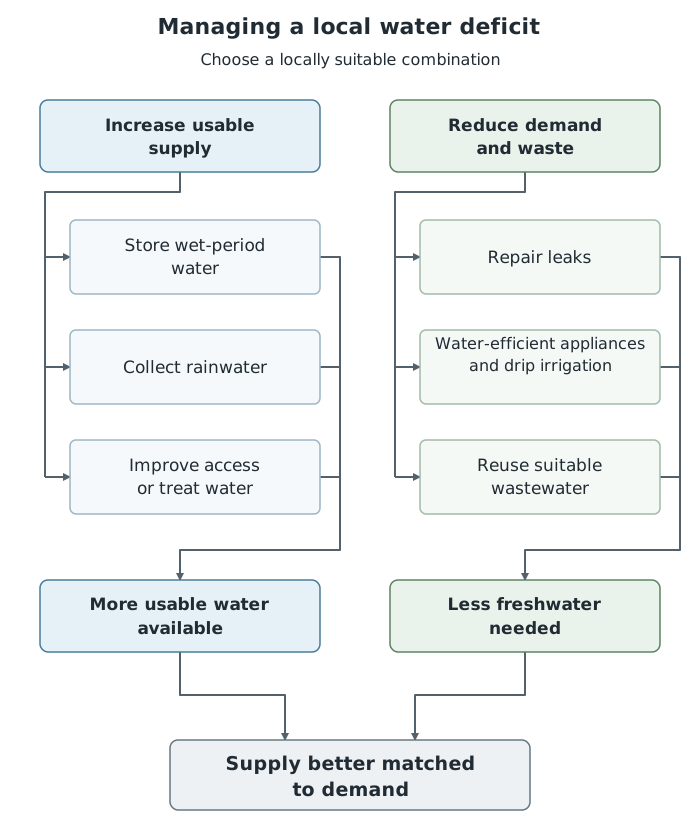
Local management can improve usable supply and reduce demand at the same time. The combination depends on the place.
The Shinja resettlement area experienced acute water shortages. Communities depended on shallow wells that dried up within a few months of the end of the rainy season. This made sanitation and hygiene difficult.
Elephant pumps were installed in several communities to improve access to water. They were inexpensive to make and repair and used local materials, making maintenance more manageable. Their enclosed design reduced contamination: improving water quality was as important as providing access to water.
Water- and sanitation-related diseases, including diarrhoea and bilharzia, decreased. Vegetable growing and livestock rearing increased, improving the quantity and quality of food. Water collection took less time, and school attendance increased because children were less involved in collecting water. The potential for conflict with neighbouring communities also fell.
This example shows why a locally suitable technology can be valuable. A scheme does not need to be enormous to improve water security: affordability, repairability and protection from contamination can determine whether it benefits a community.
There is no single method that suits every place. A coastal town may consider desalination; a farming area may gain more from efficient irrigation; a rural community may need affordable pumps and better access. Storage helps with seasonal shortages, but cannot guarantee supply through an indefinitely long drought.
The strongest approach often combines methods. Conservation reduces the deficit that new infrastructure must fill, while storage, treatment or improved access makes supply more reliable. A sustainable choice meets present needs without exhausting water stores, damaging the environment or undermining future supplies.
Shallow wells dried up after the rainy season. Enclosed elephant pumps used local materials and were inexpensive to make and repair.
Results: less contamination and disease, more vegetable growing and livestock rearing, shorter collection times and better school attendance.
Choose a combination suited to local rainfall, available sources, demand and resources. Judge success by clean, reliable access, affordability, maintainability and environmental sustainability.
Explain the link between a strategy and the imbalance: repairing leaks means more of the existing supply reaches users, whereas a reservoir stores surplus water for a drier period.
Use specific local evidence, such as the elephant pumps in Shinja, rather than only listing management methods.
When judging a strategy, consider reliability, cost, maintenance, environmental effects and who benefits. A method that works in one place may not suit another.
It can see this note and what your specification asks for.
Answers are free with an account.
1 free note left this week
Get more free notesYour answer sets when this note comes back for review, or marks it complete.
Was this note helpful?
Log in to tell us whether it helped, or to report a problem.
Last updated
Water deficit
A situation in which demand for water is greater than the available supply.
Water surplus
A situation in which the available water supply is greater than demand.
Water security
Having access to a clean, reliable water supply.
Rainwater harvesting
The collection and storage of rainfall for use where it falls.
Water conservation
Reducing water use and waste so that existing supplies last longer.
Desalination
Removing salt from seawater to produce freshwater.
Aquifer
A body of rock that stores groundwater.
Greywater
Domestic wastewater suitable for reuse where drinking-water quality is not required, such as flushing toilets.
Put your knowledge into practice — try past paper questions for Geography B
Water deficit
A situation in which demand for water is greater than the available supply.
Water surplus
A situation in which the available water supply is greater than demand.
Water security
Having access to a clean, reliable water supply.
Rainwater harvesting
The collection and storage of rainfall for use where it falls.
Water conservation
Reducing water use and waste so that existing supplies last longer.
Desalination
Removing salt from seawater to produce freshwater.
Aquifer
A body of rock that stores groundwater.
Greywater
Domestic wastewater suitable for reuse where drinking-water quality is not required, such as flushing toilets.