

Loading…
Loading…
Loading…
Eduqas GCSE Geography B · C112
Eduqas C112 · 2.1.1 Development of Coastal Landscapes Check the specification (PDF) (opens in a new tab)
The coast is where land and sea meet. Its cliffs, beaches and other landforms are shaped by geomorphological processes: natural actions that change the Earth's surface. On UK coasts, processes acting on land work alongside those acting in the sea.
Weathering weakens rock in place. Mass movement carries loosened material downhill. Marine erosion removes material, transportation moves it elsewhere, and deposition lays it down. These are connected: a cliff can supply the sediment that later becomes part of a beach or spit.
Weathering breaks down rock where it is. It does not itself transport the material away.
Mechanical weathering physically breaks rock without changing its chemical composition. In freeze–thaw weathering, water enters cracks. When it freezes, it expands and puts pressure on the sides. Repeated freezing and thawing widens the cracks until pieces break off.
Chemical weathering changes or dissolves minerals. Rainwater absorbs carbon dioxide and becomes weakly acidic. It reacts with susceptible rocks such as limestone, gradually weakening them.
Biological weathering involves living organisms. Plant roots grow into cracks and push them wider as the roots thicken. Burrowing animals can also loosen material.
These land-based processes help weaken the upper parts of cliffs, while waves attack their bases.
Mass movement is the downhill movement of rock or soil under gravity. Water can make a slope less stable by adding weight and reducing friction within the material. Waves can also remove support by undercutting the cliff base.
In a rockfall, loosened pieces fall from a steep cliff and collect at its foot. In a landslide, a mass of material slides down a slope along a slip surface. In rotational slumping, material moves down a curved slip surface, rotating as it moves. This is common where weaker material such as clay becomes saturated.
Mass movement changes the cliff's shape and supplies debris to the shore. Waves may then break up and remove that debris, allowing further erosion of the cliff base.
Wind blowing over the sea transfers energy to the water and creates waves. When waves break, swash moves water up the beach; backwash returns it down the beach under gravity.
Constructive waves have relatively strong swash and weaker backwash, so they tend to deposit sediment and build beaches. Destructive waves have stronger backwash relative to swash, so they tend to remove beach material. The balance between sediment arriving and leaving determines whether a beach grows or shrinks.
Marine erosion involves four important processes:
Hydraulic action and abrasion attack the foot of a cliff, cutting a wave-cut notch. As the notch deepens, the rock above becomes unsupported. Weathering weakens it further, and it eventually collapses under gravity.
Waves remove the fallen material and begin attacking the newly exposed cliff face. Repeated undercutting, collapse and removal cause the cliff to retreat inland. A gently sloping rocky surface remains in front of it: the wave-cut platform, which may be exposed at low tide.
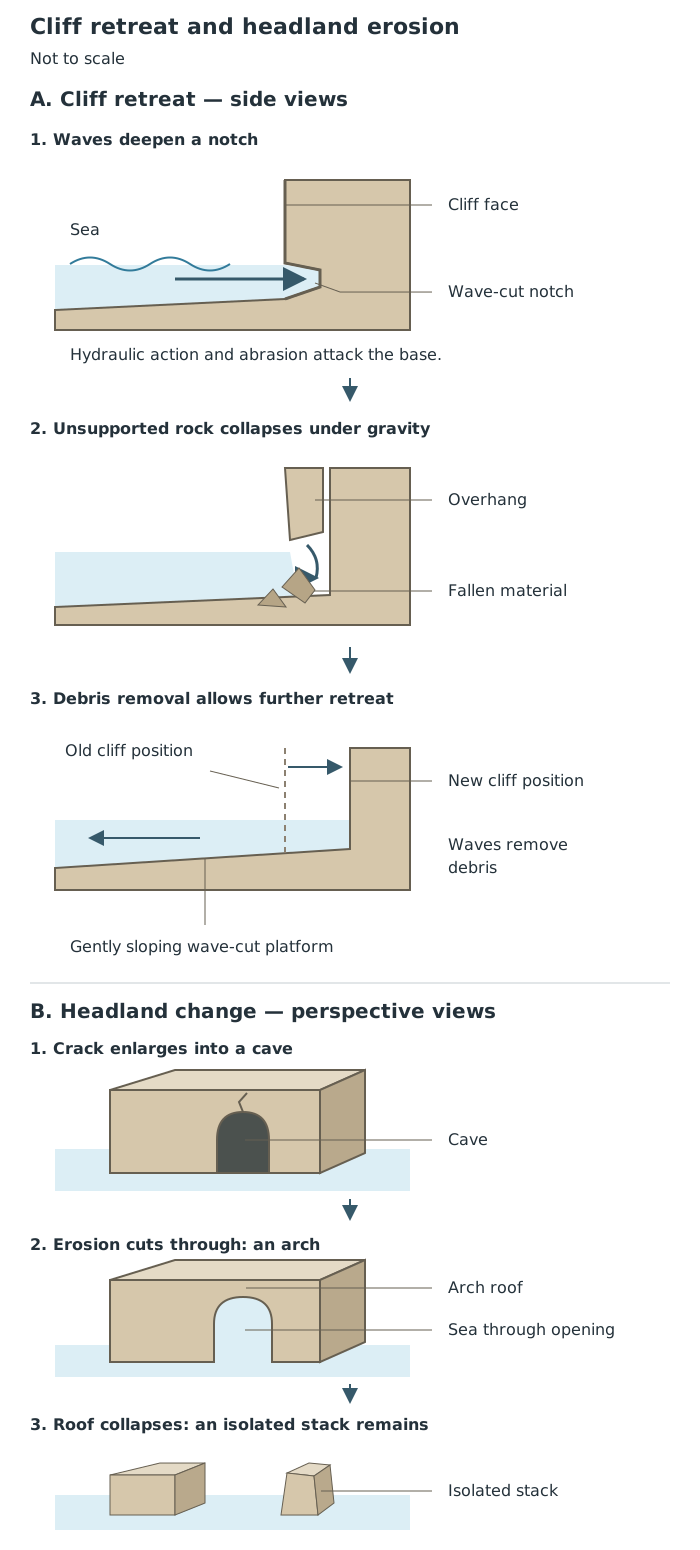
Wave erosion and gravity work together to retreat cliffs and change headlands into arches and stacks.
Where bands of rock with different resistance meet the sea, less resistant rock is eroded faster. It retreats to form a bay, while more resistant rock remains projecting into the sea as a headland. This produces an irregular coastline.
Waves bend as they enter shallow water, a process called refraction. This concentrates wave energy on headlands, encouraging erosion, while bays are more sheltered and can accumulate beach sediment.
On a headland, hydraulic action and abrasion enlarge cracks into caves. Continued erosion may cut through the headland to form an arch. Further erosion and weathering weaken the arch until its roof collapses. An isolated pillar of rock remains offshore: a stack.
These landforms are stages in continuing change, not permanent end points.
Coastal sediment comes from sources including eroded cliffs, rivers and offshore deposits. How it moves depends on particle size and the energy of the water:
Sediment can also move along the shore through longshore drift. When waves approach at an angle, their swash carries sediment diagonally up the beach. Gravity pulls the backwash straight down the slope, approximately at right angles to the shoreline. Repeated swash and backwash move sediment along the coast in a zig-zag path.
For example, imagine following one pebble: each swash moves it upwards and sideways; each backwash brings it down the beach. After several waves, it has moved along the shore even though each individual movement was short.
Deposition happens when water loses enough energy that it can no longer carry sediment. Larger particles generally require more energy to transport than finer particles.
A beach is an accumulation of sand or shingle along the shore. Constructive waves bring sediment onto it, and sheltered bays provide places where deposition can exceed removal.
A spit forms where longshore drift carries sediment towards a change in the direction of the coastline, such as a river mouth. Sediment continues beyond the bend and is deposited in the water. Continued deposition builds a narrow ridge attached to the coast at one end.
Changes in wave or wind direction can curve the end of the spit. Sheltered water behind it allows fine sediment to settle, potentially forming mudflats and salt marsh. At a river mouth, flowing water can keep a channel open and prevent the spit from completely closing the entrance.
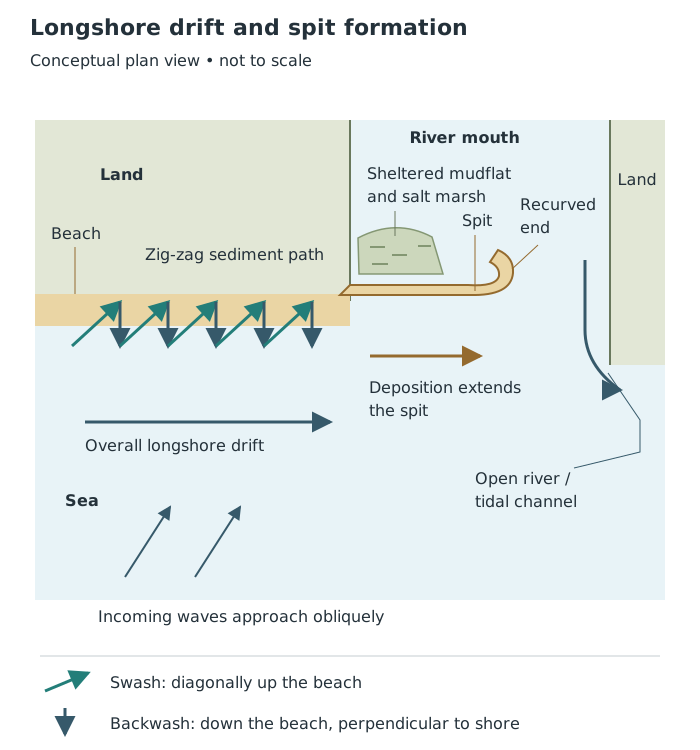
Longshore drift supplies sediment; deposition beyond a bend builds a spit and creates sheltered water behind it.
An estuary is the tidal mouth of a river, where freshwater mixes with seawater. It is shaped by the interaction of river flow, tidal currents, erosion, transportation and deposition.
Rivers deliver sediment to the coast, while tides move water and sediment into and out of the estuary. Moving water maintains channels, but in sheltered areas where flow slows, fine sediment settles. Repeated deposition builds mudflats; salt-tolerant plants can colonise suitable areas to form salt marsh.
An estuary therefore contains both moving-water channels and depositional surfaces. Its landscape shows why coastal landforms are best understood through interacting processes rather than one process acting alone.
Keep abrasion and attrition separate: abrasion wears away the cliff; attrition wears down the sediment carried by the sea.
For a landform explanation, link each stage to a process rather than simply listing the stages.
In a longshore drift diagram, show angled swash, backwash straight down the beach and the overall direction of sediment movement.
Longshore drift transports sediment; deposition builds beaches and spits when the water can no longer carry it.
Distinguish weathering, which breaks down rock in place, from mass movement, which moves material downslope under gravity.
It can see this note and what your specification asks for.
Answers are free with an account.
1 free note left this week
Get more free notesYour answer sets when this note comes back for review, or marks it complete.
Was this note helpful?
Log in to tell us whether it helped, or to report a problem.
Last updated
Geomorphological process
A natural process that changes the shape of the Earth's surface.
Weathering
The breakdown of rock in place, without transporting the broken material elsewhere.
Mass movement
The downhill movement of rock or soil under the influence of gravity.
Erosion
The wearing away and removal of material by moving water, wind or ice.
Swash
The movement of water up a beach after a wave breaks.
Backwash
The movement of water back down a beach under gravity.
Hydraulic action
Erosion caused by the force of waves, including the repeated compression and release of air trapped in rock cracks.
Abrasion
The wearing away of a rock surface by sediment carried by waves.
Attrition
The breaking and rounding of sediment as pieces collide with one another.
Solution
The dissolving of soluble minerals in water; the dissolved material can then be transported by the water.
Traction
The rolling or dragging of large sediment particles along the seabed.
Saltation
The bouncing of small sediment particles along the seabed.
Suspension
The transport of fine sediment carried within the water.
Longshore drift
The movement of sediment along a coast through repeated angled swash and backwash straight down the beach.
Deposition
The laying down of transported material when water no longer has enough energy to carry it.
Wave-cut platform
A gently sloping rocky surface left at the foot of a retreating cliff.
Spit
A narrow ridge of sand or shingle extending out from the coast, attached to land at one end.
Estuary
The tidal mouth of a river, where freshwater mixes with seawater.
Put your knowledge into practice — try past paper questions for Geography B
Geomorphological process
A natural process that changes the shape of the Earth's surface.
Weathering
The breakdown of rock in place, without transporting the broken material elsewhere.
Mass movement
The downhill movement of rock or soil under the influence of gravity.
Erosion
The wearing away and removal of material by moving water, wind or ice.
Swash
The movement of water up a beach after a wave breaks.
Backwash
The movement of water back down a beach under gravity.
Hydraulic action
Erosion caused by the force of waves, including the repeated compression and release of air trapped in rock cracks.
Abrasion
The wearing away of a rock surface by sediment carried by waves.
Attrition
The breaking and rounding of sediment as pieces collide with one another.
Solution
The dissolving of soluble minerals in water; the dissolved material can then be transported by the water.
Traction
The rolling or dragging of large sediment particles along the seabed.
Saltation
The bouncing of small sediment particles along the seabed.
Suspension
The transport of fine sediment carried within the water.
Longshore drift
The movement of sediment along a coast through repeated angled swash and backwash straight down the beach.
Deposition
The laying down of transported material when water no longer has enough energy to carry it.
Wave-cut platform
A gently sloping rocky surface left at the foot of a retreating cliff.
Spit
A narrow ridge of sand or shingle extending out from the coast, attached to land at one end.
Estuary
The tidal mouth of a river, where freshwater mixes with seawater.