

Loading…
Loading…
Loading…
Eduqas GCSE Geography B · C112
Eduqas C112 · 2.1.1 Development of Coastal Landscapes Check the specification (PDF) (opens in a new tab)
The same coastal processes operate around the UK, but they do not produce identical landscapes everywhere. Climate influences the weather conditions that drive erosion and weathering. Geology determines how readily the coast is worn away. Human activity can change the supply of sediment, the stability of cliffs and the protection available against waves.
These influences work together. For example, heavy rainfall may make an unstable cliff more likely to slump, while powerful waves remove material from its base. A more resistant rocky coast may respond much more slowly to the same weather.
The UK has a temperate maritime climate: the surrounding seas help keep temperatures relatively mild, and rainfall occurs throughout the year. The sea warms and cools more slowly than land, moderating coastal temperatures. However, mild average conditions do not mean that coastal weather is always calm.
Winter winds are generally stronger than summer winds. Strong winds transfer more energy to the sea, producing more powerful waves. These can erode cliffs and remove beach sediment more rapidly. During calmer conditions, waves may deposit sediment, helping beaches recover. Coastal change therefore varies through the year rather than occurring at one steady rate.
Weather also affects the land above the waves. When water in cracks freezes, it expands; repeated freezing and thawing can loosen rock and contribute to rockfalls. This requires temperatures to move above and below freezing, so it does not happen throughout every winter or equally around the UK.
The UK's prevailing winds come from the south-west and often bring wet weather. Heavy rainfall can saturate cliff material, making it heavier and less stable. This increases the likelihood of mass movement, particularly on less resistant coasts.
A storm can concentrate a large amount of change into a short period. Strong winds generate energetic waves that attack cliffs and move substantial quantities of beach sediment. If heavy rain occurs at the same time, the cliff may become unstable from above while waves erode its base.
The combined effect can trigger collapse or slumping and cause rapid cliff retreat. A beach may also become narrower as sediment is removed, leaving the land behind it more exposed to later waves. Some sediment may return during calmer weather, but a collapsed cliff cannot simply rebuild itself.
This explains why a coast that appears stable during several calm months can change dramatically during one extreme event.
Resistance to erosion is a key geological influence. Less resistant materials, such as sand and clay, are generally removed more readily than resistant rock. They can produce rapidly retreating coasts with smoother cliff faces and evidence of slumping. These cliffs are often lower and less steep, although local conditions vary.
More resistant rock generally erodes more slowly. It often forms steep, rugged cliffs with exposed rock and boulders at their base. Weathering and rockfalls still occur: resistant does not mean indestructible.
Geology also affects the coast when viewed from above. Where stretches of more and less resistant material occur along a coastline, the less resistant stretches retreat faster, forming bays. More resistant stretches remain projecting into the sea as headlands. Thus geology helps explain both the vertical profile of a cliff and the horizontal outline of a coast.
People do not only occupy coastal landscapes: they alter the processes shaping them. Sea walls can protect land behind them from wave attack. Groynes trap sediment moving along a beach, helping retain a wider beach that absorbs wave energy.
However, sediment trapped in one place is no longer available to beaches farther along the coast. These downdrift beaches may become narrower and less protective, increasing erosion there. Local protection is therefore not necessarily protection for the whole coastline.
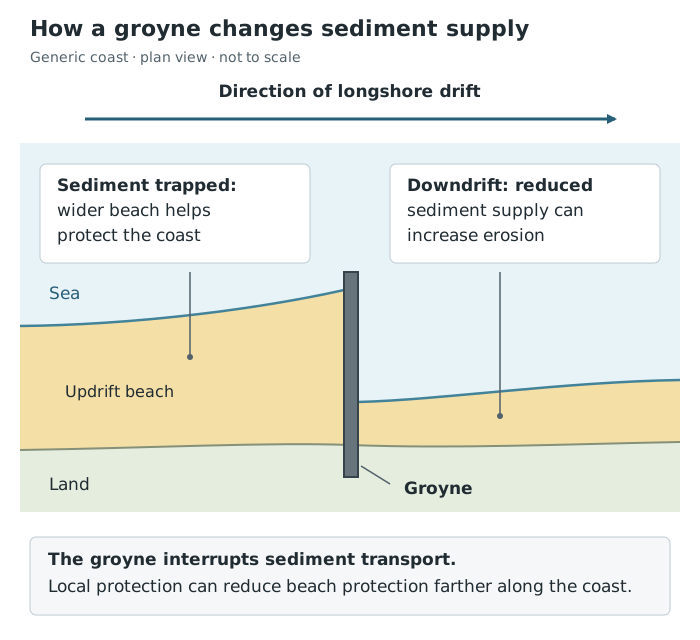
Trapping sediment can protect one stretch of coast while reducing beach protection farther along it.
Other activities can reduce sediment supplies. Dams trap material in rivers before it reaches the coast. Removing sand and gravel for construction also takes material out of the coastal system. Where losses exceed replacement, beaches can shrink. Dredging shipping channels removes seabed sediment and can alter currents and sediment movement.
Development can also affect cliff stability. Buildings add weight to unstable cliffs, while roads and pavements increase surface runoff. Damage to dunes through development, grazing or trampling weakens a natural coastal barrier. Conversely, retaining or restoring vegetation can help stabilise sediment. Human activity can therefore either slow or accelerate coastal change, depending on what is done and where.
For centuries, people have altered coastal lowlands for agriculture. Drainage in the Somerset Levels converted wet, boggy land into land suitable for growing crops and grazing livestock. This increased its economic usefulness but reduced wetland habitats. Restoration at places such as Shapwick Heath shows that priorities can change over time.
Ports and industry have also reshaped coasts. Southampton and the Thames estuary illustrate the importance of coastal locations for shipping, trade and industrial activity. Harbours, quays, buildings and dredged channels turn parts of natural coastlines into working landscapes, supporting transport and employment while altering habitats and sediment movement.
Tourism and settlement have expanded the built-up coast. Along Dorset's Jurassic Coast, hotels, campsites and visitor attractions provide income and jobs. Housing and infrastructure have also grown in coastal towns, replacing some natural landscapes and increasing the value of assets exposed to erosion or flooding.
These changes brought economic benefits, but often created environmental costs and a continuing need for protection. Understanding a modern UK coast therefore means considering both its physical processes and the history of human use.
Explain a chain of causes: stronger winter winds → more energetic waves → increased erosion, rather than simply stating that winter causes erosion.
Describe rocks as more or less resistant to erosion. Cliff profiles are general tendencies, not rules that apply to every coastline.
Distinguish protection at one location from effects elsewhere: a groyne can retain beach sediment locally while reducing the supply farther along the coast.
For past human activity, connect the landscape change to its economic purpose and use a relevant UK example.
It can see this note and what your specification asks for.
Answers are free with an account.
1 free note left this week
Get more free notesYour answer sets when this note comes back for review, or marks it complete.
Was this note helpful?
Log in to tell us whether it helped, or to report a problem.
Last updated
Climate
The long-term pattern of weather conditions in a place, including temperature, rainfall and wind.
Temperate maritime climate
A climate influenced by the sea, with generally mild temperatures, rainfall throughout the year and seasonal changes.
Geology
The rocks and sediments of an area, including their types and structure.
Weathering
The breakdown of rock in place by physical, chemical or biological processes.
Mass movement
The movement of rock or soil downslope under gravity, including rockfalls, landslides and slumping.
Longshore drift
The movement of beach sediment along the coast by waves approaching the shore at an angle.
Downdrift
Farther along the coast in the direction of sediment movement by longshore drift.
Sediment
Loose material, such as sand, gravel and mud, that can be transported and deposited.
Put your knowledge into practice — try past paper questions for Geography B
Climate
The long-term pattern of weather conditions in a place, including temperature, rainfall and wind.
Temperate maritime climate
A climate influenced by the sea, with generally mild temperatures, rainfall throughout the year and seasonal changes.
Geology
The rocks and sediments of an area, including their types and structure.
Weathering
The breakdown of rock in place by physical, chemical or biological processes.
Mass movement
The movement of rock or soil downslope under gravity, including rockfalls, landslides and slumping.
Longshore drift
The movement of beach sediment along the coast by waves approaching the shore at an angle.
Downdrift
Farther along the coast in the direction of sediment movement by longshore drift.
Sediment
Loose material, such as sand, gravel and mud, that can be transported and deposited.