

Loading…
Loading…
Loading…
Eduqas GCSE Geography B · C112
Eduqas C112 · 1.2 Fieldwork Evidence Collection Check the specification (PDF) (opens in a new tab)
Design effective data collection sheets for fieldwork execution.
Select appropriate locations for data gathering and establish robust control groups.
Justify sample sizes and the use of random, systematic, opportunistic, and stratified sampling techniques.
Operate fieldwork equipment, such as clinometers or quadrats, to obtain accurate and reliable measurements.
Collect quantitative data measuring flow, scale, spatial patterns, and temporal changes.
Gather qualitative data using questionnaires, bi-polar techniques, and annotated photographs or sketches.
Utilize secondary sources of evidence, including satellite images, aerial and oblique photographs, large statistical databases, and Geographic Information Systems (GIS).
Fieldwork planning connects a geographical question to evidence that can answer it. Before choosing a site or preparing a recording sheet, decide what you need to compare or measure. For example, pedestrian counts could help investigate whether a regenerated shopping area attracts more people. Counting people somewhere convenient, without considering whether it represents that area, would be much less useful.
A workable plan specifies what will be recorded, where, when and how much. These choices affect whether the evidence supports a convincing conclusion.
Select specific sites that provide relevant information and capture the contrasts your enquiry needs. An investigation of spatial change needs locations across the area, rather than several observations in one small corner. An investigation comparing different environments needs sites from each environment.
Sites must also be safe and accessible. Check permission, access routes and conditions before collecting data. A beach may be inaccessible at high tide; a river may be too deep to approach safely; a tourist survey outside the tourist season may find very few respondents. These are not just practical inconveniences: they can prevent the planned evidence from being collected.
Precautions should match the hazard. For pedestrian counts, choose a position away from traffic that does not obstruct the pavement. For physical fieldwork, follow the agreed safe boundaries and do not enter unsafe water or approach unstable ground to reach a planned sample point. If access changes, record any change to the plan rather than silently replacing a site with a more convenient one.
Timing matters because geographical conditions change. A city-centre count at lunchtime may differ from one early in the morning. Choose times that suit the question, and use comparable times when comparing places. If the enquiry concerns change through the day, sample at several times rather than treating one count as typical of the whole day.
A data collection sheet should make recording quick and consistent while preserving the information needed for later comparisons. Use a clear title, labelled columns, units in headings and enough space for every planned observation. Include site identifiers, dates and times so results can be matched to their locations and conditions.
Suppose you are comparing pedestrian flows at several shopping streets. A recording sheet could use this structure:
| Site identifier | Date | Start time | Count duration (minutes) | Pedestrian tally | Total pedestrian passages | Conditions or problems |
|---|---|---|---|---|---|---|
| A | 5 | |||||
| B | 5 |
Define the counting rule before starting: for example, count each passage across an agreed line in either direction. This measures passages, not necessarily different individuals, because someone may return. All groups should use the same rule and duration so their totals can be compared.
For a measurement sheet, give each variable its own column and state its unit, such as width in metres. Provide separate spaces for repeated measurements rather than replacing the first reading with a later one. For categories or scores, define the categories or scale so different observers interpret them consistently.
Try the sheet before fieldwork. A short trial can reveal missing columns, unclear instructions or insufficient space. Recording is complete when every planned observation has an identifiable entry, with any missing result or departure from the method explained. A blank should not be mistaken for a measured zero.
A control group provides a baseline against which another group or set of sites can be compared. In geographical fieldwork, this may be a comparison area rather than a laboratory group.
Suppose you want to investigate the effect of regeneration on pedestrian flow. You could compare regenerated streets with similar streets that have not been regenerated. The non-regenerated streets act as the control. Choose streets with comparable functions and collect counts using the same rules, durations and times.
The factor being compared is regeneration status. Other conditions, such as count duration, are control variables kept consistent. The control group does not make the streets identical: differences in transport access or shop types could still influence pedestrian flow. A good plan therefore identifies remaining differences and avoids assuming that regeneration alone caused any contrast.
The population is everything your investigation aims to draw conclusions about: perhaps all pedestrians using an area, all pebbles on a beach or all possible measurement locations in a field. Usually there is not enough time to investigate the whole population, so you select a sample.
A representative sample reflects important variations within that population. Its quality depends on both the number of observations and how they are selected. A large sample from one convenient location can still overlook most of the area.
Random sampling gives each member of the population an equal chance of selection. Number the eligible people, objects or locations and use random numbers to select them. For an area, randomly generated coordinate pairs can identify sampling positions within its boundaries.
This reduces selection bias because the investigator does not choose locations that look especially interesting or easy to measure. However, chance can produce clusters or leave some parts poorly covered, particularly with a small sample. Reaching scattered points may also take time. Random sampling is useful when you want to avoid choosing observations according to personal preference, but it does not guarantee a representative result on every occasion.
Systematic sampling uses a fixed interval. Examples include taking a river-depth reading every 50 centimetres across a channel or selecting every tenth person passing a survey point. Regular spacing is straightforward to organise and helps reveal change along a route or across an area.
However, the interval can miss important features. Consider 100 possible positions numbered across a grid. Selecting positions 10, 20, 30 and so on samples every tenth position, but it also selects only the last column of this particular grid.
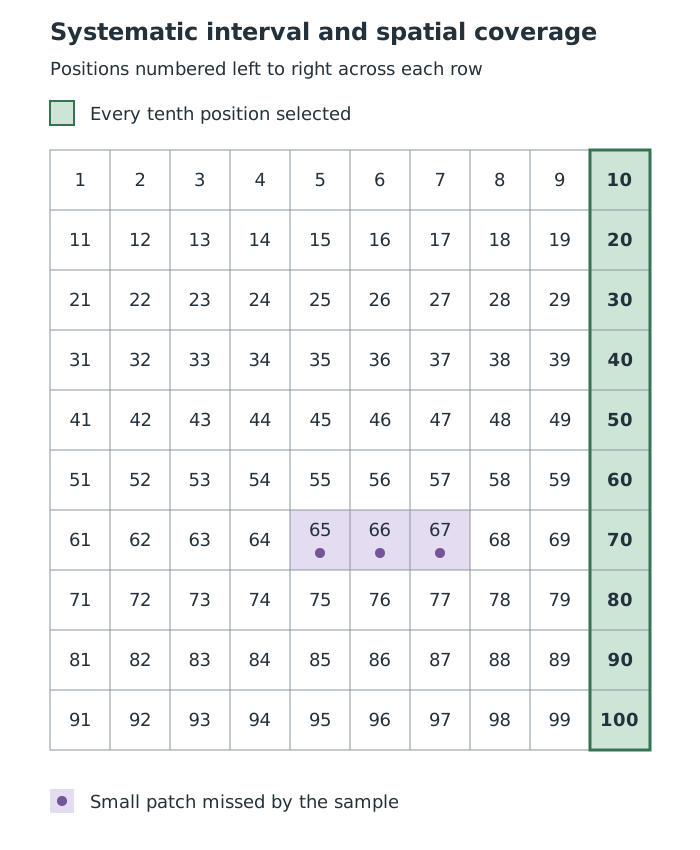
Every tenth numbered position selects only the right-hand column here, missing the patch at positions 65–67. Check geographical coverage as well as the numerical interval.
A small patch at positions 65–67 would be missed completely. When judging systematic sampling, examine both the interval and the spatial arrangement of the selected points. A regular numerical sequence does not necessarily provide good geographical coverage.
Systematic sampling can also operate through time. Measuring wind speed every 10 minutes in a sand-dune ecosystem is systematic. So is counting city-centre pedestrians for five minutes every hour. Choose an interval short enough to capture the variation relevant to the enquiry, but manageable within the available time.
Opportunistic sampling uses people or observations that are readily available. For example, an interviewer might approach available pedestrians who are willing to answer questions, rather than selecting them using random numbers or a fixed interval.
It is quick and practical when time or access is limited. If a planned sampling site cannot be accessed safely, an accessible site nearby may allow data collection to continue. Record the replacement and the reason for it, because changing the site can change what the sample represents.
However, opportunistic sampling can over-represent convenient places or people who are easy to approach, while omitting those who are busy, absent or unwilling to participate. Its results should not automatically be treated as representative of all users of the area. Justify it by explaining the practical constraint, while recognising how more planned coverage of sites, groups or times could improve the sample.
Stratified sampling divides the population into relevant groups and samples each one. These groups might be age categories in a questionnaire or different land-use areas in a town.
This ensures that important groups are included. If the aim is to represent the population as a whole, sampling in proportion to each group's share can be appropriate. If the aim is to compare groups, equal numbers from each group can make the comparison more balanced, but those numbers may not reflect their proportions in the whole population.
Selection within each group can be random or systematic. The main limitations are that you need information about the groups beforehand and must avoid leaving out relevant groups through poorly chosen categories.
There is no single sample size suitable for every investigation. More observations generally provide a better opportunity to capture variation and reduce the influence of an unusual individual result. However, collecting more data takes time, and rushed recording can introduce errors.
Base your choice on the variation expected, the area or groups to be covered, the time available and the effort needed for each observation. A varied town may need more sampling locations than a small, relatively uniform area. Repeated observations at one site help assess consistency, but do not replace observations from other relevant sites or times.
A strong justification explains the trade-off. For example, systematic counts across several streets provide spatial coverage and can be completed within the fieldwork period, but repeating them at other times would be needed before making a claim about typical daily pedestrian flow. The best plan is not simply the easiest or the largest: it is one that collects relevant, reasonably representative evidence safely and consistently.
| Technique | Main advantage | Main limitation |
|---|---|---|
| Random | Reduces investigator selection bias | Small samples can cluster or miss areas |
| Systematic | Organised coverage at regular intervals | Interval or layout can miss features |
| Opportunistic | Quick and practical when time or access is limited | Convenient sites or willing respondents may be unrepresentative |
| Stratified | Includes relevant groups | Requires suitable group information and categories |
To justify a sampling choice, link the method to your enquiry: explain what variation it captures, why it is practical and what limitation remains.
Give the sample size and explain its coverage. ‘It was a large sample’ does not show whether different locations, groups or times were represented.
Distinguish the sampling interval from the measurement duration: a five-minute pedestrian count every hour has a five-minute duration and an hourly interval.
A control group is a comparison group; a control variable is a condition kept consistent to make that comparison fair.
It can see this note and what your specification asks for.
Answers are free with an account.
1 free note left this week
Get more free notesYour answer sets when this note comes back for review, or marks it complete.
Was this note helpful?
Log in to tell us whether it helped, or to report a problem.
Last updated
Population
The complete set of people, places, objects or observations that an investigation aims to draw conclusions about.
Sample
A subset of a population selected for investigation.
Representative sample
A sample that reflects the important variations within the population being investigated.
Sample size
The number of people, objects, locations or observations included in a sample.
Bias
A systematic tendency in selection, measurement or interpretation that can distort results.
Random sampling
Selecting members of a population by chance, with each member having an equal chance of selection.
Systematic sampling
Selecting observations at a regular interval, such as every tenth person or every 20 metres.
Opportunistic sampling
Selecting available people or accessible observations when the opportunity arises.
Stratified sampling
Dividing a population into relevant groups and taking a sample from each group.
Control group
A group or set of sites used as a baseline for comparison with the group or sites experiencing the factor being investigated.
Control variable
A condition kept consistent between observations so that differences in results are less likely to arise from that condition.
Put your knowledge into practice — try past paper questions for Geography B
Population
The complete set of people, places, objects or observations that an investigation aims to draw conclusions about.
Sample
A subset of a population selected for investigation.
Representative sample
A sample that reflects the important variations within the population being investigated.
Sample size
The number of people, objects, locations or observations included in a sample.
Bias
A systematic tendency in selection, measurement or interpretation that can distort results.
Random sampling
Selecting members of a population by chance, with each member having an equal chance of selection.
Systematic sampling
Selecting observations at a regular interval, such as every tenth person or every 20 metres.
Opportunistic sampling
Selecting available people or accessible observations when the opportunity arises.
Stratified sampling
Dividing a population into relevant groups and taking a sample from each group.
Control group
A group or set of sites used as a baseline for comparison with the group or sites experiencing the factor being investigated.
Control variable
A condition kept consistent between observations so that differences in results are less likely to arise from that condition.
Systematic sampling can be spatial or temporal. Stratified sampling can use random or systematic selection within groups. Record any substitutions for inaccessible sites.