

Loading…
Loading…
Loading…
Eduqas GCSE Geography A · C111
Eduqas C111 · 6.3.2 Sustainable Water Management Check the specification (PDF) (opens in a new tab)
Small-scale water management supplies individual households or local communities rather than serving a whole region. It can be valuable where a piped supply is absent, unreliable or too expensive. However, a small scheme is not automatically sustainable: it must provide useful water, remain affordable to maintain and avoid unacceptable environmental damage.
Appropriate technology is technology matched to local needs, conditions, skills and resources. A system that people can afford, operate and repair may be more useful than a technically advanced system that depends on unavailable equipment or expertise. The appropriate choice also depends on rainfall, water demand and the space available for storage.
Rainwater harvesting means collecting rainfall and storing it for later use. A typical household system uses an existing roof as its collection surface. Rain runs down the roof into gutters, which carry it to a storage container. Storing water separates the time when rain falls from the time when people need to use it.
The first runoff after a dry period may wash accumulated dirt and debris from the roof. A first-flush system diverts this initial dirty water away from storage. Filtration can remove further debris before water enters the tank. These measures improve water quality, but collecting rainwater does not by itself guarantee that it is safe to drink. Water quality must be suitable for its intended use.
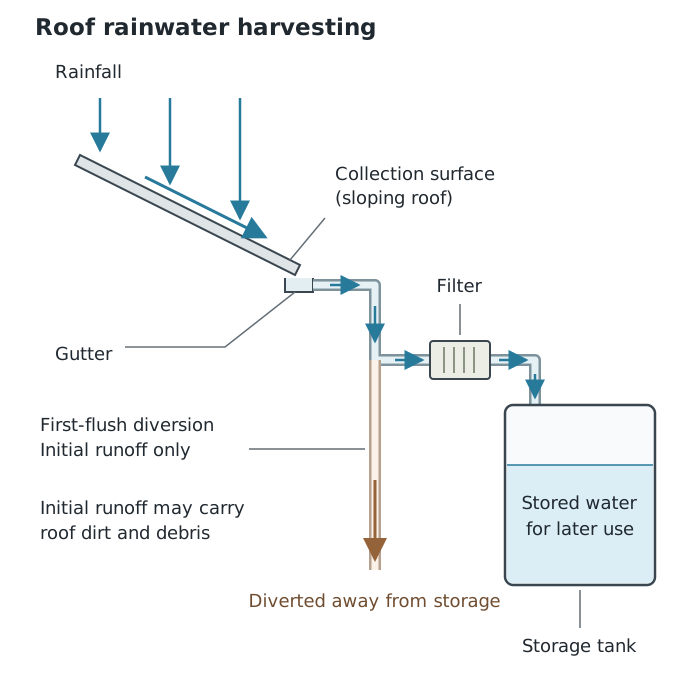
A domestic system collects rainfall, diverts initial dirty runoff and stores water for later use.
Rainwater harvesting can use very different levels of technology. In Sri Lanka, traditional systems include a sheet or cloth tied to four poles, with a hole directing water into a pot. In Uganda and Sri Lanka, banana leaves or stems have also been used as temporary gutters to collect water from trees; a large tree can yield up to 200 litres in a single storm. These examples show how locally available materials can be adapted to collect water without a complex piped network.
Rainwater harvesting is not restricted to poorer countries. Marks and Spencer stores in the UK use harvested roof water to supply toilets. This matches the water supply to a use that does not require drinking-water quality.
Collecting water at home can improve access where other sources dry up seasonally or the town supply is unreliable. Having a nearby supply can reduce journeys to collect water, leaving more time for work, education and household activities. These benefits depend on enough water being available and its quality being suitable.
Using an existing roof avoids building a separate collection surface. Gutters can be made locally from materials such as bamboo or folded metal, helping match the scheme to local resources and skills. Where harvested rainwater replaces purchased water, it can reduce water bills.
Nevertheless, the storage tank is usually the largest initial investment. A household may be able to afford gutters but not enough storage to last through a long dry season. Costs therefore affect who can benefit: a technically simple scheme may still be unaffordable for the poorest households. Cleaning collection surfaces, keeping gutters clear and checking for leaks also require continuing attention.
Knowledge matters as well as equipment. In some communities, unfamiliarity initially made rainwater harvesting unpopular. Understanding how the system works and recognising its benefits helped it gain acceptance.
Where harvested rainfall replaces water drawn from rivers or groundwater, it can reduce pressure on those supplies. Roof collection also captures some water that would otherwise run off immediately. However, a household tank has limited capacity; once it is full, further rainfall cannot be stored. A small domestic system should not be treated as a solution to large-scale flooding.
Reliability is the central limitation. Rainfall may be plentiful during a wet season but scarce when water is most needed. Storage can bridge a dry period only if enough rain has first been collected. A larger tank cannot compensate for an inadequate overall supply.
Assess rainwater harvesting by asking whether collection and storage can meet demand throughout the year, whether users can afford and maintain the system, and whether it reduces pressure on other water sources.
At a medical dispensary in Ruganzu, Biharamulo District, Tanzania, storage planning used rainfall records kept by a local hospital nurse over 12 years. This illustrates why local rainfall patterns matter: designers must consider seasonal shortages, not simply whether rain falls during the year.
Rainwater harvesting is most effective where rainfall and collection area are adequate, storage is affordable and local people can maintain the system. It can offer a flexible, locally managed supply, but its seasonal limits often make it better as part of a combined water supply than as the only source.
| Type | Benefits | Limitations |
|---|---|---|
| Social | Water close to home; less dependence on unreliable supplies | Seasonal shortages; water quality must suit its use |
| Economic | Existing roofs and local gutter materials; possible lower bills | Tanks are a major initial cost; maintenance continues |
| Environmental | Can reduce demand on rivers and groundwater; captures some runoff | Limited storage; cannot solve large-scale flooding |
Most sustainable where rainfall is sufficient, storage bridges dry periods and users can afford maintenance. Often best as a supplementary supply: more storage cannot solve insufficient rainfall.
Explain consequences through a chain of reasoning: collecting water at home reduces the need to travel to another source, freeing time for other activities.
Distinguish social, economic and environmental consequences rather than listing several benefits of the same type.
When judging sustainability, weigh benefits against rainfall reliability, storage costs and maintenance, then explain where the method is most suitable.
Appropriate technology means technology suited to local conditions, resources and skills; it does not always mean the simplest technology.
It can see this note and what your specification asks for.
Answers are free with an account.
1 free note left this week
Get more free notesYour answer sets when this note comes back for review, or marks it complete.
Was this note helpful?
Log in to tell us whether it helped, or to report a problem.
Last updated
Appropriate technology
Technology suited to local needs, environmental conditions, available skills and financial resources.
Rainwater harvesting
Collecting and storing rainfall for later use, often using roofs, gutters and storage containers.
Sustainable water management
Managing water to meet present needs while protecting supplies and the environment for future generations.
First-flush system
An arrangement that diverts the initial runoff from a collection surface, which may carry accumulated dirt and debris, away from stored water.
Put your knowledge into practice — try past paper questions for Geography A
Appropriate technology
Technology suited to local needs, environmental conditions, available skills and financial resources.
Rainwater harvesting
Collecting and storing rainfall for later use, often using roofs, gutters and storage containers.
Sustainable water management
Managing water to meet present needs while protecting supplies and the environment for future generations.
First-flush system
An arrangement that diverts the initial runoff from a collection surface, which may carry accumulated dirt and debris, away from stored water.