

Loading…
Loading…
Loading…
Eduqas GCSE Geography A · C111
Eduqas C111 · 6.3.2 Sustainable Water Management Check the specification (PDF) (opens in a new tab)
Water supply does not always match demand. An area may receive plenty of rain during one season but experience shortages during another. Elsewhere, water may be plentiful in one region but scarce where cities, farms and industries need it.
Water management can therefore store water for later, move it to another place or access water underground. Increasing supply is useful, but sustainable management also considers the costs to communities and ecosystems, including those beyond a country's borders.
A dam is a barrier built across a river. Water collects behind it, forming a reservoir. During wetter periods, the reservoir stores water; during drier periods, controlled releases make that water available for households, industry and agriculture.
Irrigation supplies water artificially to crops. Reservoir water can be transported to farmland, allowing crops to grow when rainfall is insufficient. This can make food production more reliable. However, irrigation also increases the amount of water taken from the river system, leaving less available for other users.
Reservoirs have costs as well as benefits. Large dams are expensive to construct, and land flooded by the reservoir can displace people and remove habitats. Water can also be lost through evaporation. Controlling river flow may reduce the water available downstream. A large store of water is therefore not automatically a sustainable solution.
A water transfer scheme moves water from an area with more available water than it needs to an area where supply is insufficient. Canals and pipelines may take water between different river basins.
China's South–North Water Transfer Scheme moves water from the humid south towards the drier north. Northern cities such as Beijing and Tianjin, alongside farming and manufacturing, create substantial demand. This illustrates why having enough water nationally does not necessarily mean that water is available in the right places.
Transfers can improve water supply in the receiving region, supporting homes, irrigation and industry. However, complex networks of canals and pipelines are costly. Taking water from the supplying area can reduce the water available to its ecosystems, with consequences such as declining fish stocks. More abundant supplies in the receiving area may also encourage wasteful use rather than conservation.
Some precipitation soaks into the ground and moves through soil and permeable rock. Water held in underground pores and cracks is groundwater. A body of permeable rock that stores and transmits this water is an aquifer.
People access groundwater by digging wells or drilling boreholes and bringing the water to the surface. This is groundwater abstraction. It provides access to an underground store rather than relying only on rivers and reservoirs.
Rainfall can replenish this store through recharge, but abstraction must be balanced against replenishment. Taking water faster than it is replaced depletes the store. Groundwater quality also matters: pollutants from agriculture, industry and domestic waste can seep underground. A water source is only useful if both its quantity and quality are suitable.
An international river crosses national boundaries. Upstream means towards the river's source; downstream means in the direction the water flows. Countries sharing a river are interdependent because actions upstream can affect supplies downstream.
An upstream country may abstract water for irrigation, industry or domestic use. This can benefit its own population while leaving less water for the next country. A dam changes the timing and amount of downstream flow, while pollution introduced upstream can travel across the border.
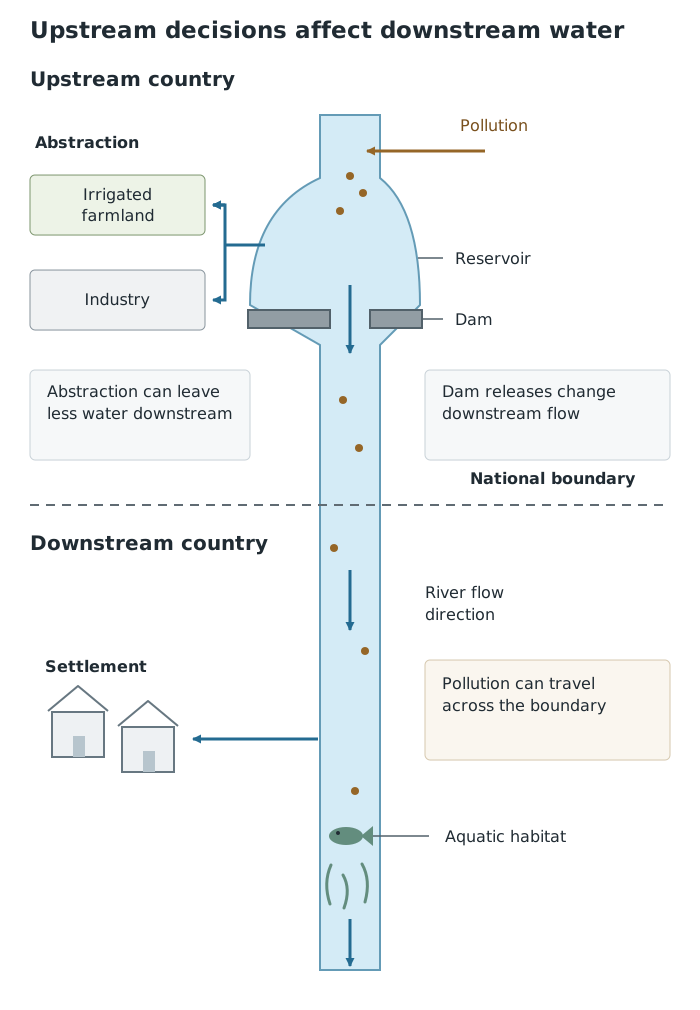
Countries sharing a river are linked: upstream decisions can change the quantity, timing and quality of water available downstream.
These connections produce several kinds of consequence:
The important distinction is between increasing water availability for one group and improving water security across the whole shared river system.
The Lesotho Highlands Water Project transfers water from Lesotho to South Africa. Lesotho's mountainous terrain, high precipitation and relatively small population help explain its water surplus. South Africa has a larger population and uneven rainfall, creating demand for additional supplies.
The project uses dams, including the Katse Dam, reservoirs and pipelines, supported by infrastructure such as roads and bridges. It shows how storing and transferring water can form part of one international scheme.
The receiving country gains additional water, while selling water can benefit the supplying country's economy. Nevertheless, the same questions apply as for other large transfer schemes: how much water remains for local people and ecosystems, who bears the construction costs, and who benefits from the additional supply? The project illustrates cooperation across borders, but cooperation alone does not mean that every consequence is beneficial.
A scheme should be judged by more than the volume of water it delivers. Consider whether it provides a reliable supply, whether its costs are affordable, whether affected communities benefit, and whether enough good-quality water remains for downstream users and ecosystems.
Reservoirs, transfers and groundwater abstraction can all reduce shortages. Their sustainability depends on how they are managed. For shared rivers, an approach that considers the needs of all countries and protects downstream flows is more sustainable than one that simply maximises an upstream country's withdrawals.
Upstream abstraction or flow control → changed downstream supply. Pollution can also cross borders.
Judge sustainability across the whole shared system: who benefits, who loses, and can supplies and ecosystems be maintained?
Explain a consequence as a chain: upstream abstraction → less water downstream → reduced irrigation → lower crop yields and farm incomes.
Distinguish a reservoir, which stores water, from a water transfer scheme, which moves it between areas.
For international rivers, consider people and environments both upstream and downstream. A benefit in one country may create a cost in another.
A sustainability judgement should weigh social, economic and environmental consequences, rather than simply stating that a scheme increases supply.
It can see this note and what your specification asks for.
Answers are free with an account.
1 free note left this week
Get more free notesYour answer sets when this note comes back for review, or marks it complete.
Was this note helpful?
Log in to tell us whether it helped, or to report a problem.
Last updated
Sustainable water management
Managing water to meet present needs without undermining the ability of future generations to meet theirs, while considering people, the economy and the environment.
Reservoir
A store of water, often created by building a dam across a river.
Irrigation
The artificial supply of water to land to help crops grow.
Water transfer scheme
A system that moves water from an area of surplus to an area of deficit, usually through canals and pipelines.
Groundwater
Water stored beneath the ground in the pores and cracks of soil and rock.
Aquifer
A permeable body of rock that stores groundwater and allows it to move through the rock.
Abstraction
The removal of water from a river, lake or underground store for human use.
International river
A river whose course crosses national boundaries, linking the water resources of different countries.
River discharge
The volume of water flowing past a point in a river per unit of time, usually measured in cubic metres per second.
Put your knowledge into practice — try past paper questions for Geography A
Sustainable water management
Managing water to meet present needs without undermining the ability of future generations to meet theirs, while considering people, the economy and the environment.
Reservoir
A store of water, often created by building a dam across a river.
Irrigation
The artificial supply of water to land to help crops grow.
Water transfer scheme
A system that moves water from an area of surplus to an area of deficit, usually through canals and pipelines.
Groundwater
Water stored beneath the ground in the pores and cracks of soil and rock.
Aquifer
A permeable body of rock that stores groundwater and allows it to move through the rock.
Abstraction
The removal of water from a river, lake or underground store for human use.
International river
A river whose course crosses national boundaries, linking the water resources of different countries.
River discharge
The volume of water flowing past a point in a river per unit of time, usually measured in cubic metres per second.