

Loading…
Loading…
Loading…
Eduqas GCSE Geography A · C111
Eduqas C111 · 6.4.3 Check the specification (PDF) (opens in a new tab)
Regional inequality means differences in economic conditions between areas of a country. A deprived area may have high unemployment, low incomes and limited opportunities. Reducing inequality therefore involves more than increasing the size of the UK economy: investment must improve opportunities in places that have fallen behind.
Investment is spending intended to produce future benefits. Government can invest in transport, broadband and training, while private businesses invest in premises, equipment and workers. These forms of investment can reinforce one another. Better connections make a place more attractive to businesses; new businesses then provide jobs and encourage further investment.
Infrastructure is the basic network of facilities on which economic activity depends. Reliable transport helps workers reach jobs and firms reach customers and suppliers. Broadband enables businesses to communicate and sell online. Training helps residents gain the skills needed for new employment. Together, these improvements can remove barriers that previously discouraged businesses from locating in a deprived region.
Regeneration puts investment into declining places. For example, government and private-sector partnerships have redeveloped former industrial land at Salford Quays and Cardiff Bay. Reusing land and improving an area's environment can provide space for new businesses and make it more attractive to investors. However, new development will not necessarily benefit existing low-income residents if they cannot access the jobs or afford the new housing.
A positive multiplier occurs when an initial increase in investment or employment generates further economic activity. The important idea is that the effects extend beyond the organisation receiving the original investment.
Suppose a new employer opens in a deprived town. It directly employs workers and places orders with suppliers. Employees spend some of their wages in local shops, cafés and other services. These businesses gain customers and may employ more staff. Their employees also spend locally, spreading the benefits further.
This connects different parts of the economy: one firm's investment can support jobs in businesses that were not involved in the original project. A more prosperous, attractive area may then draw in additional businesses, reinforcing growth.
The multiplier is stronger when local residents obtain the jobs and local firms supply goods and services. It is weaker when workers live elsewhere or businesses buy most of their supplies from outside the region, because less of the spending supports the local economy.
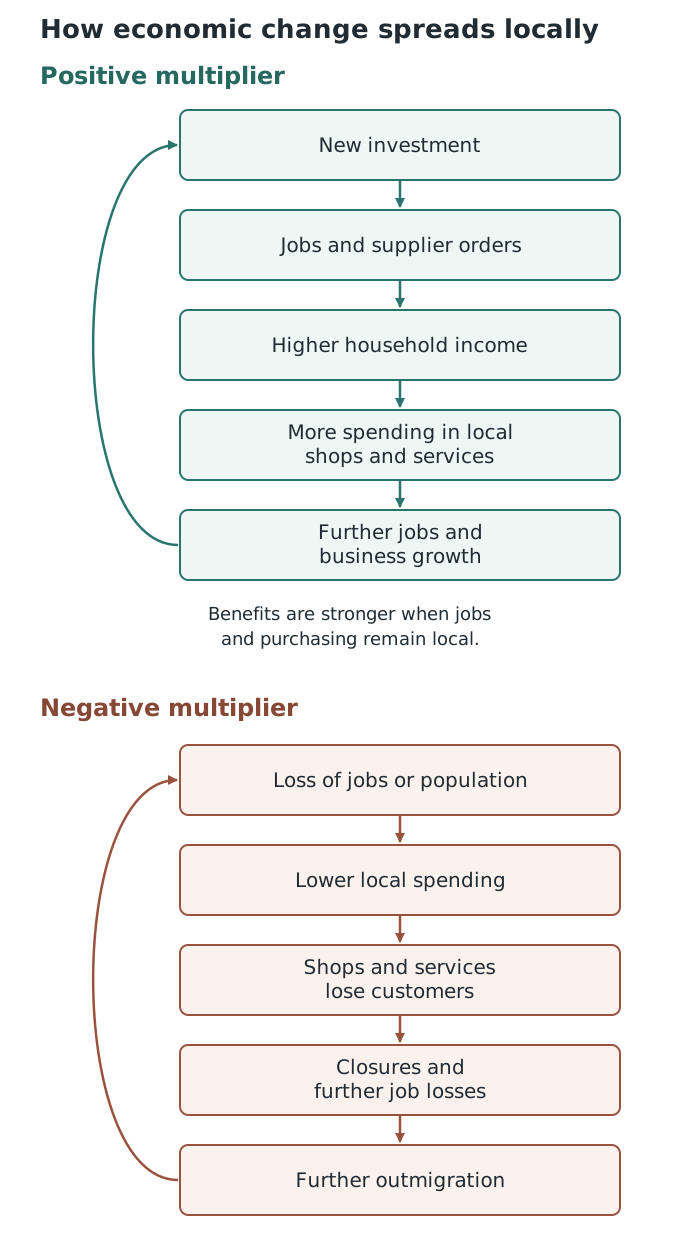
Investment can spread growth through local spending; losses of employment or population can spread decline.
A negative multiplier works in the opposite direction. An initial loss of jobs or population reduces spending, which causes further economic decline.
For example, if a major employer closes, former employees have less income to spend locally. Shops and services lose customers and may reduce staffing or close. This creates further job losses. Some residents may move away to find work, reducing demand even more.
Rural depopulation shows a related process. Parts of rural Wales and the Scottish Highlands have experienced long-term population loss. When younger people leave because employment opportunities are limited, fewer customers remain to support shops and services. Service closures then make the area less attractive to residents, encouraging further departures.
Investment can help interrupt this cycle by improving access to work, attracting employers and supporting services. However, a building project alone cannot guarantee lasting recovery: the resulting jobs and opportunities need to be accessible to local people.
National government can fund major projects whose scale is beyond the resources of individual local authorities. HS2, a high-speed railway programme, is an example of infrastructure investment that could support regional growth. The government's May 2026 report describes funding to progress HS2 between the West Midlands and London Euston. It should not be treated as an already completed railway or as a completed high-speed network across northern England.
HS2 can influence regional economies in two stages. During construction, spending supports workers, contractors and suppliers. The government reported that the programme supported around 31,000 jobs and had created 2,136 apprenticeships since 2017. Wages and business orders can create positive multiplier effects, while apprenticeships can leave workers with useful skills beyond the project itself.
Once operating, improved connections could make it easier for people to reach jobs and for businesses to access workers, customers and other firms. Moving services onto the new railway is also intended to release capacity on existing lines for regional, local and freight services between London and the West Midlands.
Stations can encourage regeneration around them. Birmingham's Curzon Street and the West Midlands' Interchange are among the locations where land could support new homes, shops and commercial development. In May 2026, HS2 estimated that regeneration associated with its four new stations would support 49,000 new jobs in the West Midlands and west London over the following ten years. This is a forecast, not a count of jobs already created.
The strongest argument for major transport investment is that it can tackle poor connectivity while creating employment and attracting further private investment. Combining transport improvements with local training and regeneration can help deprived communities participate in growth rather than simply watch it happen nearby.
However, benefits are uneven. Areas near stations may gain more than places further away. Residents still need affordable local connections to reach stations and employment sites. New jobs may bypass poorer households if their skills do not match employers' needs. Regeneration can also raise housing costs, making it harder for existing residents to remain.
Growth is not confined to deprived regions. HS2 also supports development in London, including around Euston. If wealthier places gain as much as, or more than, deprived places, national economic growth may occur without a substantial reduction in regional inequality.
Cost and delivery matter too. By the end of March 2026, £44.2 billion had been spent on HS2, in nominal prices—the money values recorded at the time of spending. This is expenditure to that date, not the final project cost. Large commitments have an opportunity cost: money cannot simultaneously be used for alternative improvements, such as local transport or broadband. Delays postpone benefits and prolong construction disruption. The government's report recorded complaints about traffic disruption, noise and vibration.
Overall, major infrastructure can help reduce regional inequality, but it is not sufficient on its own. Its success depends on where investment goes, whether local people can access the resulting jobs, and whether benefits justify the costs. A coordinated approach linking national infrastructure with local transport, skills and regeneration is more likely to spread gains to deprived communities than an isolated prestige project.
Positive: investment → jobs and business orders → higher local spending → further employment and growth.
Negative: job losses or outmigration → lower spending → business and service closures → further decline.
Local employment and purchasing strengthen the positive multiplier.
Judgement: infrastructure is most likely to reduce inequality when combined with local connections, skills and regeneration that benefit deprived communities.
Explain a multiplier as a chain of linked effects: investment creates jobs, wages increase local spending, and other businesses gain customers.
Distinguish jobs supported during construction from jobs forecast through later regeneration.
When evaluating regional inequality, ask who benefits and where. Growth in a region does not automatically mean that its poorest communities benefit or that the gap with wealthier regions narrows.
Use a named infrastructure example, weigh benefits against limitations, and reach a judgement about the conditions needed for success.
It can see this note and what your specification asks for.
Answers are free with an account.
1 free note left this week
Get more free notesYour answer sets when this note comes back for review, or marks it complete.
Was this note helpful?
Log in to tell us whether it helped, or to report a problem.
Last updated
Regional inequality
Differences in economic conditions, such as income and employment opportunities, between areas of a country.
Investment
Spending on assets or improvements, such as transport, buildings or skills, intended to produce future benefits.
Infrastructure
The basic networks and facilities that allow society and the economy to function, including transport, electricity and broadband.
Positive multiplier
A process in which an initial increase in investment or employment generates further economic activity through business orders and spending.
Negative multiplier
A process in which an initial loss of jobs, income or population causes further falls in spending, employment and services.
Regeneration
Improvement of a declining area through investment in its economy, buildings, services and environment.
Opportunity cost
The benefit of the next-best alternative given up when money or other resources are committed to a particular choice.
Put your knowledge into practice — try past paper questions for Geography A
Regional inequality
Differences in economic conditions, such as income and employment opportunities, between areas of a country.
Investment
Spending on assets or improvements, such as transport, buildings or skills, intended to produce future benefits.
Infrastructure
The basic networks and facilities that allow society and the economy to function, including transport, electricity and broadband.
Positive multiplier
A process in which an initial increase in investment or employment generates further economic activity through business orders and spending.
Negative multiplier
A process in which an initial loss of jobs, income or population causes further falls in spending, employment and services.
Regeneration
Improvement of a declining area through investment in its economy, buildings, services and environment.
Opportunity cost
The benefit of the next-best alternative given up when money or other resources are committed to a particular choice.