

Loading…
Loading…
Loading…
Eduqas GCSE Geography A · C111
Eduqas C111 · 2.3.3 Check the specification (PDF) (opens in a new tab)
A global city interacts with other places at a global scale. Its importance comes from its economic, social and cultural connections, rather than simply the number of people living there. Decision makers in global cities can influence where businesses invest, where goods are traded and how ideas spread.
Globalisation describes flows of people, ideas, money and goods that link people and places in different countries together. Global cities are important meeting points in these networks: a business can have an office in one city, customers overseas and investment arriving from another country.
A megacity, by contrast, is defined by population: it has more than 10 million residents. Mumbai is both a megacity and a global city, but a city does not need to reach this population threshold to have worldwide connections.
A transport hub is a place where routes meet and people or goods can transfer between them. An international airport connects a city with overseas destinations, carrying tourists, students and business travellers. Ports connect cities with shipping routes and allow goods to move between countries.
These international gateways also need connections within the country. Roads and railways bring passengers to airports and move goods between ports, businesses and markets. A port's influence therefore extends beyond the waterfront: it connects an inland area with the wider world.
Trade is the buying and selling of goods and services. Not all international trade travels in a container. A city's banks, media companies or software businesses can also sell services to customers abroad.
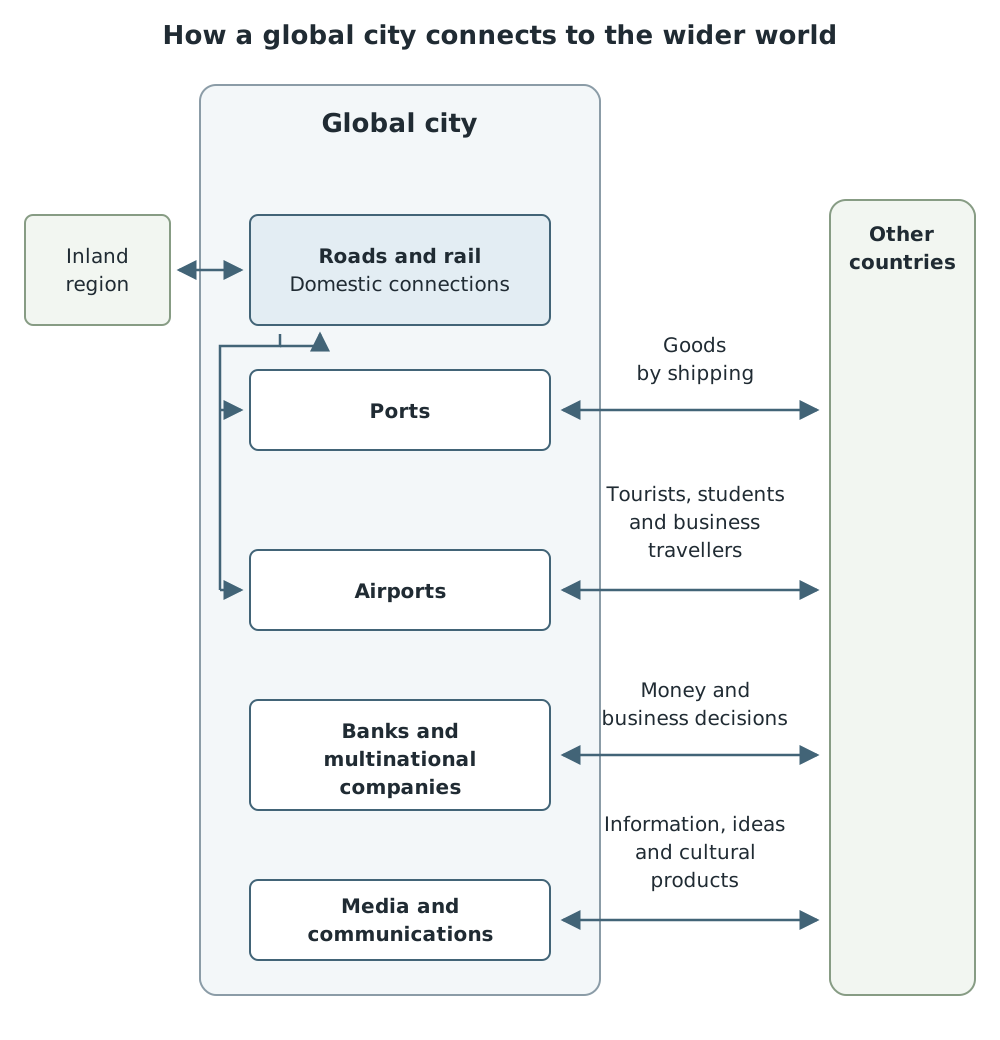
Global cities connect international flows with businesses, people and places within their own country.
Tourism links a city to the places its visitors come from. Visitors travel into the city and spend money on accommodation, food, transport and attractions. International students create further connections through education, knowledge and personal relationships.
Media carry cultural connections beyond the city itself. Films, television programmes and advertising can reach audiences overseas without those audiences travelling to the place where they were produced.
Communications also help businesses exchange information and coordinate activities across borders. A multinational company has branches in several countries, so its offices need to communicate with one another. Transport and communications work together: information can be exchanged remotely, while goods and people still need physical routes.
Mumbai lies on India's western coast beside the Arabian Sea. Its two major ports handle a large proportion of India's container trade, linking Indian businesses to international shipping routes. Road and rail connections help move people and goods within India, while its international airport connects the city with overseas destinations.
Mumbai is also India's financial capital. The Bombay Stock Exchange, major Indian banks and international banks such as JP Morgan and Citibank connect the city to flows of investment. A stock exchange is a market where shares in companies are bought and sold. Overseas investment gives Mumbai connections that cannot be measured simply by the volume of cargo passing through its ports.
Its cultural influence is especially visible through Bollywood, the Hindi-language film industry based in Mumbai. Films reach audiences in India and abroad, including Indian communities overseas. This is a flow of culture and ideas as well as a business activity.
Tourism adds another connection. Attractions such as the Gateway of India and Marine Drive draw visitors, whose spending supports hotels, restaurants and other services. Mumbai's global role therefore combines transport, finance, trade, tourism and media rather than depending on a single connection.
Sydney is on Australia's south-eastern coast. In 2014, the Sydney Morning Herald carried the headline “Sydney not yet a true global city”. The debate illustrates an important distinction: having international connections does not necessarily mean having the same influence as the world's leading global cities.
The mid-2010s debate included strong evidence of Sydney's economic connections. 45 of the 47 international banks operating in Australia were in Sydney, alongside 65% of Australia's international companies. These concentrations linked Sydney to overseas finance and business. Its time zone also provided opportunities to do business with Asia and the USA during overlapping working hours.
People and culture provided further links. Almost 3 million international tourists visited annually, and its universities had over 50,000 international students. Around one third of residents spoke a language other than English at home, reflecting its multicultural population. Sydney's television broadcasters, advertising and animation industries also gave it a role in media production.
However, the strength and reach of these connections were disputed. The airport served 46 international destinations, compared with 170 at London Heathrow in the comparison used at the time. Some multinational offices focused on local activities rather than decisions of global importance. Sydney was also far from many of its trading partners.
The newspaper's argument emphasised inadequate transport and business infrastructure, alongside relatively low employment in innovative high-tech industries. Although existing business infrastructure could be high quality, it could still lack the capacity to meet demand. Poor connections within a city can make it harder for workers and businesses to benefit from international opportunities.
The most useful test is not whether a city is large or famous, but how it connects to the world and how much influence those connections give it. Sydney's population of 4.5 million in the debate did not, by itself, rule out global-city status: population defines a megacity, not a global city.
A justified conclusion is that Sydney had substantial global-city characteristics through finance, tourism, education and media, while its transport limitations and more limited global decision-making role weakened comparisons with leading centres such as London. Mumbai likewise demonstrates that a city's worldwide importance comes from several connected flows, not population alone.
Explain what moves through a connection: goods through a port, people through an airport, or money and information through a financial centre.
Link named city evidence to its significance. An international bank is evidence of financial connections, not simply a building in the city.
Do not confuse a global city with a megacity: global importance and population size are different measures.
When judging global-city status, weigh the importance of the evidence rather than counting points on each side.
Keep the mid-2010s Sydney figures in their historical context; do not present them as current statistics.
It can see this note and what your specification asks for.
Answers are free with an account.
1 free note left this week
Get more free notesYour answer sets when this note comes back for review, or marks it complete.
Was this note helpful?
Log in to tell us whether it helped, or to report a problem.
Last updated
Global city
A city that interacts with other places at a global scale through economic, social and cultural connections.
Globalisation
Flows of people, ideas, money and goods that link people and places in different countries together.
Megacity
A city with more than 10 million residents.
Transport hub
A place where transport routes meet, allowing people or goods to transfer between routes or forms of transport.
Trade
The buying and selling of goods and services.
Multinational company
A large business with branches in several countries.
Infrastructure
The basic systems and facilities that support a place's activities, such as transport and communications networks.
Put your knowledge into practice — try past paper questions for Geography A
Global city
A city that interacts with other places at a global scale through economic, social and cultural connections.
Globalisation
Flows of people, ideas, money and goods that link people and places in different countries together.
Megacity
A city with more than 10 million residents.
Transport hub
A place where transport routes meet, allowing people or goods to transfer between routes or forms of transport.
Trade
The buying and selling of goods and services.
Multinational company
A large business with branches in several countries.
Infrastructure
The basic systems and facilities that support a place's activities, such as transport and communications networks.