

Loading…
Loading…
Loading…
Eduqas GCSE Geography A · C111
Eduqas C111 · 3.1.1 Tectonic Processes and Landforms Check the specification (PDF) (opens in a new tab)
Earth’s surface may seem fixed, but its rigid outer shell is divided into tectonic plates. These include the crust and the uppermost mantle and usually move only a few centimetres each year. Over millions of years, this movement creates features stretching for hundreds or thousands of kilometres.
There are two main types of crust. Oceanic crust lies beneath the oceans and is thinner and denser than continental crust, which forms the continents. This difference in density helps explain what happens when plates meet.
The mantle beneath the plates is rocky and mostly solid, but it can deform and flow extremely slowly. Heat within Earth produces convection currents: hotter, less dense material rises, while cooler, denser material sinks. This slow circulation helps move the plates. Their movement brings them apart, towards each other or past each other at plate boundaries, also called margins.
Earthquakes and volcanoes are not evenly scattered across the world. Most occur in long, narrow belts along plate boundaries, where moving plates interact.
Around the Pacific Ocean, many boundaries involve one plate descending beneath another. Frequent earthquakes and numerous active volcanoes form the Pacific Ring of Fire. Along the Mid-Atlantic Ridge, plates move apart, producing earthquakes and volcanic activity as new crust forms. The ridge is largely underwater, but it reaches the surface in Iceland.
Earthquakes also occur where plates collide, including the Alpine–Himalayan belt extending from Europe towards Asia. Where plates slide past each other at conservative margins, such as the San Andreas Fault in California, they can lock through friction and then slip suddenly, causing earthquakes. Crust is neither created nor destroyed there, and this movement does not normally generate volcanoes.
The distribution therefore reflects different types of plate movement. Earthquake belts and volcanic belts overlap in many places, but not every earthquake zone has volcanoes. Hotspots provide another important exception: volcanoes can form within plates, away from their edges.
At a constructive margin, plates move apart. This movement is called divergence. Magma—molten rock beneath Earth’s surface—rises into the opening. When it reaches the surface it is called lava; as it cools and solidifies, it creates new crust.
Beneath an ocean, repeated magma supply builds a mid-ocean ridge. Newly formed oceanic crust moves away on either side as the plates continue separating. The Mid-Atlantic Ridge is an example. ‘Constructive’ describes the creation of crust, not an absence of hazards: earthquakes and volcanic eruptions still occur.
Where continental crust is pulled apart, it stretches and fractures along faults. A block of land can sink between faults, creating a long rift valley. The East African Rift Valley is an example. The valley is formed by movement and sinking of the crust, rather than by a river eroding it.
At a destructive margin, plates move towards each other. Where an oceanic plate meets a continental plate, the denser oceanic plate is forced beneath the continental plate and descends into the mantle. This is subduction. Oceanic crust is removed from the surface, which explains the name ‘destructive’.
As the oceanic plate bends downwards, it creates a long, deep ocean trench beside the overriding plate. The trench marks the beginning of the subduction zone; it is not a gap created by plates pulling apart. The Mariana Trench is another example of a subduction trench, formed where one oceanic plate descends beneath another.
Plates can become locked by friction during subduction. Stress builds until sudden movement releases energy as an earthquake. Subduction also leads to magma formation, and this magma can rise through the overriding plate to supply volcanoes. Along western South America, the Nazca Plate subducts beneath the South American Plate, helping explain the earthquakes and volcanoes of the Andes.
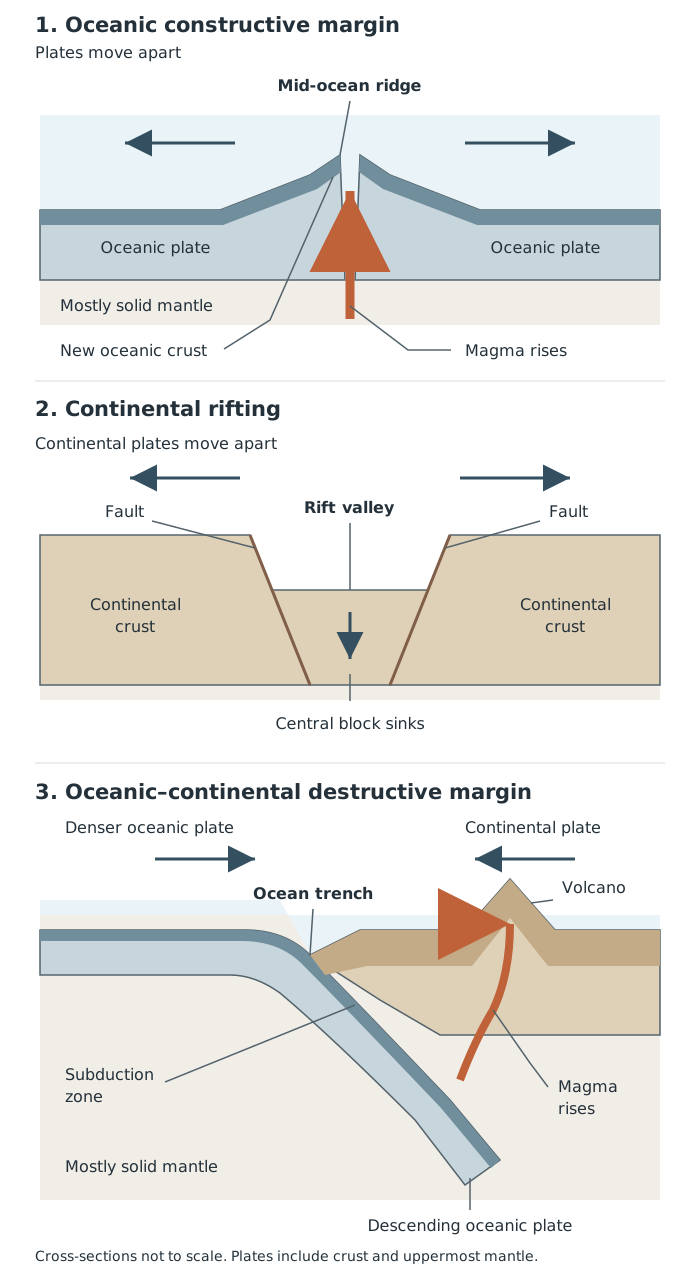
Different plate movements produce different large-scale landforms: ridges and rift valleys at divergent margins, and trenches at subduction margins.
The contrasting landforms follow from the movement: pulling continental crust apart can produce a rift valley, whereas bending a plate down into a subduction zone produces an ocean trench.
A volcanic hotspot is supplied by unusually hot mantle material rising towards the surface, often described as a mantle plume. Magma rises through the plate above it and can build a volcano without two plates meeting there.
Hawaii lies within the Pacific Plate rather than at its edge. The Pacific Plate moves north-west over a relatively stationary hotspot. A volcano forms above the hotspot, but plate movement gradually carries it away from its magma supply. Its activity eventually stops, while a new volcano develops above the hotspot.
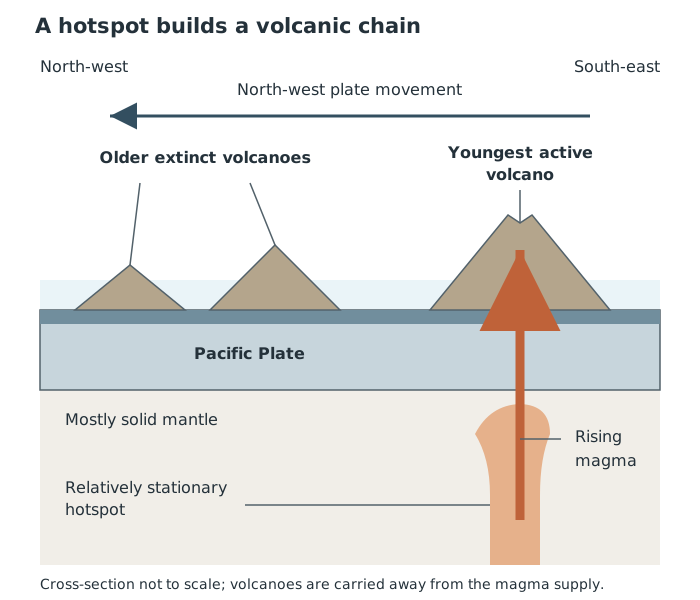
As the Pacific Plate moves north-west, it carries volcanoes away from the hotspot and new volcanoes form above the magma supply.
Repeating this process creates a chain of volcanic islands. In the Hawaiian chain, islands generally become older towards the north-west, while the youngest volcanism is at the south-eastern end. The chain records the direction of plate movement: the plate moves, rather than the hotspot travelling from island to island.
Describe global distribution using named belts or locations, such as the Pacific Ring of Fire and Mid-Atlantic Ridge, rather than saying only ‘at plate boundaries’.
In an explanation, connect plate movement to the process and then the landform: plates converge → subduction → an ocean trench forms.
Use ‘denser’, not simply ‘heavier’, to explain why oceanic crust subducts beneath continental crust.
Distinguish an ocean trench, where a plate bends downwards, from a rift valley, where land sinks as the crust is pulled apart.
Hotspots explain why some volcanoes occur away from plate boundaries.
It can see this note and what your specification asks for.
Answers are free with an account.
1 free note left this week
Get more free notesYour answer sets when this note comes back for review, or marks it complete.
Was this note helpful?
Log in to tell us whether it helped, or to report a problem.
Last updated
Tectonic plate
A large, rigid section of Earth’s outer shell, made of crust and the uppermost mantle, which moves slowly over the mantle beneath.
Plate boundary
The zone where two tectonic plates meet.
Convection current
Slow circulation within the mantle as hotter, less dense material rises and cooler, denser material sinks.
Constructive margin
A plate boundary where plates move apart and magma cools to form new crust.
Divergence
The movement of tectonic plates away from one another.
Destructive margin
A plate boundary where plates move towards each other and one plate is forced beneath another into the mantle.
Subduction
The process in which one tectonic plate descends beneath another into the mantle.
Rift valley
A long depression formed where the crust is pulled apart and a block of land sinks between faults.
Ocean trench
A long, narrow, deep depression in the ocean floor formed where a tectonic plate bends down into a subduction zone.
Mid-ocean ridge
A long underwater mountain chain formed where magma rises and creates new oceanic crust at a constructive margin.
Volcanic hotspot
An area of volcanic activity fed by unusually hot mantle material rising beneath a plate, which can occur away from a plate boundary.
Put your knowledge into practice — try past paper questions for Geography A
Tectonic plate
A large, rigid section of Earth’s outer shell, made of crust and the uppermost mantle, which moves slowly over the mantle beneath.
Plate boundary
The zone where two tectonic plates meet.
Convection current
Slow circulation within the mantle as hotter, less dense material rises and cooler, denser material sinks.
Constructive margin
A plate boundary where plates move apart and magma cools to form new crust.
Divergence
The movement of tectonic plates away from one another.
Destructive margin
A plate boundary where plates move towards each other and one plate is forced beneath another into the mantle.
Subduction
The process in which one tectonic plate descends beneath another into the mantle.
Rift valley
A long depression formed where the crust is pulled apart and a block of land sinks between faults.
Ocean trench
A long, narrow, deep depression in the ocean floor formed where a tectonic plate bends down into a subduction zone.
Mid-ocean ridge
A long underwater mountain chain formed where magma rises and creates new oceanic crust at a constructive margin.
Volcanic hotspot
An area of volcanic activity fed by unusually hot mantle material rising beneath a plate, which can occur away from a plate boundary.