

Loading…
Loading…
Loading…
Eduqas GCSE Geography A · C111
Eduqas C111 · 1.2.1 River and Coastal Landform Processes Check the specification (PDF) (opens in a new tab)
A coast is shaped by processes that work together. Weathering weakens rock in place; erosion wears it away and removes it. Gravity moves loosened material down cliffs, while waves and currents transport it elsewhere. Where the water can no longer carry the sediment, deposition builds features such as beaches and spits.
These changes operate at different scales. A crack or rock pool is a small feature within a much larger cliff or wave-cut platform. Repeated wave action gradually enlarges weaknesses, but a single collapse can suddenly change a cliff face. Over longer periods, repeated erosion and collapse reshape whole headlands. Beaches can gain or lose sediment as wave conditions change, so coastal development is not simply a steady progression towards a finished landscape.
Three important coastal processes affect rock and sediment in different ways:
Hydraulic action and abrasion can directly erode a cliff. Attrition changes the material being transported. The fragments produced by erosion can then become tools for further abrasion, connecting sediment supply with erosion.
Waves exploit weaknesses in the rock. Joints are cracks, while bedding planes are boundaries between layers of sedimentary rock. Water can enter these weaknesses, and blocks may eventually separate along them.
Cliff change is not caused by waves alone. Weathering weakens the exposed rock above the sea. In freeze–thaw weathering, water enters cracks, freezes and expands. Repeated freezing and thawing widens the cracks until fragments loosen. Salt crystals growing in cracks can also weaken coastal rock, while plant roots can force cracks wider.
Mass movement is the downslope movement of material under gravity. A rockfall occurs when loosened fragments break away from a steep cliff and fall. A landslide occurs when a mass of material slides down a slope along a slip surface. Bedding planes may provide surfaces along which rock slides.
In weaker cliffs, rainfall can saturate material, making it heavier and less stable. It may move along a curved slip surface in a rotational slump, leaving a stepped cliff profile. Wave erosion at the cliff foot can trigger movement by removing the support beneath the slope.
Together, these processes create a cycle: weathering weakens the cliff, waves undercut its base, gravity causes collapse, and waves remove the fallen debris. Once that temporary protection is removed, waves can attack the cliff again.
Waves repeatedly attack the base of a cliff, cutting an indentation called a wave-cut notch. Hydraulic action and abrasion deepen the notch, leaving the rock above unsupported. Weathering further weakens it, and the overhang eventually collapses.
As waves remove the debris, they begin cutting a new notch farther inland. Repeated undercutting and collapse cause the cliff to retreat. A gently sloping surface of exposed rock remains in front of it: the wave-cut platform. It generally slopes towards the sea and is exposed at low tide.
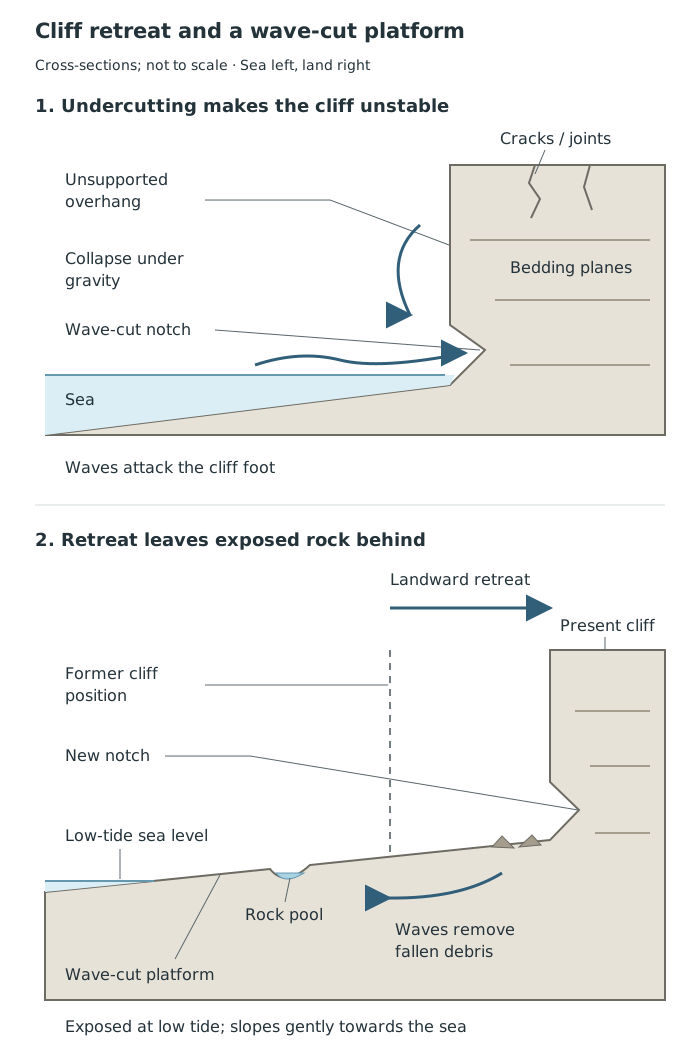
Repeated undercutting, collapse and debris removal move the cliff inland, leaving a rocky wave-cut platform.
The platform contains smaller features. Erosion and weathering enlarge cracks and hollows; some hollows retain seawater as the tide falls, forming rock pools. Bedding planes may also be visible where layers of rock are exposed. These small features show how weaknesses and uneven erosion contribute to the larger coastal landscape.
Where more resistant and less resistant rocks occur alongside one another along a coast, they erode at different rates. Less resistant rock is worn back more quickly, forming a bay. More resistant rock remains projecting into the sea as a headland. This is differential erosion.
As waves approach an uneven coastline, they bend, a process called wave refraction. Wave energy becomes concentrated around headlands, encouraging further erosion. Bays are more sheltered, so deposition is more likely there and beaches can accumulate. A single stretch of coast can therefore contain both erosional and depositional landforms.
The Dorset coast in southern England contains distinctive headlands and bays, as well as arches and stacks. Detailed differences in rock arrangement and rates of change are considered separately; the central formation process here is unequal erosion followed by continuing wave attack.
On a rocky headland, hydraulic action and abrasion enlarge a joint or other weakness into a cave. Continued erosion deepens the cave. If it cuts through the headland, or meets a cave eroding from the other side, an arch forms: an opening through the rock with a roof above it.
Marine erosion attacks the arch, while weathering weakens its roof. Eventually the roof becomes unstable and collapses under gravity. This leaves an isolated pillar of rock called a stack. Waves attack the stack on all sides, so it continues to change and may eventually collapse into a low remnant, or stump.
Durdle Door in Dorset is an arch, while Old Harry Rocks includes stacks and stumps. These examples represent different coastal features, rather than successive stages observed at one particular location. Not every cave develops into an arch: its development depends on whether erosion can create an opening through the headland.
Coastal sediment comes from cliff erosion, rivers and offshore deposits. Waves and currents redistribute it. Large particles may roll along the seabed, smaller grains may bounce, and fine sediment can be carried within the water.
Longshore drift moves beach sediment along the coastline. When waves approach at an angle, swash carries sediment diagonally up the beach. Backwash then flows straight down the beach under gravity, approximately at right angles to the shoreline. Repeated swash and backwash produce a zig-zag path with an overall movement along the coast.
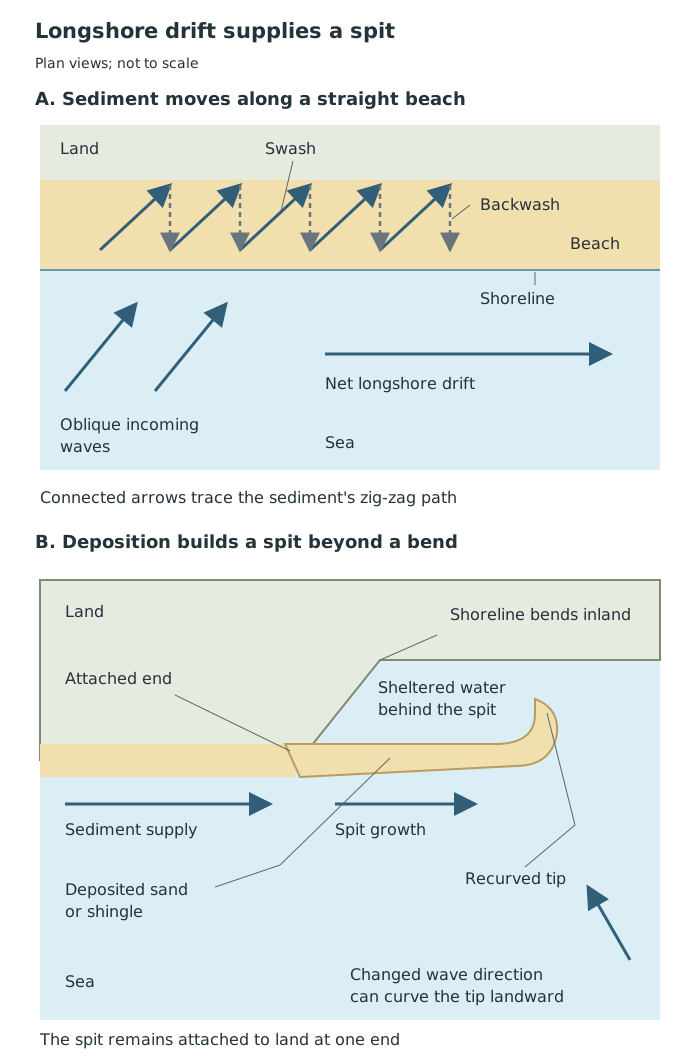
Angled swash and straight backwash transfer sediment alongshore. Deposition beyond a coastline bend can build a spit.
Longshore drift does not create new sediment: it transfers material from one place to another. Erosion in one part of a coastline can therefore supply material for a beach or spit elsewhere.
Deposition occurs when waves and currents lose energy and can no longer transport their sediment load. It is common in sheltered water, including bays. A beach forms where sand, shingle or other sediment accumulates faster than it is removed.
Constructive waves help build beaches because their swash is stronger than their backwash, producing a net movement of sediment up the beach. Beach growth still depends on a supply of material. If removal exceeds replacement, the beach becomes smaller. Beaches also absorb wave energy, helping protect the cliffs behind them: sediment is both a product of erosion and a possible protection against it.
A spit develops where longshore drift carries sediment to a bend in the coastline or an estuary. Sediment continues beyond the point where the shoreline changes direction. In the lower-energy water beyond, it is deposited, gradually building a ridge attached to the land at one end.
Continued sediment supply can lengthen the spit. Changes in wave direction may curve its tip back towards the land, producing a recurved end. Water behind the spit is sheltered, allowing finer sediment to settle.
Spurn Head on the Holderness coast in England is a recurved spit formed by sediment transported southwards by longshore drift. It demonstrates the connection between sediment movement along a coast and deposition building a distinctive landform.
The complete connection is weathering and erosion → slope collapse → sediment supply → transport → deposition. Small weaknesses help determine where a notch or cave develops. Repeated local changes produce larger cliffs, platforms and headlands, while transported sediment builds beaches and spits elsewhere. To explain coastal change, follow both what happens to the rock and where the resulting sediment goes.
For a formation question, explain a sequence: name the process, describe what it does and link it to the next stage.
Distinguish abrasion, which wears away cliffs and rock surfaces, from attrition, which wears down the transported sediment itself.
Explain cliff retreat using both marine processes and slope processes: undercutting, weathering, collapse and removal of debris.
When drawing longshore drift, show angled swash, backwash straight down the beach and the overall direction of sediment movement.
A wave-cut platform is exposed rock left by cliff retreat, not a beach made from deposited sediment.
It can see this note and what your specification asks for.
Answers are free with an account.
1 free note left this week
Get more free notesYour answer sets when this note comes back for review, or marks it complete.
Was this note helpful?
Log in to tell us whether it helped, or to report a problem.
Last updated
Weathering
The breakdown or chemical alteration of rock in place, without its removal.
Erosion
The wearing away and removal of rock or sediment by moving water, waves or other agents.
Hydraulic action
Erosion caused by the force of water and by air being compressed and released within cracks as waves strike and retreat.
Abrasion
The wearing away of rock surfaces by sediment carried or thrown against them by waves.
Attrition
The wearing down of sediment particles as they collide, making them smaller, smoother and rounder.
Mass movement
The downslope movement of rock or soil under gravity.
Rockfall
The movement of detached rock fragments falling from a steep slope or cliff under gravity.
Landslide
The movement of a mass of rock or soil downslope along a slip surface.
Bedding plane
A boundary between layers of sedimentary rock, which may provide a line of weakness.
Wave-cut notch
An indentation eroded into the base of a cliff by wave action.
Wave-cut platform
A gently sloping rocky surface left behind as a cliff retreats, often exposed at low tide.
Rock pool
A hollow in a rocky shore that retains seawater when the tide falls.
Longshore drift
The movement of beach sediment along the coast through angled swash and backwash flowing straight down the beach.
Swash
The movement of water up a beach after a wave breaks.
Backwash
The movement of water back down a beach under gravity.
Deposition
The laying down of transported sediment when waves or currents can no longer carry it.
Spit
A ridge of sand or shingle attached to the land at one end and extending out into the sea or across an estuary.
Put your knowledge into practice — try past paper questions for Geography A
Weathering
The breakdown or chemical alteration of rock in place, without its removal.
Erosion
The wearing away and removal of rock or sediment by moving water, waves or other agents.
Hydraulic action
Erosion caused by the force of water and by air being compressed and released within cracks as waves strike and retreat.
Abrasion
The wearing away of rock surfaces by sediment carried or thrown against them by waves.
Attrition
The wearing down of sediment particles as they collide, making them smaller, smoother and rounder.
Mass movement
The downslope movement of rock or soil under gravity.
Rockfall
The movement of detached rock fragments falling from a steep slope or cliff under gravity.
Landslide
The movement of a mass of rock or soil downslope along a slip surface.
Bedding plane
A boundary between layers of sedimentary rock, which may provide a line of weakness.
Wave-cut notch
An indentation eroded into the base of a cliff by wave action.
Wave-cut platform
A gently sloping rocky surface left behind as a cliff retreats, often exposed at low tide.
Rock pool
A hollow in a rocky shore that retains seawater when the tide falls.
Longshore drift
The movement of beach sediment along the coast through angled swash and backwash flowing straight down the beach.
Swash
The movement of water up a beach after a wave breaks.
Backwash
The movement of water back down a beach under gravity.
Deposition
The laying down of transported sediment when waves or currents can no longer carry it.
Spit
A ridge of sand or shingle attached to the land at one end and extending out into the sea or across an estuary.
Weathering → erosion and collapse → sediment supply → transport → deposition elsewhere.
Small cracks and notches contribute to larger landforms. Sudden collapses interrupt gradual change; beaches and spits can grow or lose sediment.