

Loading…
Loading…
Loading…
Eduqas GCSE Geography A · C111
Eduqas C111 · 1.2.1 River and Coastal Landform Processes Check the specification (PDF) (opens in a new tab)
A river does more than carry water downhill. It wears away rock and sediment, moves this material downstream and deposits it elsewhere. These are fluvial processes: processes involving flowing river water. Erosion, transportation and deposition work together to change river landscapes in the UK.
Changes happen at different scales. Collisions can alter individual stones, erosion can deepen a plunge pool, and repeated erosion and deposition can reshape an entire valley. Some changes, such as a bank collapsing during high flow, happen quickly. Larger landforms develop through repeated events over much longer periods.
The amount of change depends partly on the river's flow and the resistance of the material it encounters. Discharge is the volume of water passing a point each second; velocity is its speed. Greater discharge and faster flow generally give a river more energy for erosion and transportation, although much of its energy is used in overcoming friction with the bed and banks.
Erosion is the wearing away and removal of material. Rivers do this through four main processes:
These processes affect different things. Abrasion wears away the river channel, whereas attrition wears down the material travelling through it. That transported sediment can then become a tool for further abrasion.
Erosion also has a direction. Vertical erosion cuts downwards, deepening the channel and valley. Lateral erosion cuts sideways, widening them. Vertical erosion is usually dominant in the upper course, nearer the river's source; lateral erosion becomes more important in the middle and lower course.
A river's load is the material it transports. Different parts of the load travel in different ways:
Solution therefore describes both an erosion process and a transportation process: rock first dissolves, then the dissolved material is carried downstream.
Deposition occurs when the river can no longer transport part of its sediment load. Slower flow has less ability to carry sediment, so material is dropped. This can happen on the inside of a bend, where flow is slower, or when floodwater spreads out across surrounding land. Larger, heavier particles generally settle before finer particles.
Erosion, transport and deposition are connected: material removed from one part of a river landscape can be carried downstream and help build another landform.
In the upper course, downward erosion deepens the river channel. Hydraulic action and abrasion help the river cut into its bed.
The river does not carve the whole valley shape by itself. Weathering breaks down rock on the valley sides in place. Gravity then moves loosened material downslope through mass movement. Material reaching the channel can be carried away by the river, exposing the slopes to further weathering.
Repeated downcutting, weathering and downslope movement produce a narrow valley with steep sides: a V-shaped valley. Its shape records the combined action of river and slope processes over time.
A waterfall often develops where a river crosses more resistant rock overlying less resistant rock. The less resistant rock erodes faster, creating a drop in the riverbed.
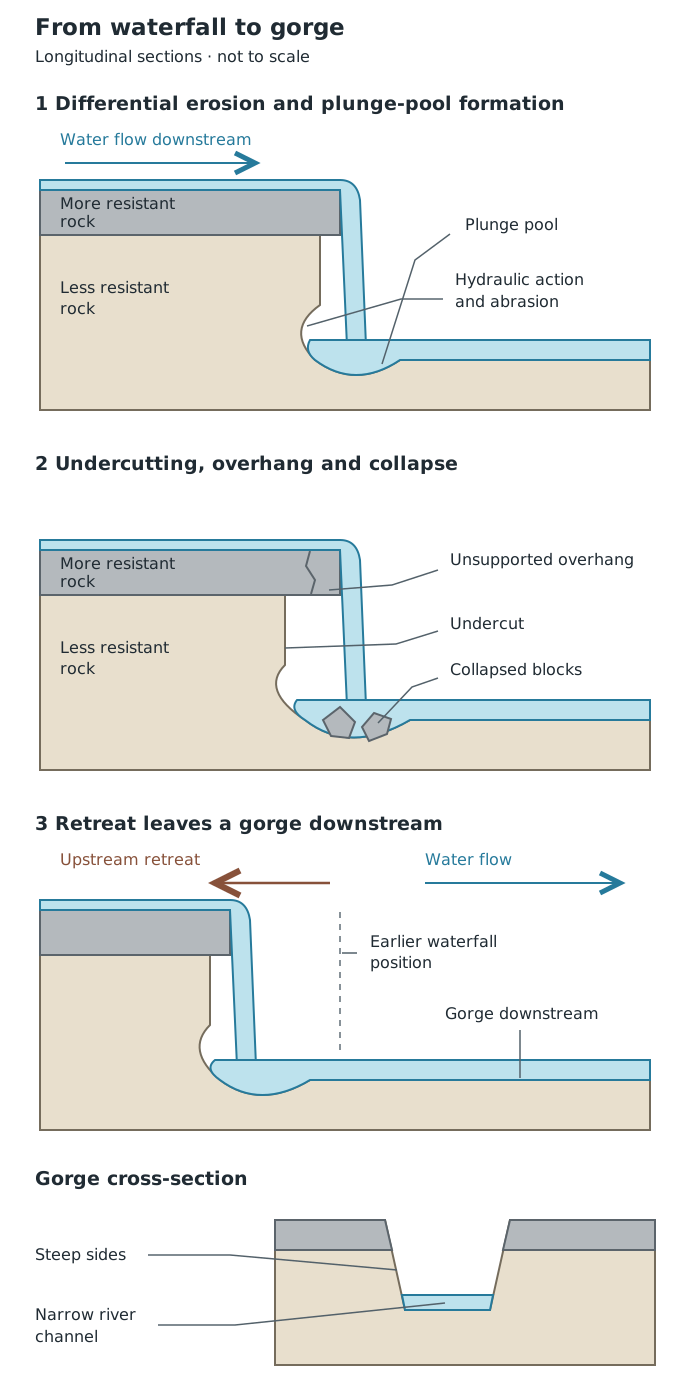
Repeated undercutting and collapse move a waterfall upstream, leaving a gorge downstream.
As the waterfall retreats, it leaves a narrow, steep-sided gorge downstream. The plunge pool is a smaller feature within the waterfall system; the gorge is the larger landform produced by repeated retreat. A collapse may be sudden, but the gorge develops through many such events.
A meander is a bend in a river. In the middle and lower course, lateral erosion helps bends grow and migrate across the valley.
On the outside of a bend, flow is faster. Hydraulic action and abrasion erode and undercut the bank. The bank can collapse, creating a steep river cliff and moving the outside edge of the bend outwards.
On the inside of the same bend, flow is slower. The river deposits sediment, building a gently sloping slip-off slope. Erosion on one side and deposition on the other gradually shift the channel's position.
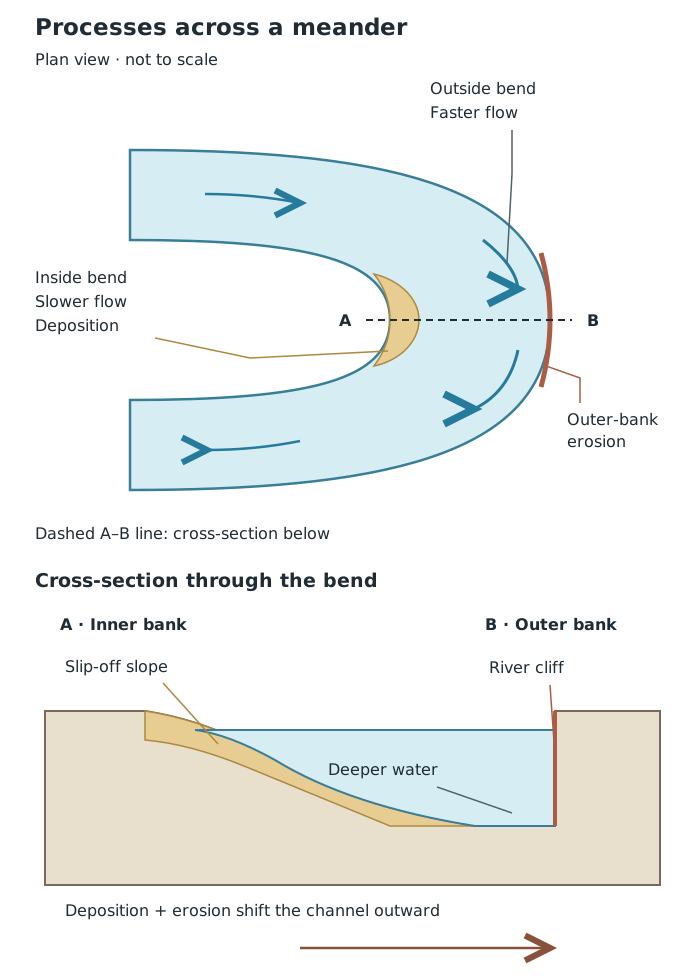
Outer-bend erosion forms a river cliff; inner-bend deposition builds a slip-off slope.
The river cliff and slip-off slope are therefore related features, not separate accidents. Their contrasting shapes result from different flow conditions across one bend.
A floodplain is the broad, relatively flat land beside a river that can be covered by floodwater. Both lateral erosion and deposition contribute to its development.
As meanders migrate, sideways erosion widens the valley floor. During high discharge, water may overflow the banks and spread across this land. Contact with the land surface increases friction, slowing the water and causing it to deposit sediment called alluvium.
Repeated floods add layers of alluvium, gradually building up the floodplain. One flood can leave a fresh layer of sediment, while repeated flooding and channel migration create a much larger landscape over time. This shows how short-lived events combine to produce long-term landform change.
Explain landform development as a linked sequence: name the process, explain what it does and show how the landform changes.
Distinguish abrasion, which wears away the bed and banks, from attrition, which changes the sediment being carried.
For meanders, link outer-bend erosion to faster flow and inner-bend deposition to slower flow.
For waterfalls, explain repeated undercutting and collapse, then link upstream retreat to the formation of a gorge.
In labelled diagrams, show flow direction and locate smaller features precisely, such as the plunge pool and slip-off slope.
It can see this note and what your specification asks for.
Answers are free with an account.
1 free note left this week
Get more free notesYour answer sets when this note comes back for review, or marks it complete.
Was this note helpful?
Log in to tell us whether it helped, or to report a problem.
Last updated
Fluvial process
A process involving flowing river water, such as erosion, transportation or deposition.
Erosion
The wearing away and removal of material from a river's bed and banks.
Hydraulic action
Erosion in which the force of flowing water loosens and removes material from the river's bed and banks.
Abrasion
Erosion caused by sediment carried by a river scraping and striking its bed and banks.
Attrition
The wearing down of sediment as pieces collide during transportation, making them smaller, smoother and rounder.
Solution
The dissolving of soluble rock by river water; also the transportation of dissolved material within the water.
Transportation
The movement of sediment and dissolved material by a river.
Traction
Transportation in which large particles are rolled along the riverbed.
Saltation
Transportation in which small particles bounce along the riverbed.
Suspension
Transportation in which fine particles are carried within flowing water.
Deposition
The dropping of sediment when a river can no longer transport it.
Vertical erosion
Downward erosion that deepens a river channel and valley.
Lateral erosion
Sideways erosion that widens a river channel and valley.
V-shaped valley
A narrow valley with steep sides, formed through river downcutting combined with weathering and movement of material down its slopes.
Waterfall
A drop in a river's course where water falls from a higher level to a lower level.
Plunge pool
A deep hollow eroded at the foot of a waterfall by hydraulic action and abrasion.
Gorge
A narrow, steep-sided valley that can form as a waterfall retreats upstream.
Meander
A bend in a river channel.
River cliff
A steep bank formed by erosion on the outside of a river bend.
Slip-off slope
A gently sloping deposit of sediment on the inside of a river bend.
Floodplain
The broad, relatively flat land beside a river that is flooded when the river overflows its banks.
Alluvium
Sediment deposited by a river.
Put your knowledge into practice — try past paper questions for Geography A
Fluvial process
A process involving flowing river water, such as erosion, transportation or deposition.
Erosion
The wearing away and removal of material from a river's bed and banks.
Hydraulic action
Erosion in which the force of flowing water loosens and removes material from the river's bed and banks.
Abrasion
Erosion caused by sediment carried by a river scraping and striking its bed and banks.
Attrition
The wearing down of sediment as pieces collide during transportation, making them smaller, smoother and rounder.
Solution
The dissolving of soluble rock by river water; also the transportation of dissolved material within the water.
Transportation
The movement of sediment and dissolved material by a river.
Traction
Transportation in which large particles are rolled along the riverbed.
Saltation
Transportation in which small particles bounce along the riverbed.
Suspension
Transportation in which fine particles are carried within flowing water.
Deposition
The dropping of sediment when a river can no longer transport it.
Vertical erosion
Downward erosion that deepens a river channel and valley.
Lateral erosion
Sideways erosion that widens a river channel and valley.
V-shaped valley
A narrow valley with steep sides, formed through river downcutting combined with weathering and movement of material down its slopes.
Waterfall
A drop in a river's course where water falls from a higher level to a lower level.
Plunge pool
A deep hollow eroded at the foot of a waterfall by hydraulic action and abrasion.
Gorge
A narrow, steep-sided valley that can form as a waterfall retreats upstream.
Meander
A bend in a river channel.
River cliff
A steep bank formed by erosion on the outside of a river bend.
Slip-off slope
A gently sloping deposit of sediment on the inside of a river bend.
Floodplain
The broad, relatively flat land beside a river that is flooded when the river overflows its banks.
Alluvium
Sediment deposited by a river.