

Loading…
Loading…
Loading…
Eduqas GCSE Geography A · C111
Eduqas C111 · 3.1.1 Tectonic Processes and Landforms Check the specification (PDF) (opens in a new tab)
Volcanic landscapes contain more than volcanoes. Erupted material can build mountains and small cones, draining lava can leave underground passages, and heat beneath the ground can power geysers. These features form at different scales: a caldera may stretch across many kilometres, while a geyser erupts through a much smaller surface opening.
Magma is molten rock beneath the Earth’s surface. Once it erupts, it is called lava. An opening through which volcanic material emerges is a vent. The way material moves through and away from a vent helps determine the shape of the resulting landform.
Viscosity means resistance to flowing. Think of the difference between a runny liquid that spreads easily and a sticky liquid that piles up. Low-viscosity magma flows easily and allows gases to escape relatively readily.
At constructive plate boundaries, where plates move apart, and at many hotspots, magma tends to have low viscosity. When it reaches the surface, the lava spreads far from the vent before cooling and solidifying. Successive flows build a broad volcano with gentle slopes: a shield volcano.
Hotspots allow volcanic activity to occur away from plate boundaries. Hawaii is an example, and Mauna Loa is one of its shield volcanoes. Although shield volcanoes have low, gentle profiles, they can be enormous; ‘gentle slopes’ does not mean ‘small volcano’.
At destructive plate boundaries, where one plate is forced beneath another, rising magma commonly has a higher viscosity. This sticky magma traps gases more easily. Its lava does not flow as far, so volcanic material accumulates closer to the vent, building a steep-sided stratovolcano, also called a composite volcano.
Gas trapped in viscous magma can build up pressure. Its release can produce an explosive eruption rather than a mainly flowing eruption. Such eruptions can also produce pyroclastic flows: hot mixtures of gas and volcanic fragments moving across the ground.
The connection is therefore between material, movement and shape: runny lava spreads widely and builds gentle slopes; more viscous material stays nearer the vent and builds steeper slopes.
A magma chamber is an underground reservoir of magma. A very large eruption can remove so much magma that the rock above the chamber loses support. The top of the volcano then collapses into the space beneath it, creating a large, roughly circular depression called a caldera.
This is a different process from building a cone: a caldera is a collapse feature. Calderas can be a few kilometres across or much larger. The Yellowstone caldera in the USA is over 50 km across.
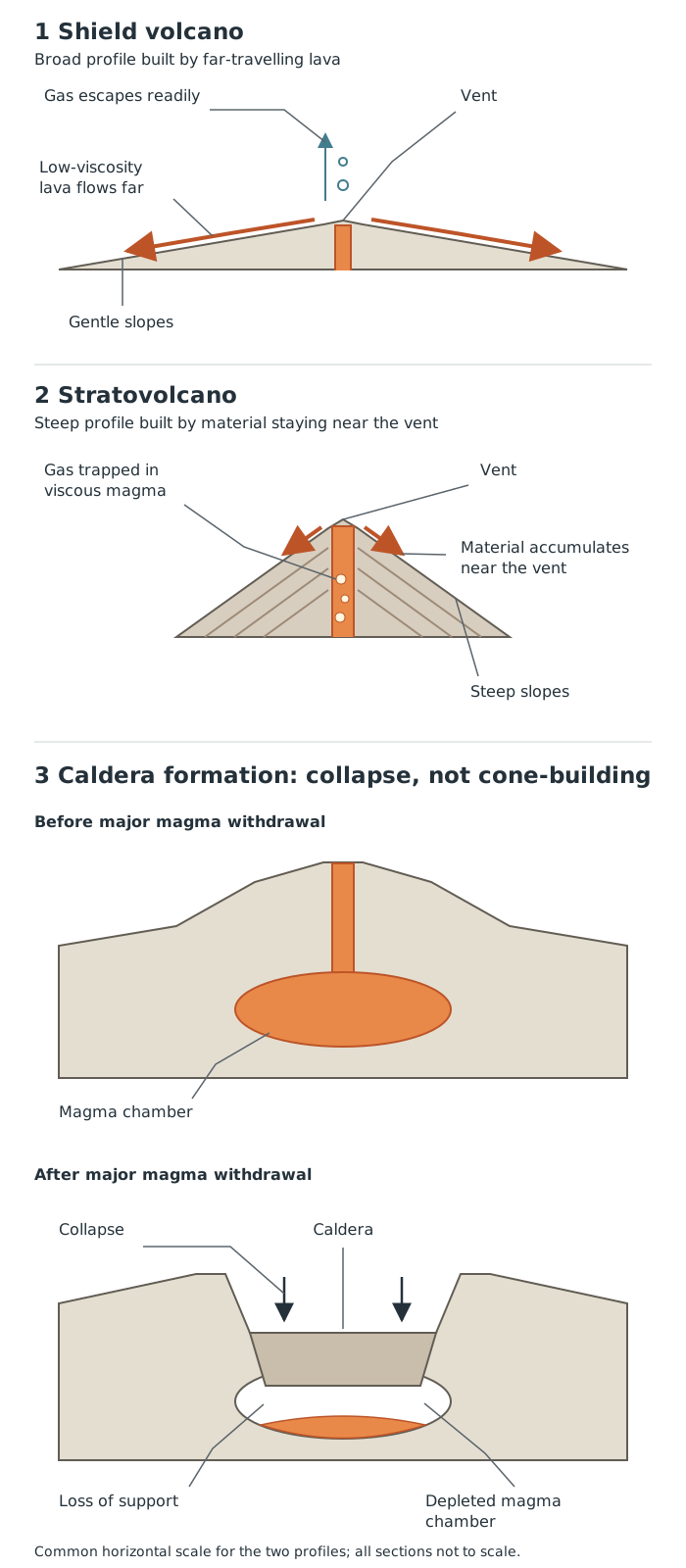
Lava behaviour controls volcano shape; loss of support above a depleted magma chamber can create a caldera.
A cinder cone is a small volcano made from scoria, also called cinders. Scoria is volcanic rock containing holes left by gas bubbles. During an eruption, fragments are thrown out of a vent and accumulate around it, building a cone.
Cinder cones can form during a single eruption. They may stand on their own or develop on the sides of larger volcanoes. Unlike the broad lava flows that build a shield volcano, the material forming a cinder cone is deposited close to its vent.
During a lava flow, the exposed surface cools and solidifies before the lava beneath it. This solid crust acts as insulation, slowing heat loss and allowing the liquid lava underneath to keep flowing far from the volcano’s crater.
When the lava supply ends, liquid lava can drain away from beneath the crust. An empty passage remains: a lava tube. Some tubes extend for hundreds of metres and are large enough to walk through.
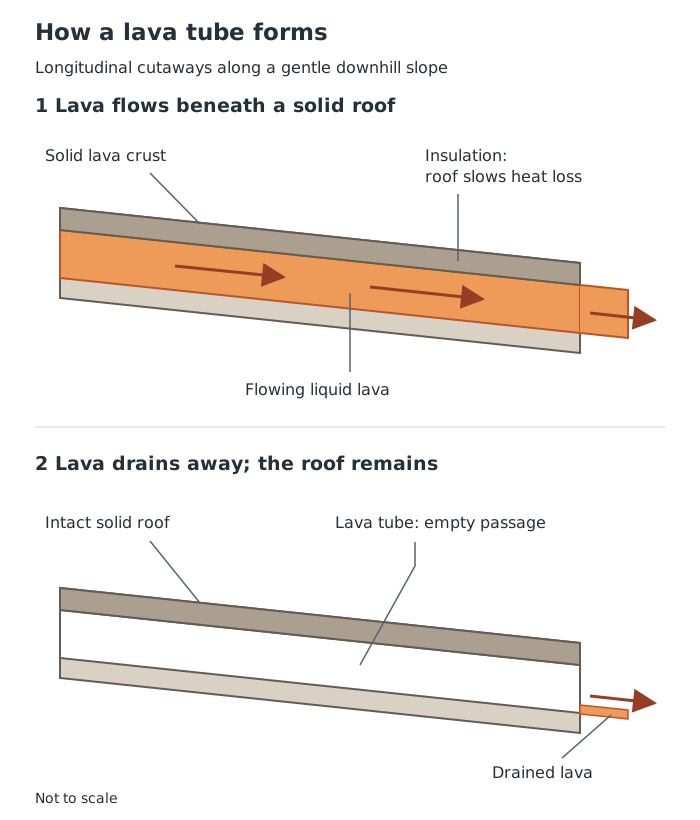
A solidified lava crust insulates the flow beneath it. Drainage leaves a hollow lava tube.
A geyser intermittently erupts hot water and steam, not lava. It forms where geothermal heat heats underground water and narrow passages restrict its escape.
Water enters cracks in the rock and is heated by the volcanic system below. Pressure underground allows it to become hotter than its surface boiling point without immediately boiling. As hot water rises, steam forms and expands within the restricted passages. This pushes some water out, reducing pressure in the system. More water then boils rapidly, and expanding steam forces hot water out through the vent.
The eruption stops as the water supply is depleted or the system cools. Water can collect and heat again, allowing another eruption. Old Faithful, in Yellowstone National Park in the USA, is a famous example.
Geysers show how the same volcanic system can create features at different scales: a large volcanic landscape may also contain small surface outlets powered by heat below ground.
For an explanation, link the process to the landform: low viscosity → lava travels farther → broad volcano with gentle slopes.
Compare shield volcanoes and stratovolcanoes using both their shape and the behaviour of their magma.
Explain caldera formation through loss of support and collapse, not simply by saying that an eruption makes a hole.
Keep the erupted materials distinct: cinder cones consist of scoria, whereas geysers erupt hot water and steam.
It can see this note and what your specification asks for.
Answers are free with an account.
1 free note left this week
Get more free notesYour answer sets when this note comes back for review, or marks it complete.
Was this note helpful?
Log in to tell us whether it helped, or to report a problem.
Last updated
Magma
Molten rock beneath the Earth’s surface.
Lava
Molten rock that has erupted onto the Earth’s surface.
Viscosity
A fluid’s resistance to flowing. High-viscosity magma is sticky and flows less easily than low-viscosity magma.
Volcanic vent
An opening through which volcanic material reaches the surface.
Shield volcano
A broad volcano with gentle slopes, built by low-viscosity lava that spreads far from its vent.
Stratovolcano
A steep-sided volcano built from volcanic material that accumulates around a vent; its viscous magma can trap gases and produce explosive eruptions.
Magma chamber
An underground reservoir where magma is stored.
Caldera
A large, roughly circular volcanic depression formed when the ground above a depleted magma chamber collapses.
Cinder cone
A small volcano built from fragments of scoria erupted around a volcanic vent.
Scoria
Volcanic rock containing holes left by gas bubbles; fragments of it are also called cinders.
Lava tube
A hollow passage left when flowing lava drains out from beneath a solidified lava crust.
Geyser
A geothermal feature that intermittently erupts hot water and steam through a surface vent.
Geothermal heat
Heat from within the Earth.
Put your knowledge into practice — try past paper questions for Geography A
Magma
Molten rock beneath the Earth’s surface.
Lava
Molten rock that has erupted onto the Earth’s surface.
Viscosity
A fluid’s resistance to flowing. High-viscosity magma is sticky and flows less easily than low-viscosity magma.
Volcanic vent
An opening through which volcanic material reaches the surface.
Shield volcano
A broad volcano with gentle slopes, built by low-viscosity lava that spreads far from its vent.
Stratovolcano
A steep-sided volcano built from volcanic material that accumulates around a vent; its viscous magma can trap gases and produce explosive eruptions.
Magma chamber
An underground reservoir where magma is stored.
Caldera
A large, roughly circular volcanic depression formed when the ground above a depleted magma chamber collapses.
Cinder cone
A small volcano built from fragments of scoria erupted around a volcanic vent.
Scoria
Volcanic rock containing holes left by gas bubbles; fragments of it are also called cinders.
Lava tube
A hollow passage left when flowing lava drains out from beneath a solidified lava crust.
Geyser
A geothermal feature that intermittently erupts hot water and steam through a surface vent.
Geothermal heat
Heat from within the Earth.
Volcanic landscapes form through accumulation, collapse, drainage and geothermal heating—not one single process.