

Loading…
Loading…
Loading…
Eduqas GCSE Design and Technology · C600
Eduqas C600 · Prototyping Techniques and Assembly Check the specification (PDF) (opens in a new tab)
A textile seam joins pieces of fabric by stitching them together. A high-quality seam must do more than hold: it should maintain the intended size and shape, lie smoothly and have a finish suitable for the fabric and the product’s use. A cushion edge, a sheer blouse and a hard-wearing pair of jeans therefore need different construction decisions.
Construction processes create and secure the product’s structure. Decorative processes improve its appearance. Some processes do both: piping defines an edge, while topstitching can decorate a seam and hold its allowances in position.
The seam line is where the pieces are stitched together. The seam allowance is the fabric between that line and the cut edge. It provides material for a secure join and, where the construction permits, later adjustment.
For a plain seam, place the fabric pieces with their right sides together—the surfaces intended to face outwards. Align the relevant edges and construction marks, then pin or tack the pieces so they cannot slide. Sew along the specified seam line, keeping the allowance consistent and securing the beginning and end with backstitching. Remove pins before they reach the needle; do not stretch or pull the fabric through the machine.
Accuracy means achieving the intended measurement. A tolerance states how much variation is acceptable. Suppose a product requires a seam allowance of 10 mm with a tolerance of ±1 mm: an allowance between 9 mm and 11 mm meets that requirement. These are example dimensions, not a standard allowance for all textiles. Sewing too far into the fabric can make a product smaller; sewing too close to the edge can leave an insecure join.
Use the machine’s seam guide and check the distance from the needle’s stitching line to the fabric edge. Before trimming, inspect the seam position and fit. Trimming removes material that cannot simply be put back. On bulky fabrics, grading—trimming the allowances to different widths—reduces the thickness concentrated at the seam while retaining enough fabric to support the stitches.
Press seams as construction proceeds rather than waiting until the end. A plain seam can be pressed open after its edges are finished; allowances overlocked together are pressed to one side. Use a temperature appropriate to the fabric, test on a scrap and keep fingers clear of the hot soleplate and steam. The finished seam should lie flat without puckering, scorching or a visible allowance imprint.
A striped or checked fabric can be joined securely yet still look poorly made if its pattern jumps across the seam. Repeating motifs also need visual checks for their vertical position, or pattern drop, and their match between adjoining pieces.
Lay the pieces in their intended relationship and compare the pattern at the future seam lines. The seam allowance will be hidden, so matching only the cut edges is not enough. Check that stripes continue, checks meet and motifs follow the intended repeat or offset. Tack the pieces to prevent movement, then check again after stitching and before trimming. Tacking is especially useful for slippery, loosely woven or bias-cut edges.
A standard presser foot holds fabric against the machine’s feed mechanism, but its shape can prevent the needle from getting close to a raised feature. A zipper foot allows stitching close beside zip teeth or piping cord.
Piping is cord wrapped in a strip of fabric, usually cut on the bias so it can follow curves. To make it, wrap the strip around the cord and use the zipper foot to stitch close beside the cord. To insert it, tack the piping to the right side of one panel, with its allowance towards the panel edge. Place the second panel on top, right sides together, and stitch close to the cord through the layers. When the panels are turned out, the covered cord projects neatly along the join.
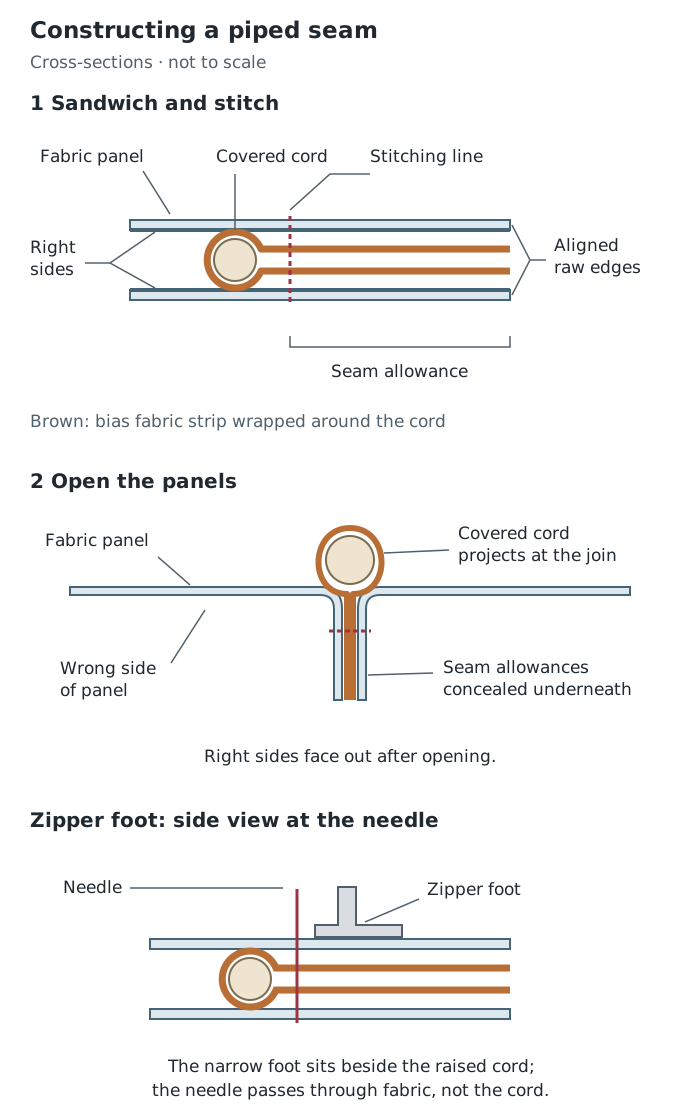
Piping is enclosed between the panels, with stitching close beside the cord so it forms an even raised edge.
Switch off the machine before changing the foot or needle, follow its instructions and check needle clearance before restarting. Test the arrangement on scraps. Successful piping has an even exposed width, smooth curves and no gaps between the seam and cord. It is useful on cushion edges and garment necklines where a defined edge is wanted.
An overlocker uses needle and looper threads to form stitches around an edge. With an appropriate seam-forming setting, it can join fabric, trim excess allowance with a blade and neaten the raw edge in one pass. This combines operations efficiently in manufacturing. It can also finish the edges of a seam that is joined separately on a conventional sewing machine.
The loops cover the raw edge and help prevent fraying. Balanced stitches have the upper and lower looper threads meeting evenly along the edge, rather than leaving loose loops hanging from one side. Test on scraps of the actual fabric and adjust according to the machine’s instructions. A starting stitch length of about 3 mm can suit medium-weight fabric; delicate or readily fraying fabric may need a shorter setting, such as 2 mm. These are trial settings, not universal rules.
Check fit and alignment before overlocking: the blade removes allowance as the seam is sewn, limiting later alterations. Keep fingers clear of the needle and blade, and remove pins well before they enter the cutting area. Switch off before threading or changing accessories. Secure the thread-chain ends, for example by drawing them back under the stitches with a suitable needle. The completed edge should be evenly covered, secure and free from puckering.
Sewing thread is the strand used to form stitches that join or decorate fabric. Its fibre, construction and thickness affect how well it sews and how the finished seam performs during movement, washing and wear.
General-purpose polyester thread is a versatile choice for dressmaking, repairs and everyday construction because it offers strength and durability. Spun polyester thread is stronger than cotton thread of comparable size and has good resistance to abrasion, helping seams withstand rubbing during use. It can be suitable for cotton clothing as well as polyester fabrics: the thread fibre does not have to be identical to the fabric fibre.
Cotton thread is a natural-fibre option commonly chosen for cotton patchwork and quilting, particularly where an all-cotton construction is wanted. It can also be used with cotton and linen fabrics. Both cotton and polyester may be suitable, so the choice should reflect the sewing technique and desired finish rather than simply the fabric’s name.
Corespun thread combines a continuous filament core with a covering of short fibres. For example, Coats Dual Duty has a polyester filament core for strength and durability, wrapped in cotton that supports sewing performance and protects the core from needle heat. This combination is useful for high-speed sewing and demanding products such as jeans and workwear, where seams must resist wear. It shows how combining fibres can meet several requirements in one thread.
For stretch knitted fabrics, such as jersey used in a close-fitting T-shirt, the seam must extend with the fabric rather than restrict movement or break. A specialist stretch thread, such as Gütermann Maraflex, can produce a flexible seam using a straight stitch when used according to its instructions. Select a compatible jersey or stretch needle and test the seam’s movement as well as its appearance.
Thread thickness must also suit the fabric, needle and required seam strength. Fine fabrics generally need fine thread and an appropriate fine needle to avoid unnecessary distortion. Heavier or highly loaded seams may require stronger thread, but choosing the thickest available thread can introduce unwanted bulk. Use a thread fine enough for a neat finish while still providing the strength required.
For unobtrusive construction, choose a thread colour and shade that blend with the fabric. Colour identifies the general hue; shade distinguishes variations within it. Compare actual thread or a physical shade card against the fabric, rather than relying only on screen colours. Contrast thread can deliberately emphasise topstitching or a decorative detail. On an overlocker, matching the needle thread is especially important because it may show at the seam on the right side; looper threads normally remain less visible.
Construction thread needs to make a reliable seam, whereas a decorative thread may be selected primarily for its visible effect. For example, a two-coloured thread can add a decorative effect to embroidery or stitching on denim. Even decorative thread must be compatible with the fabric, needle and machine. For overlocking, using one thread type consistently helps avoid uneven performance.
Stitch length controls spacing, not thread colour or type. Test the chosen thread, stitch length and tension on the same number of fabric layers as the product. Look for even stitches, no thread breakage or skipped stitches, and a seam that lies smoothly. For a stretch product, check that the trial seam extends sufficiently without breaking. Change the settings before committing to the product if the trial is unsatisfactory.
A plain seam is a straightforward join for many products. If the woven fabric frays, finish its raw edges with overlocking or zigzag stitching. Pinking can suit some light, closely woven fabrics, but is less effective on loose weaves.
A French seam encloses the raw edges and is useful for delicate or sheer fabrics, such as chiffon, where a bulky edge finish would be conspicuous. It is sewn first with wrong sides together, trimmed, then folded with right sides together and stitched again so the raw edges are enclosed. Its success depends on accurate widths: the trimmed edges must fit completely inside the final seam.
A flat-fell seam encloses raw edges in a flat, secure construction and is used on products such as jeans and sportswear. Its folded layers make it sturdy, but can be too bulky for some fabrics. A welt seam offers another option for thicker fabric: one allowance is trimmed, the other is finished and laid over it, then secured by topstitching.
Choose decoration just as carefully. Topstitching on pockets gives a visible, controlled line; piping emphasises an outline. Neither should introduce unwanted bulk or distortion. The best process is the one that achieves the required appearance and durability while respecting the fabric’s thickness, tendency to fray and behaviour during sewing.
Link a process choice to both a fabric property and the product’s use: for example, a French seam encloses fraying edges neatly in a sheer blouse.
Distinguish seam allowance from tolerance: allowance is fabric beyond the seam line; tolerance is the permitted variation from a specified measurement.
Use the specified seam allowance rather than assuming every pattern uses the same width.
Explain the accessory’s purpose: a zipper foot allows stitching close to piping cord, not just beside zip teeth.
Check pattern matching at the finished seam line, not only at the raw edges.
Stitch length is a machine setting, not a property of the thread.
Thread fibre does not always have to match fabric fibre: polyester thread can be suitable for cotton clothing. Justify the choice using the seam’s required performance.
It can see this note and what your specification asks for.
Answers are free with an account.
1 free note left this week
Get more free notesYour answer sets when this note comes back for review, or marks it complete.
Was this note helpful?
Log in to tell us whether it helped, or to report a problem.
Last updated
Seam
A join made by stitching two or more pieces of fabric together.
Seam allowance
The distance between the seam line and the cut edge of the fabric.
Tolerance
The permitted variation from a specified dimension or position.
Right side
The surface of a fabric intended to face outwards in the finished product.
Overlocker
A machine that forms stitches around a fabric edge and can trim away excess fabric while stitching.
Zipper foot
A sewing-machine presser foot that allows the needle to stitch close beside raised features such as zip teeth or piping cord.
Piping
Cord enclosed in a fabric strip and usually inserted into a seam to define or decorate an edge.
Stitch length
The distance the fabric advances between successive stitches, usually measured in millimetres.
Topstitching
Visible stitching on the right side of a product, used for decoration and sometimes to secure seam allowances.
Tacking
Temporary stitches used to hold fabric pieces in position before permanent stitching.
Corespun thread
Sewing thread made with a continuous filament core surrounded by a covering of short fibres, combining the properties of the core and covering.
Elasticity
The ability of a material to recover its original length or shape after being stretched or deformed.
Put your knowledge into practice — try past paper questions for Design and Technology
Seam
A join made by stitching two or more pieces of fabric together.
Seam allowance
The distance between the seam line and the cut edge of the fabric.
Tolerance
The permitted variation from a specified dimension or position.
Right side
The surface of a fabric intended to face outwards in the finished product.
Overlocker
A machine that forms stitches around a fabric edge and can trim away excess fabric while stitching.
Zipper foot
A sewing-machine presser foot that allows the needle to stitch close beside raised features such as zip teeth or piping cord.
Piping
Cord enclosed in a fabric strip and usually inserted into a seam to define or decorate an edge.
Stitch length
The distance the fabric advances between successive stitches, usually measured in millimetres.
Topstitching
Visible stitching on the right side of a product, used for decoration and sometimes to secure seam allowances.
Tacking
Temporary stitches used to hold fabric pieces in position before permanent stitching.
Corespun thread
Sewing thread made with a continuous filament core surrounded by a covering of short fibres, combining the properties of the core and covering.
Elasticity
The ability of a material to recover its original length or shape after being stretched or deformed.