

Loading…
Loading…
Loading…
Eduqas GCSE Design and Technology · C600
Eduqas C600 · Surface Treatments and Finishes Check the specification (PDF) (opens in a new tab)
A textile surface treatment changes the appearance or surface of fabric after it has been made. Colour and pattern can make a product attractive, communicate a message or help it fit its intended use. A printed logo, for example, identifies a team or organisation; a raised painted detail adds texture as well as colour.
The process must suit both the design and the textile. Natural and synthetic fibres do not necessarily accept the same dyes, and a heat-sensitive fabric may not tolerate the temperature needed to fix a paint or transfer. A treatment is only successful if the finished fabric retains the required colour, feel and suitability for use.
Dyeing changes the colour of fibres, yarn or fabric using dye. Printing applies a pattern or image to selected areas. Painting gives direct control with pens, brushes or other applicators, while transfers move an existing image onto the fabric.
Fabric can be immersed in a bath of water containing dye. The dye must be suitable for the fibres: natural dyes can work well with natural fibres, whereas synthetic fibres generally require specially formulated chemical dyes. Follow the dye instructions for any fixing agent, temperature and rinsing needed. Some dyes use a mordant, a substance that helps the colour bind to the fibres; not every dye uses the same fixing system.
The five dyeing techniques produce different effects:
Tie and dye and batik are both resist dyeing methods. Their shared principle is to protect selected areas from dye, but ties compress the fabric whereas wax forms a barrier on it.
For practical dyeing, protect the work surface, wear suitable gloves and an apron, and avoid splashes or inhaling dye powder. Handle hot dye baths carefully. Batik also involves hot wax, so use controlled heating and teacher supervision rather than an open flame. Complete the dye's specified fixing and rinsing stages before drying; assess the colour after the fabric is dry, and check that unwanted loose dye has been removed.
Printing places a design in chosen areas, often allowing it to be repeated. The tool controls where the colour reaches the fabric.
Silk-screen printing, also called screen printing, uses a screen with open areas that allow colour through and blocked areas that prevent it passing through. Colour is pushed through onto the fabric. Screens may be flat or cylindrical, and each screen applies a different colour. In a multicoloured design, the separate prints must line up accurately.
Roller printing uses circular rollers engraved with a design. As the fabric passes the rollers, the design is printed repeatedly. This makes it useful for repeated patterns across long lengths of fabric.
Block printing uses a relief block: its raised design carries the colour and is stamped onto the fabric. Repeated impressions can form a pattern, but placement and pressure affect the consistency of the result.
Stencilling uses a design cut into card or acetate. Paint or dye is applied through the openings, while the solid parts protect the fabric beneath them. Keeping the stencil still and controlling the amount of colour helps maintain clear edges.
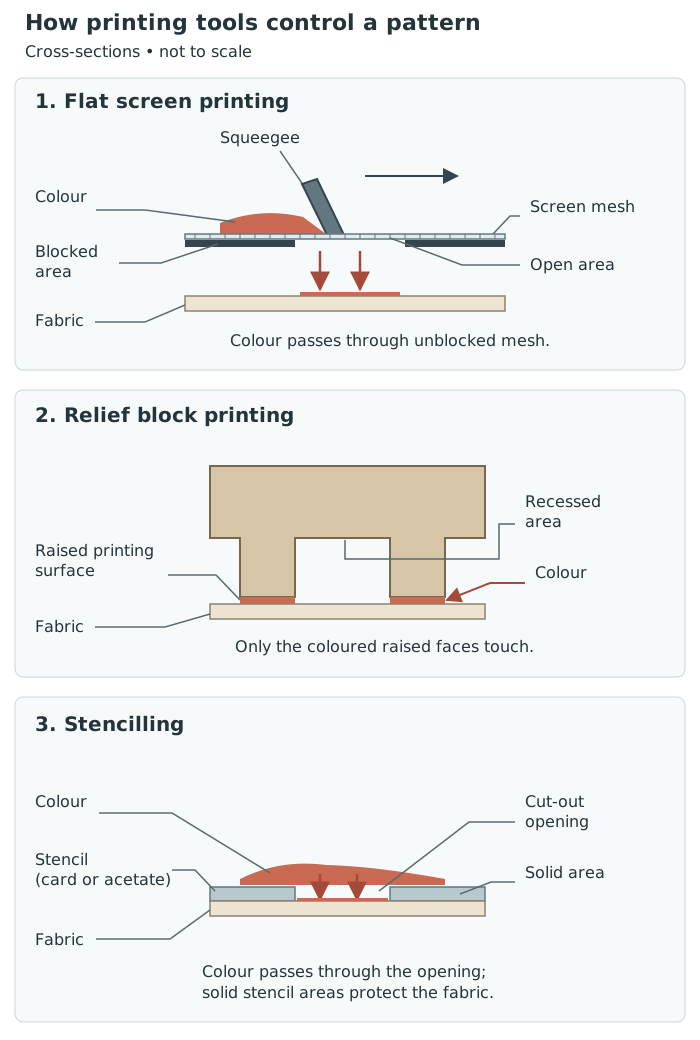
Screens, relief blocks and stencils control which parts of the fabric receive colour in different ways.
For these methods, the finished print should have the intended coverage, clear boundaries and correctly aligned repeats or colours. Allow it to dry and carry out any fixing required by the printing medium before using or washing it. Use cutting tools safely when preparing blocks or stencils, keeping fingers away from the cutting path.
Not all printing adds colour. Some processes create a pattern by selectively removing something already present.
Discharge printing uses a bleaching agent, applied through a screen, to destroy some of the colour in dyed fabric. This produces a paler design against the coloured background. The fabric remains, but its colour changes in the printed areas.
Burn-out printing uses an acid on a knitted polyester–cotton blended fabric. The acid destroys the cotton in selected areas, while the polyester resists it and remains. This creates patterned, finer areas in the fabric itself, not simply a paler colour.
The important distinction is therefore removing colour versus removing fibre. These chemical processes require suitable materials, protective equipment, ventilation and specialist supervision. They should not be improvised with household chemicals. Their processing and washing stages must follow the chemical instructions before the finished pattern is assessed.
Marbling creates a flowing, irregular pattern. Fabric paints float on a specialist paste; the colours are arranged on its surface, and fabric laid onto that surface picks up the pattern. The surface pattern must be ready before the fabric is placed on it. Lift the fabric carefully, then complete the paint's required drying and fixing stages.
Air brushing uses an air-operated tool to spray dye onto fabric. It can create an irregular surface pattern rather than the sharply repeated impression of a block. Control of the spray affects the coverage and appearance. Protect surrounding surfaces and use appropriate ventilation and protection against inhaling the spray.
These methods are useful where flowing or irregular effects are wanted. They offer less exact repetition than a fixed block, stencil or engraved roller.
Painting allows colour to be applied directly rather than through a printing tool. The four specified methods give different results:
For example, a cushion design can combine a splattered fabric-paint background with a detailed motif coloured using fabric felt pens. The methods perform different jobs within the same design.
Use a sample to check spreading, coverage and the effect on the fabric's feel. Let the work dry before fixing it as directed. Dimensional paint must retain its raised shape rather than being flattened. When heat fixing, use a stable ironing surface, protect against burns and follow the specified temperature, time and protective covering for the product and fabric.
An image-maker is a transfer medium that moves a photocopied image onto fabric. It is different from printing an image onto heat-transfer paper.
For the DYLON Image Maker process, start with washed, dry, washable fabric and place a protective backing beneath the design area. Coat the printed side of a black-and-white or colour photocopy generously with the medium, then place it paste-side down on the fabric. Smooth out wrinkles and use a paper towel and rolling pin to press it into contact, rolling in alternate directions for about one minute. Blot away excess paste.
Allow it to dry thoroughly for at least four hours, preferably overnight. Wet the paper and gently rub away its layers. After drying, remove remaining paper fuzz with a damp sponge. Once thoroughly dry again, rub a few drops of the medium over the image to seal it and leave it to dry.
The transfer is ready when the paper residue has been removed and the sealed image is thoroughly dry. Because the image is placed face down, its orientation reverses: lettering needs particular care. Keep the medium away from eyes and follow its handling instructions.
For this product, do not wash the fabric within the first 72 hours. Afterwards, hand wash in lukewarm water or use a 30°C gentle machine cycle with the garment inside out. Dry flat, do not dry clean and do not iron directly onto the image.
An ink-jet transfer starts with a digital image printed using an ink-jet printer onto specialist transfer paper. Heat then transfers the image onto the fabric. The computer-controlled printing stage is an example of computer-aided manufacture (CAM).
Prepare the design at the required size, check its position and use paper compatible with both the printer and the intended fabric. Follow that paper's instructions about whether the image must be mirrored. Print, position and heat-apply the transfer using the specified temperature, time and pressure, then remove the backing at the instructed stage.
A successful transfer is attached evenly, without wrinkles or lifting edges. Allow the transfer to cool as directed before checking or handling it. An iron or heat press can cause burns, so use a stable work area, keep hands away from hot surfaces and follow supervised operating procedures.
Ink-jet transfer suits detailed digital images, while image-maker transfers a photocopy through a medium and a drying-and-paper-removal process. Choose between them according to the required image, fabric compatibility, equipment and care needs.
Choose a dye and fixing system suitable for the fibres.
Match the method to the fabric, desired effect, repeatability and equipment. Check coverage, alignment, drying and fixing. Use suitable protection for chemicals and sprays, and supervised precautions for hot wax, irons and heat presses.
Link the chosen process to the fabric, intended effect and production needs: for example, roller printing suits repeated patterns on long lengths of fabric.
Distinguish discharge printing, which removes colour, from burn-out printing, which removes part of a blended fabric.
For resist dyeing, explain what prevents dye reaching the fabric: tight ties in tie and dye, or wax in batik.
Do not treat all transfers as iron-on processes. Image-maker uses a transfer medium; ink-jet transfer uses specialist paper and heat.
Include fabric paint as well as felt tip, dimensional paint and silk paint when recalling painting methods.
It can see this note and what your specification asks for.
Answers are free with an account.
1 free note left this week
Get more free notesYour answer sets when this note comes back for review, or marks it complete.
Was this note helpful?
Log in to tell us whether it helped, or to report a problem.
Last updated
Dyeing
Changing the colour of textile fibres, yarn or fabric using a suitable dye.
Textile printing
Applying a pattern or image to a textile using a process such as a screen, engraved roller or relief block.
Resist dyeing
A dyeing method in which selected areas are protected from dye, for example by tight ties or wax, to create a pattern.
Mordant
A substance used with some dyes to help the colour bind to the textile fibres.
Batik
A method of resist dyeing in which wax is applied to fabric before dyeing, protecting the waxed areas from the dye.
Discharge printing
Printing a bleaching agent onto dyed fabric to remove colour selectively and create a paler design.
Burn-out printing
A process that selectively destroys one fibre in a blended fabric, leaving the other fibre to form a patterned, finer structure.
Relief block
A shaped block whose raised surface carries colour and stamps a design onto fabric.
Gutta
An outline medium used on silk to form a barrier that prevents silk paint spreading across the outline.
Heat fixing
Using heat to fix a suitable textile colourant or transfer onto fabric, following the product instructions.
CAM
Computer-aided manufacture: using computer-controlled equipment to carry out a manufacturing process, such as printing a digital design onto transfer paper.
Put your knowledge into practice — try past paper questions for Design and Technology
Dyeing
Changing the colour of textile fibres, yarn or fabric using a suitable dye.
Textile printing
Applying a pattern or image to a textile using a process such as a screen, engraved roller or relief block.
Resist dyeing
A dyeing method in which selected areas are protected from dye, for example by tight ties or wax, to create a pattern.
Mordant
A substance used with some dyes to help the colour bind to the textile fibres.
Batik
A method of resist dyeing in which wax is applied to fabric before dyeing, protecting the waxed areas from the dye.
Discharge printing
Printing a bleaching agent onto dyed fabric to remove colour selectively and create a paler design.
Burn-out printing
A process that selectively destroys one fibre in a blended fabric, leaving the other fibre to form a patterned, finer structure.
Relief block
A shaped block whose raised surface carries colour and stamps a design onto fabric.
Gutta
An outline medium used on silk to form a barrier that prevents silk paint spreading across the outline.
Heat fixing
Using heat to fix a suitable textile colourant or transfer onto fabric, following the product instructions.
CAM
Computer-aided manufacture: using computer-controlled equipment to carry out a manufacturing process, such as printing a digital design onto transfer paper.