

Loading…
Loading…
Loading…
Eduqas GCSE Design and Technology · C600
Eduqas C600 · Properties and Ecological Footprint Check the specification (PDF) (opens in a new tab)
A polymer is a large molecule made from many repeating units. The small molecules used to build it are called monomers. During polymerisation, monomers join chemically to form long polymer molecules. Think of individual beads being connected into a long necklace: joining changes separate small units into a much larger structure.
Polythene, also called polyethylene, is an example. Its starting monomer is ethene; many ethene molecules join to form polythene. The resulting material has different properties from its starting substance. This is a chemical process, not simply melting or mixing ingredients.
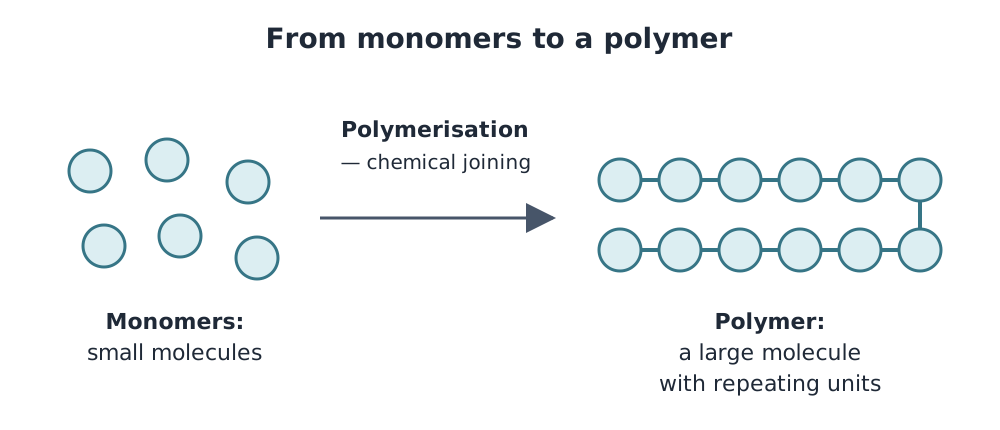
Polymerisation joins small monomer molecules to form much larger polymer molecules.
Polymers can have natural or synthetic origins. Natural polymers occur in living things: cellulose is found in plants, while wool and silk contain proteins. Natural resources such as cellulose can provide the starting material for plastics. Synthetic polymers are manufactured through chemical processes, commonly using raw materials obtained from crude oil. Polythene, PVC and nylon are examples.
‘Natural’ describes the origin, rather than guaranteeing that a material is suitable for a particular product. Designers still need to consider its properties. Also, not every natural polymer is a plastic: wool is a polymer material, but it is not a moulded plastic casing.
Thermoforming plastics, also called thermoplastics, soften when heated. They can be shaped and then cooled so that they retain the new shape. Heating can soften them again, allowing repeated reshaping without the shaping cycle itself causing a chemical change. This makes remelting possible for recycling.
Thermosetting plastics set permanently during their initial forming or curing process. Once cured, they cannot be softened and remoulded by reheating. They therefore cannot be recycled by the same melt-and-remould route as thermoplastics.
Curing is not identical for every thermoset. Epoxy resin, for example, is supplied as resin and hardener: mixing the two starts the process that produces the set material. The important distinction is between a thermoplastic’s reversible softening and a thermoset’s permanent setting.
A material’s physical properties include how it transfers heat and electricity. Most common plastics are poor conductors of both, making them useful insulators.
Low thermal conductivity means that heat travels through the material slowly. Heat resistance means that the material can withstand elevated temperatures without losing its useful properties. These are not interchangeable: a material may slow heat transfer but still soften when it becomes hot.
Electrical insulation means resistance to the passage of current. A plug casing needs to insulate the user from the conducting parts inside it; the casing and the internal metal contacts therefore need different properties.
Mechanical properties describe how materials respond to forces:
These properties must be considered at the temperature at which the product will be made and used. A plastic that is stiff at room temperature may become easy to shape when heated.
A useful material choice connects a property to a product requirement, rather than simply calling the material ‘strong’ or ‘good’.
| Plastic | Strengths and working properties | Weaknesses and selection reasons |
|---|---|---|
| Acrylic | Hard, weather-resistant and easy to bend or fold when heated. Available in transparent and coloured forms; cast acrylic machines well. | Scratches easily and can be brittle. Used for baths, car light covers and D&T projects; heated plasticity allows shaping, but brittleness limits suitability where impacts are likely. |
| Polythene | HDPE is lightweight and stiff, with excellent chemical resistance and good plasticity when heated. LDPE is tough and flexible. Polythene can be injection moulded or extruded. | HDPE is difficult to bond and has limited high-temperature use. HDPE suits buckets, bottles, pipes and washing-up bowls; flexible LDPE suits packaging film. |
| Polyvinyl chloride, PVC | Low-cost, strong, chemically resistant and weather-resistant. Available in rigid or flexible, glossy or matt forms. | Rigid grades can be brittle and scratch. Rigid PVC suits window frames, guttering and cladding; plasticised, flexible PVC suits cable insulation. |
| Polypropylene, PP | Lightweight, strong and tough, with good heat and chemical resistance. Can be bent repeatedly without breaking, allowing integral hinges. | Difficult to paint and can discolour under ultraviolet light. Used for computer game cases, patio chairs, toys and food-wrapping film; toughness suits products exposed to knocks. |
Polystyrene is another thermoforming polymer. It is inexpensive and available as sheet or foam, with opaque coloured and transparent forms. Polystyrene sheet is used for vacuum forming in schools: the ability to soften and take a new shape is central to this use.
Foaming changes how a plastic behaves by creating a structure containing many gas-filled cells. Polystyrene foams are very light and provide thermal insulation because the trapped gas slows heat transfer.
Expanded polystyrene (EPS) is made from beads that expand and are fused together in a mould. It is the familiar beaded foam used for protective packaging and insulation boards. It is inexpensive, lightweight and can be moulded into packaging shapes or cut from blocks into boards.
EPS has limitations: it is combustible, and the small spaces between its fused beads can allow water uptake during prolonged wet exposure. Standard EPS also has lower compressive strength than XPS, although its performance varies with grade. It is useful where low cost, low weight and insulation matter, but persistent moisture or heavy loading can make another material more suitable.
Styrofoam is a trade name for extruded polystyrene (XPS), rather than a technical name for EPS. XPS is made by extruding a foamed polystyrene mixture through a shaped opening to produce a continuous board. Its uniform closed-cell structure gives it good thermal insulation, greater resistance to water absorption and higher compressive strength than standard EPS.
These properties make XPS useful for insulation in damp or load-bearing situations. Its disadvantages include higher cost and a smooth surface that can make adhesive bonding more difficult. The choice is therefore a trade-off: EPS offers economical insulation, while XPS offers better moisture and load resistance where those properties are needed.
Thermosets are useful where a permanently set material and particular resistance or insulation properties are needed.
| Plastic | Strengths and working properties | Weaknesses and selection reasons |
|---|---|---|
| Urea formaldehyde | Hard and stiff, with excellent electrical insulation. Once set, it cannot be remoulded by heating. | Brittle, so it can break under impact. Used for switches, plugs and electrical fittings: insulation helps separate the user from live conducting parts. |
| Melamine formaldehyde, often called melamine | Excellent resistance to heat, moisture, scratching and staining. Once set, it cannot be remoulded by heating. | Brittle and can crack under impact. Used for kitchen worktop laminates and tableware, which encounter hot items, spills and surface wear. |
| Epoxy resin | Supplied as resin and hardener. Mixing produces a very strong adhesive with good chemical and heat resistance and excellent thermal insulation. | The cured resin can be brittle and cannot be remoulded by heating. Used for adhesive joints where a strong bond and resistance to heat or chemicals are needed. |
For these materials, permanent setting is useful when the finished shape or bond must remain stable. It is a limitation if the designer needs a product that can later be reshaped by heating.
Start with the product’s job, then identify the property needed. For an outdoor window frame, weather resistance makes rigid PVC a suitable choice. For a plug casing, electrical insulation makes urea formaldehyde suitable. For a kitchen worktop surface, melamine’s resistance to heat, moisture, scratches and stains addresses several demands at once.
A choice also involves trade-offs. Acrylic offers useful heated plasticity and weather resistance, but scratching and brittleness may limit its suitability. Polycarbonate is a better candidate where impact resistance is the priority, despite its lower hardness. Thermoplastics can be reheated for reshaping, but that same response to heat must be considered during use. Thermosets retain their permanently set form, but cannot be remoulded in this way.
Finally, consider the material’s supplied form. Polymers are available as sheet, film, bar, rod and tube. The appropriate form depends on the component and how it will be made; a thin film and a rigid sheet do not serve the same purpose.
Justify a material choice by linking a named property to the product’s needs: urea formaldehyde is an electrical insulator, so it is suitable for a plug casing.
Distinguish hardness from toughness: resisting scratches is not the same as resisting impact.
Use ‘thermoforming’ or ‘thermoplastic’ for plastics that can be softened and reshaped by reheating. A cured thermosetting plastic cannot be remoulded this way.
Do not assume every grade of a polymer behaves identically: PVC, for example, can be rigid or flexible.
Low thermal conductivity does not automatically mean high heat resistance. These describe different behaviours.
Distinguish expanded polystyrene (EPS) from Styrofoam, a trade name for extruded polystyrene (XPS), rather than treating all polystyrene foams as identical.
It can see this note and what your specification asks for.
Answers are free with an account.
1 free note left this week
Get more free notesYour answer sets when this note comes back for review, or marks it complete.
Was this note helpful?
Log in to tell us whether it helped, or to report a problem.
Last updated
Polymer
A large molecule made from many repeating units joined together.
Monomer
A small molecule that can join with other monomer molecules to form a polymer.
Polymerisation
The chemical process in which monomers join together to form polymers.
Natural polymer
A polymer occurring in nature, such as cellulose or the proteins in wool and silk.
Synthetic polymer
A polymer manufactured through chemical processes, commonly using raw materials obtained from crude oil.
Thermoforming plastic
A plastic that softens when heated and can be shaped, cooled and reheated for reshaping.
Thermosetting plastic
A plastic that sets permanently during curing and cannot subsequently be softened and remoulded by heating.
Thermal conductivity
The ability of a material to transfer heat. A material with low thermal conductivity is a thermal insulator.
Electrical conductivity
The ability of a material to allow electric current to pass through it.
Electrical insulation
Resistance to the passage of electric current.
Tensile strength
A material’s ability to resist pulling forces without breaking.
Toughness
A material’s ability to absorb energy and withstand impact without breaking.
Plasticity
A material’s ability to undergo a permanent change of shape without breaking.
Malleability
A material’s ability to be shaped under compressive forces, such as pressing, without cracking.
Hardness
Resistance to scratching, indentation and surface wear.
Expanded polystyrene
A lightweight polystyrene foam made from expanded beads fused together, used for packaging and thermal insulation.
Styrofoam
A trade name for extruded polystyrene (XPS) foam insulation, not the technical name for expanded polystyrene (EPS).
Put your knowledge into practice — try past paper questions for Design and Technology
Polymer
A large molecule made from many repeating units joined together.
Monomer
A small molecule that can join with other monomer molecules to form a polymer.
Polymerisation
The chemical process in which monomers join together to form polymers.
Natural polymer
A polymer occurring in nature, such as cellulose or the proteins in wool and silk.
Synthetic polymer
A polymer manufactured through chemical processes, commonly using raw materials obtained from crude oil.
Thermoforming plastic
A plastic that softens when heated and can be shaped, cooled and reheated for reshaping.
Thermosetting plastic
A plastic that sets permanently during curing and cannot subsequently be softened and remoulded by heating.
Thermal conductivity
The ability of a material to transfer heat. A material with low thermal conductivity is a thermal insulator.
Electrical conductivity
The ability of a material to allow electric current to pass through it.
Electrical insulation
Resistance to the passage of electric current.
Tensile strength
A material’s ability to resist pulling forces without breaking.
Toughness
A material’s ability to absorb energy and withstand impact without breaking.
Plasticity
A material’s ability to undergo a permanent change of shape without breaking.
Malleability
A material’s ability to be shaped under compressive forces, such as pressing, without cracking.
Hardness
Resistance to scratching, indentation and surface wear.
Expanded polystyrene
A lightweight polystyrene foam made from expanded beads fused together, used for packaging and thermal insulation.
Styrofoam
A trade name for extruded polystyrene (XPS) foam insulation, not the technical name for expanded polystyrene (EPS).
| Polycarbonate | Absorbs impacts well and can be cut easily. | Less hard than acrylic, so high impact resistance should not be mistaken for high surface hardness. Used for eye protection, machine guards and riot shields, where resisting impact is particularly important. |
| Nylon | Strong, easy to mould and available as fibres or engineering shapes. Engineering grades can be machined and threaded. Its slippery surface provides useful low friction. | Absorbs moisture and can degrade in strong sunlight unless stabilised. Used for clothing, gears, bearings, washers and bushes; low friction is valuable in moving components. |
| Material | Recall links |
|---|---|
| Acrylic | Hard, weather-resistant, shapeable when heated; brittle and easily scratched. |
| Polythene | HDPE: stiff, lightweight, chemically resistant; bottles and pipes; difficult to bond. LDPE: flexible; packaging film. |
| PVC | Rigid or flexible grades; weather resistance for frames and guttering; rigid grades can be brittle. |
| PP | Tough, lightweight, repeatable bending for hinges; difficult to paint. |
| Polycarbonate | Impact-resistant, easily cut; guards and eye protection; less hard than acrylic. |
| Nylon | Strong, slippery, mouldable and machinable; gears and bearings; absorbs moisture. |
| EPS | Fused-bead foam; lightweight, economical insulation and packaging; water uptake and lower load resistance than XPS. |
| Styrofoam/XPS | Extruded foam; insulation with better moisture and compressive resistance; higher cost and harder to bond. |