

Loading…
Loading…
Loading…
Eduqas GCSE Design and Technology · C600
Eduqas C600 · Properties and Ecological Footprint Check the specification (PDF) (opens in a new tab)
A plastic product’s ecological footprint includes its effects on resources, habitats, pollution, energy use and waste throughout its life. Its social footprint concerns effects on people and communities. These footprints extend beyond the factory: obtaining raw materials can affect local water supplies, while choices about disposal affect the communities handling waste.
Many synthetic plastics are made using raw materials derived from crude oil. This connects an everyday plastic product to oil exploration and extraction, even if the finished product needs no energy during use. A greener approach therefore considers the whole journey, not just whether the product can eventually be recycled.
Exploration means searching for oil reserves; extraction means bringing oil out of the ground. Both can affect the environment. Clearing vegetation for land-based drilling removes habitats. Offshore exploration can use seismic techniques whose sound may harm fish and marine mammals.
Oil can also escape during extraction or transport. Spills contaminate soil and water, damaging ecosystems, and can create fire and explosion hazards. Where oil extraction uses hydraulic fracturing, large water requirements can compete with other uses, and poorly handled fluids or wastewater can cause pollution. These consequences connect environmental harm with people’s safety and access to resources.
The impacts can be reduced, although not eliminated. More accurate exploration can reduce the number of exploratory wells. Smaller drilling rigs disturb less land, while directional drilling can reach a larger area from fewer wells. Safe operating procedures, spill prevention and environmental regulation also help limit damage.
A greenhouse gas absorbs outgoing heat radiation and contributes to warming the atmosphere. Carbon dioxide is an important example.
Extracting oil, transporting it and producing plastic require energy. Pumps, machinery and transport need power; manufacturing also uses energy to operate equipment and provide heat. Where this energy comes from burning fossil fuels, carbon dioxide is released. The environmental cost of a plastic product therefore begins before it reaches the user.
Manufacturing can also produce waste material, chemical pollutants, noise and heat. Reducing unnecessary material use, avoiding production waste and using lower-carbon energy can reduce these impacts. Recycling is valuable, but it is not a substitute for making production more efficient.
Life-cycle analysis (LCA) evaluates the environmental impacts of a material or product from raw material extraction through manufacture and use to disposal, recycling or reuse. Designers use it to identify where the greatest impacts occur and where changes would be most effective. Transport must also be considered between stages.
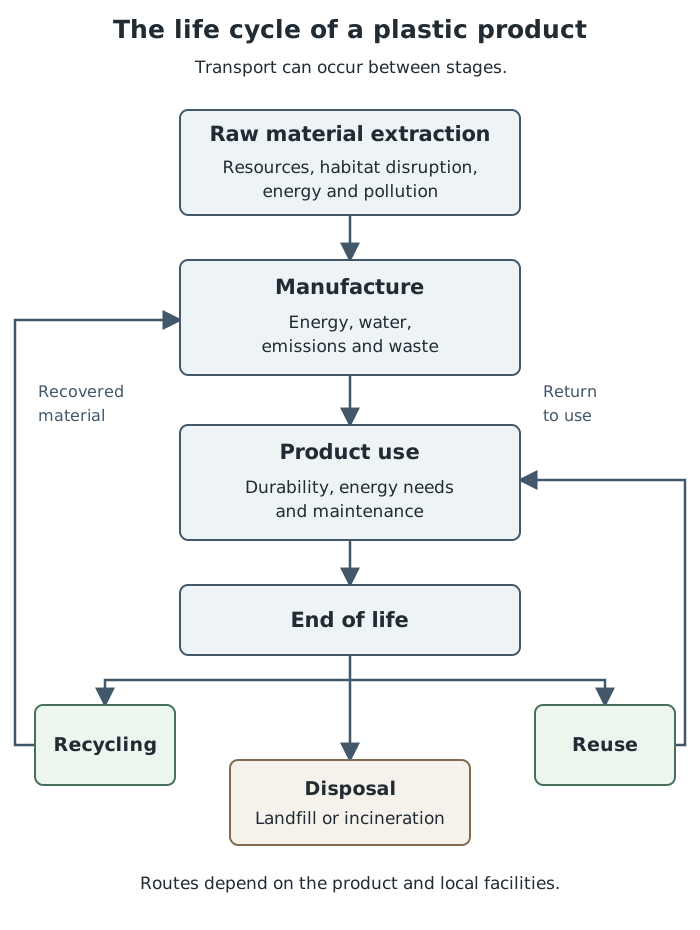
Life-cycle analysis considers impacts across the whole journey, including transport and the options available at the end of use.
At each stage, a designer asks different questions:
Following these stages through to final disposal is often called cradle to grave. Recycling can return material to production rather than ending its useful life immediately.
An acrylic desk lampshade shows why the stages must be considered separately. During use, the shade itself needs no energy and transmits light efficiently. Acrylic’s resistance to weathering and ultraviolet light can help it last longer. However, it scratches easily, which can reduce its useful life, and cleaning may require specialist products.
Those use-stage benefits do not remove the impacts of obtaining raw materials, making the acrylic, forming the shade and transporting it. Nor do they guarantee that the shade will be recycled when discarded.
A designer could improve the product by making the shade replaceable and easy to separate from the rest of the lamp. This supports repair and material recovery. A justified judgement weighs these benefits against the impacts of manufacture and the recycling facilities actually available; it does not assume that one favourable property makes the entire product sustainable.
Reuse keeps a product in use without turning its material into a new material. Recycling processes waste material for use in new materials or products. Both can help reduce the demand for new raw materials and the amount sent for disposal.
Encouraging recycling of all plastics means treating plastic as a potentially valuable resource rather than automatically as rubbish. It also requires practical support: clear disposal information, suitable collection facilities and products whose different materials can be separated. Users need to follow the requirements of the available recycling service rather than assume that every plastic item belongs in the same collection.
Designers can support a greener world by reducing unnecessary material, making products durable and repairable, enabling reuse and planning for recycling from the start. Society’s participation matters too: a product designed for recycling still needs to be collected and handled appropriately. The strongest approach combines responsible design, informed user behaviour and effective waste-management facilities.
Raw material extraction → manufacture → use → end of life, with transport between stages.
Consider resources, energy, emissions, pollution, waste, durability, maintenance and disposal options. Use LCA to locate major impacts and compare improvements across the whole life cycle.
Acrylic lampshade: no energy consumed by the shade during use; useful light transmission and weathering resistance. Scratching and cleaning requirements are limitations. Manufacture and disposal still matter.
Reduce unnecessary material; extend life through durability and repair; enable reuse and .
Link each environmental impact to a stage and a cause: for example, clearing vegetation for oil wells can destroy habitats.
Distinguish the energy used by a plastic component from that used by the whole product: a lampshade does not consume electricity, but the lamp does.
When recommending recycling, consider material separation and available facilities. Encouraging recycling of all plastics does not mean every plastic is currently accepted everywhere.
Support a sustainability judgement with benefits and limitations across the life cycle, rather than calling a material simply ‘environmentally friendly’.
It can see this note and what your specification asks for.
Answers are free with an account.
1 free note left this week
Get more free notesYour answer sets when this note comes back for review, or marks it complete.
Was this note helpful?
Log in to tell us whether it helped, or to report a problem.
Last updated
Ecological footprint
The effects that obtaining, making, using and disposing of a material or product have on the environment.
Social footprint
The effects that obtaining, making, using and disposing of a material or product have on people and communities.
Life-cycle analysis
A method of evaluating a material’s or product’s environmental impacts across its life, from raw material extraction through manufacture and use to disposal, recycling or reuse.
Raw material extraction
The obtaining of natural resources used to make materials or products, such as drilling for crude oil.
Greenhouse gas
A gas, such as carbon dioxide, that absorbs outgoing heat radiation and contributes to warming the atmosphere.
Recycling
Processing waste materials so that they can be used to make new materials or products.
Reuse
Using a product again without processing its material into a new material.
Cradle to grave
An approach that considers a product’s environmental impacts from obtaining its raw materials to its final disposal.
Put your knowledge into practice — try past paper questions for Design and Technology
Ecological footprint
The effects that obtaining, making, using and disposing of a material or product have on the environment.
Social footprint
The effects that obtaining, making, using and disposing of a material or product have on people and communities.
Life-cycle analysis
A method of evaluating a material’s or product’s environmental impacts across its life, from raw material extraction through manufacture and use to disposal, recycling or reuse.
Raw material extraction
The obtaining of natural resources used to make materials or products, such as drilling for crude oil.
Greenhouse gas
A gas, such as carbon dioxide, that absorbs outgoing heat radiation and contributes to warming the atmosphere.
Recycling
Processing waste materials so that they can be used to make new materials or products.
Reuse
Using a product again without processing its material into a new material.
Cradle to grave
An approach that considers a product’s environmental impacts from obtaining its raw materials to its final disposal.
Recycling depends on material separation, collection and suitable facilities. Encouraging recycling of all plastics is an aim, not a guarantee that every item is locally recyclable.