

Loading…
Loading…
Loading…
Eduqas GCSE Design and Technology · C600
Eduqas C600 · Factors Influencing Material Selection Check the specification (PDF) (opens in a new tab)
A sheet used to develop a drawing needs different properties from a box used to deliver a fragile product. Selecting paper or board means deciding which properties matter most for the intended use, then balancing benefits against limitations.
Functional properties determine how well the material does its job. These include stiffness, resistance to tearing or crushing, cushioning, printability and the ability to crease and fold. Aesthetic properties affect its appearance and feel: colour, texture, smoothness, opacity and surface finish. A retail carton needs to carry attractive graphics as well as hold its contents; a delivery box may prioritise protection over a refined finish.
Cost and availability also influence selection. Low-cost paper is useful for numerous early sketches, whereas a more substantial sheet may be justified for a final presentation. The best choice is not necessarily the strongest or most expensive material: it is the one that meets the requirements without unnecessary cost or bulk.
Paper and board grades are often described using grams per square metre, or gsm. An 80 gsm sheet has a mass of 80 grams for each square metre of material. This does not mean that every sheet weighs 80 grams. Thickness can instead be measured in microns; one micron is 0.001 mm. Materials with different structures can have different thicknesses and stiffnesses even at a similar gsm.
A smooth surface supports clear printed detail, while a slightly textured surface gives pencil something to grip. Opacity matters when printing must not show through from the other side. For tracing and overlays, the opposite is useful: enough light must pass through to reveal the drawing underneath.
Layout paper is thin, lightweight, white and semi-transparent. It is commonly around 50–60 gsm. Its low cost makes it suitable for initial product ideas and drawing layouts. Its smooth surface takes colour well, and its semi-transparency helps with overlay work.
The disadvantage is its weakness: it tears easily and is awkward to handle or store without damage. It is therefore better for developing ideas than for a durable final display. Its thinness is an advantage during design development, but a disadvantage when the sheet must withstand repeated handling.
Tracing paper has a very smooth, translucent surface. Placing it over an existing drawing lets a designer copy an outline or develop a different version without redrawing everything. It is useful for working drawings, transferring designs and comparing alternatives while preserving the original.
Its relatively hard surface allows mistakes to be removed, but a thin sheet is still flimsy in handling and vulnerable when wet. It is also more expensive than ordinary paper. Choose it when seeing the drawing beneath is essential, rather than simply as a costly replacement for everyday sketching paper.
Copier paper is usually a lightweight, smooth paper, commonly around 80 gsm. It is inexpensive and suitable for photocopying, printing everyday documents and making quick sketches. Its surface allows text and simple graphics to appear clearly.
However, it is not suitable for wet media. A lightweight sheet can distort when wetted and lacks the substance needed for a robust presentation. For an everyday printed document this may not matter; for a carefully painted design visualisation it does.
Cartridge paper is heavier and slightly textured. Its surface texture, called tooth, helps pencil grip the sheet. It is useful for sketching, design drawings and artwork using pencil, ink or light washes. Its greater substance makes it more durable than layout paper, and it can withstand repeated erasing.
It is not transparent enough for tracing. Heavy marker use can bleed through, and suitability for paint depends on the grade and how much water is used. Cartridge paper is a stronger choice than copier paper for a pencil presentation drawing, but it should not be treated as suitable for every drawing medium.
Recycled paper contains fibres recovered from used paper. It can be selected for everyday documents or printed products to reduce demand for virgin pulp and make use of waste material.
Its appearance and performance depend on the grade: recycled paper is not necessarily rough or grey. Colour, smoothness and printing quality still need to suit the intended product. Recycling shortens fibres, which can reduce strength; blending recovered fibres with virgin fibres can help maintain performance.
The advantage is the use of recovered material. A possible disadvantage is reduced strength where shorter fibres affect the grade. For an ordinary printed leaflet, a suitable recycled paper may meet the requirements well. For a product needing greater tear resistance, its actual strength needs checking rather than assuming that recycled content guarantees suitability.
Mounting board is a dense, rigid board used to support artwork, photographs and presentation displays. Its stiffness keeps work flat and gives a display a substantial, finished appearance. Its visible colour and surface should complement the work being mounted.
That rigidity is useful for display but makes it a poor choice when a product must bend and fold easily. It is bulkier than paper and is not a direct substitute for a lightweight sheet used for sketches or everyday printing. Choose it where support and presentation quality justify the extra substance.
Folding boxboard is a multi-layer board designed for folding cartons. Its layers provide stiffness, while its construction allows clean creasing and folding. A smooth, often coated white printing surface supports branding, product information and attractive graphics. Typical uses include cereal cartons, cosmetics packaging and other retail boxes.
Its advantage is the balance between holding a box shape and folding into that shape. However, it does not provide the cushioning of a fluted corrugated structure. It is a good choice for a printed retail carton, but less suitable on its own when a fragile item needs protection against delivery impacts.
Corrugated board has a wavy paper layer, called fluting, between flat liner sheets. This separates the liners and creates a lightweight structure with good stiffness, compressive strength and cushioning. These properties make it useful for shipping boxes, protective packaging, structural models and displays.
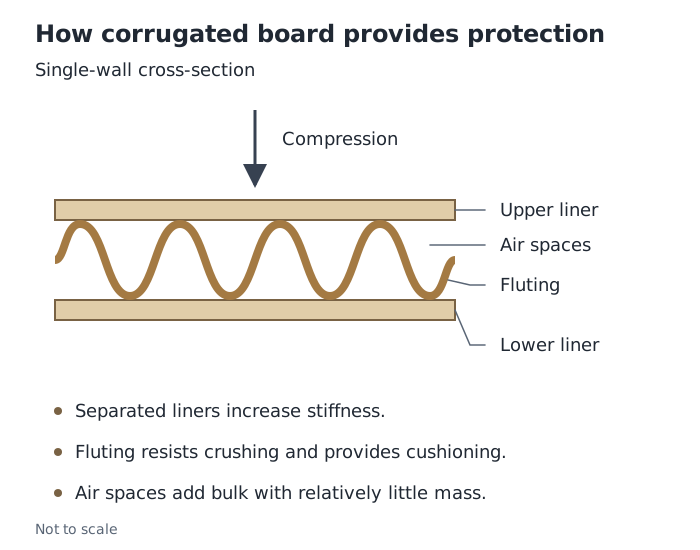
Flat liners and a fluted inner layer create a lightweight structure suited to protective packaging.
The fluted construction explains why corrugated board is chosen for protection rather than simply using a flat sheet of the same mass. It provides bulk and cushioning without needing a completely solid thickness of material.
Its limitations include vulnerability to moisture, which can cause warping, and a less refined finish than smooth presentation boards. It is generally less suitable for high-quality printed detail, although it can carry packaging graphics. The exposed fluted edge may also be undesirable on a carefully finished model.
Consider a fragile item sold in a printed carton and then delivered to a customer. Folding boxboard is useful for the retail carton because it combines printable surfaces with clean folds. Corrugated board is more suitable for the outer shipping box because cushioning and resistance to crushing are more important there. Neither is universally better: they solve different problems.
A sound evaluation follows the same reasoning for any paper or board: identify the requirement, explain how a property meets it, recognise a relevant limitation, and conclude whether the benefit outweighs that limitation for this particular use.
| Material | Main reason to choose it | Main limitation |
|---|---|---|
| Layout paper | Thin, semi-transparent and inexpensive; initial ideas and layouts | Weak and easily torn |
| Tracing paper | Translucent and smooth; copying, overlays and working drawings | Flimsy, vulnerable when wet and relatively expensive |
| Copier paper | Smooth and low-cost; printing and photocopying | Unsuitable for wet media or robust presentations |
| Cartridge paper | Heavier, with tooth; drawing and presentation sketches | Not suitable for tracing; heavy markers may bleed |
| Recycled paper | Uses recovered fibres; suitable grades serve everyday printing | Shortened fibres can reduce strength; quality varies |
| Material | Main reason to choose it | Main limitation |
|---|---|---|
| Mounting board | Dense and rigid; supporting artwork and displays | Bulky and unsuitable for easy folding |
| Folding boxboard | Stiff, printable and cleanly creasable; retail cartons | Less cushioning than corrugated board |
| Corrugated board | Fluted structure gives cushioning and crush resistance; shipping boxes | Moisture-sensitive and less refined for presentation |
Link a material property to the product requirement: corrugated board cushions impacts, helping protect goods during delivery.
When evaluating, give a relevant advantage and disadvantage, then decide which matters most for the stated use.
Avoid claims such as ‘thicker is always better’. Thinness is useful for overlays; stiffness is useful for displays.
Do not confuse gsm with thickness: gsm measures mass per unit area, while microns measure thickness.
Recycled paper describes the fibre source, not one fixed appearance or quality. Judge the particular grade against the product requirements.
It can see this note and what your specification asks for.
Answers are free with an account.
1 free note left this week
Get more free notesYour answer sets when this note comes back for review, or marks it complete.
Was this note helpful?
Log in to tell us whether it helped, or to report a problem.
Last updated
Aesthetic property
A characteristic affecting how a material or product looks or feels, such as colour, texture or surface finish.
Functional property
A characteristic affecting how well a material performs its intended job, such as stiffness, strength or ability to fold.
Stiffness
Resistance to bending; a stiff material helps a product retain its shape.
Opacity
The extent to which a material prevents light passing through it. An opaque sheet conceals what is behind it.
Translucency
The ability to let light pass through. Translucent tracing paper allows a drawing beneath it to be seen for copying or overlay work.
GSM
Grams per square metre: a measure of paper or board’s mass per unit area, not its thickness.
Fluting
The wavy paper layer between the flat liners of corrugated board, which contributes to cushioning and resistance to crushing.
Compressive strength
The ability of a material to resist being squeezed or crushed.
Tooth
The slight surface texture of drawing paper that helps pencil and other drawing media grip the surface.
Put your knowledge into practice — try past paper questions for Design and Technology
Aesthetic property
A characteristic affecting how a material or product looks or feels, such as colour, texture or surface finish.
Functional property
A characteristic affecting how well a material performs its intended job, such as stiffness, strength or ability to fold.
Stiffness
Resistance to bending; a stiff material helps a product retain its shape.
Opacity
The extent to which a material prevents light passing through it. An opaque sheet conceals what is behind it.
Translucency
The ability to let light pass through. Translucent tracing paper allows a drawing beneath it to be seen for copying or overlay work.
GSM
Grams per square metre: a measure of paper or board’s mass per unit area, not its thickness.
Fluting
The wavy paper layer between the flat liners of corrugated board, which contributes to cushioning and resistance to crushing.
Compressive strength
The ability of a material to resist being squeezed or crushed.
Tooth
The slight surface texture of drawing paper that helps pencil and other drawing media grip the surface.