

Loading…
Loading…
Loading…
Eduqas GCSE Design and Technology · C600
Eduqas C600 · Manufacturing Scales and Processes Check the specification (PDF) (opens in a new tab)
The scale of production is how many products are made and how production is organised. A single card packaging prototype needs a different approach from thousands of identical cereal boxes. Manufacturers choose an approach that suits demand, the required consistency and the cost of setting up equipment.
Paper and board products often need identical shapes and dimensions. Packaging must fit its contents, folds must line up and components must fit together. Repeating a process accurately therefore matters even when the quantity is quite small.
One-off production makes a single product. It may be a prototype used to test a design, or a bespoke product made for a particular customer. For example, a designer might hand-cut, score, fold and glue one card package to check its size and shape before committing to production.
The main advantage is freedom to meet a particular need: the owner can have an original product, and a prototype can be altered as the design develops. There is no need to set up a complete production line for just one item.
However, much of the work is done manually. Marking out, cutting and assembling each part takes time, so the labour cost per product can be high. This is worthwhile when uniqueness or testing is important, but unsuitable for supplying large quantities quickly.
Batch production makes a limited quantity at one time. A printer might produce a batch of 500 event invitations, or a manufacturer might make a limited run of seasonal packaging. Equipment and reusable guides can help keep the products consistent, and another batch can be made later.
This approach matches production to a limited demand without committing to a continuously running line. Between batches, equipment can be changed to make a different design. Reusing templates, cutting tools or digital files also avoids starting each item from scratch.
A disadvantage is that customers may have to wait until the next batch is produced if stock runs out. Changing equipment between designs also takes time. Batch production is therefore useful for limited or changing demand, but less suitable where customers need a constant supply of huge quantities.
Mass production makes large quantities of identical products, normally thousands or more, using automated machinery. Cereal boxes are a suitable example because the same packaging is required in large, consistent quantities.
Machinery is expensive to set up, but that cost is spread across many products. Buying materials in bulk and using fewer manual workers can reduce the cost per item and increase the manufacturer’s profit. Automation also supports fast, accurate and consistent production.
The disadvantages are high initial costs and limited flexibility once the production line is set up. A line designed around one package may need substantial changes to make a different one. High-volume production is most appropriate when demand is sufficient to justify that investment.
Continuous flow production goes further: production runs without stopping, 24 hours a day, seven days a week, using heavily automated machinery. Paper manufacture is an example. Pulp is formed into a continuous web of paper, which is pressed, dried and wound into rolls.
Continuous flow can produce huge quantities quickly and efficiently, reducing the need for manual labour and lowering the cost per metre or sheet. However, specialised machinery and drying require substantial energy and careful monitoring. A single fault can stop the linked production process, making downtime very costly.
Mass production and continuous flow are not interchangeable terms. Mass production describes the large quantity of identical products; continuous flow describes uninterrupted operation.
Repeatedly measuring each piece by hand creates opportunities for small differences. A reusable device gives each piece the same reference points, helping workers reproduce the intended dimensions.
A template is used to mark out a shape repeatedly. For a batch of card packages, the same net-shaped template can be placed on each sheet and traced around. Each outline starts from the same shape, although the accuracy of the final product still depends on careful cutting and folding.
A pattern is a shape attached to the material’s surface to help shape it. Unlike a template used for marking out, it remains attached during the shaping operation.
A jig holds or secures the material and guides the tool. For example, a cutting jig can locate a board blank against fixed stops and guide a cutter along the same path each time. The stops control the material’s position; the guide controls the cutting position. Together, they improve accuracy and repeatability.
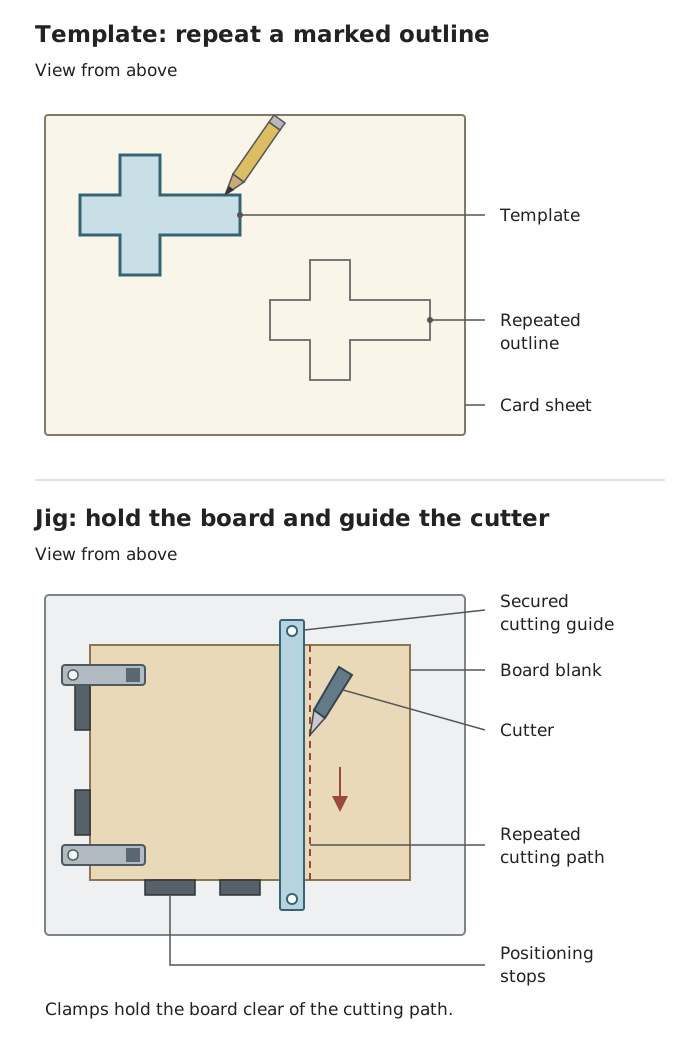
A template repeats an outline; a jig controls the position of the material and the tool.
These devices are particularly useful in batches because they reduce repeated measuring and help produce matching components. They do not automatically guarantee a correct result: an incorrectly positioned guide will repeat the same error. Check the first piece against the required dimensions before continuing. During cutting, secure the material and guide, use a suitable cutting surface and keep fingers clear of the blade’s path.
Computer-aided manufacture (CAM) uses computer-controlled machines to make products or components. For paper and board, a digital design can control a cutter so that it follows the same shape repeatedly instead of relying on a worker to cut every outline by hand.
CAM is important because it combines speed with accuracy and repeatability. Machines can produce multiple items in one operation, repeat difficult tasks consistently and make components while other parts are being produced elsewhere. Accurate cutting can reduce rejected components, while efficient positioning of shapes on a sheet can reduce wasted material.
Machines do not need lunch breaks and can perform routine programmed tasks without constant hands-on control. This helps sustain high-volume output, but it does not remove the need for safe operation, monitoring and maintenance.
CAM is most valuable when these benefits are used repeatedly across many products. Its advantages must still be weighed against high equipment and set-up costs, reduced flexibility in a specialised line and the consequences of a breakdown. For one experimental package, manual work may be more practical; for a steady supply of identical packaging, automated manufacture is much easier to justify.
Examples: a single card packaging prototype; a batch of event invitations; mass-produced cereal boxes; continuously manufactured paper.
Link a production choice to the product’s demand, required quantity and need for customisation, rather than simply saying it is cheaper.
Distinguish mass production, which describes large quantities, from continuous flow production, which describes production running without stopping.
Explain how a jig or template controls a repeated task: name what it holds, guides or marks, and how that improves consistency.
When discussing CAM, connect a benefit to its consequence: accurate repeated cutting can reduce rejected board components and material waste.
It can see this note and what your specification asks for.
Answers are free with an account.
1 free note left this week
Get more free notesYour answer sets when this note comes back for review, or marks it complete.
Was this note helpful?
Log in to tell us whether it helped, or to report a problem.
Last updated
One-off production
Making a single product, such as a prototype or a bespoke item made to an individual customer’s requirements.
Batch production
Making a limited quantity of similar or identical products at one time; the batch may be repeated later.
Mass production
Making large quantities of identical products, usually using automated machinery.
Continuous flow production
Making products continuously, with heavily automated production operating 24 hours a day, seven days a week.
Repeatability
The ability to repeat a manufacturing task with consistent results.
Jig
A device that holds or secures material and guides a cutting or drilling tool to improve accuracy and repeatability.
Template
A tool used to mark out the same shape repeatedly on material.
Pattern
A shape attached to the surface of material to help shape it.
CAM
Computer-aided manufacture: the use of computer-controlled machinery to manufacture products or components.
Put your knowledge into practice — try past paper questions for Design and Technology
One-off production
Making a single product, such as a prototype or a bespoke item made to an individual customer’s requirements.
Batch production
Making a limited quantity of similar or identical products at one time; the batch may be repeated later.
Mass production
Making large quantities of identical products, usually using automated machinery.
Continuous flow production
Making products continuously, with heavily automated production operating 24 hours a day, seven days a week.
Repeatability
The ability to repeat a manufacturing task with consistent results.
Jig
A device that holds or secures material and guides a cutting or drilling tool to improve accuracy and repeatability.
Template
A tool used to mark out the same shape repeatedly on material.
Pattern
A shape attached to the surface of material to help shape it.
CAM
Computer-aided manufacture: the use of computer-controlled machinery to manufacture products or components.
Reusable devices reduce repeated measuring and variation. Check the first item: a faulty guide repeats the fault.
Computer-controlled machinery provides speed, accuracy, consistent repetition, simultaneous component production and reduced material waste.
Weigh these benefits against set-up costs, flexibility and breakdown risk. Large, sustained demand makes investment easier to justify; automation still needs monitoring and maintenance.