

Loading…
Loading…
Loading…
Eduqas GCSE Design and Technology · C600
Eduqas C600 · Manufacturing Scales and Processes Check the specification (PDF) (opens in a new tab)
Commercial printing turns a design into many usable copies. Printing the image is only part of the job: a magazine also needs its pages assembled, a leaflet needs its folds, and a carton needs its shape cut out.
The workflow has three main stages. Pre-press prepares the design and printing information. On-press transfers the image onto the material. Finishing gives the printed material its final shape, protection and assembly. Some finishing equipment operates in line with the press; other operations happen on separate machines afterwards.
Layout is the arrangement of text, images and other elements within a page or design. Before printing, the designer decides where these elements belong and how they work together. For a magazine page, this includes the positions of the headline, body text and photographs. For packaging, the graphics and text must be positioned on the appropriate panels of the carton net.
A grid provides a framework of horizontal and vertical guidelines for this arrangement. Elements can be aligned to the same guides rather than placed independently by eye. In page-layout software, snap-to guides can align the edge of an element automatically.
For example, suppose a magazine layout uses two text columns. Vertical guides can define the column edges, while a horizontal guide aligns the tops of the text and photograph. Using the same framework across several pages gives their layouts a consistent structure. The grid guides the placement of the content; it is not itself part of the printed artwork.
The order in which pages are read is not necessarily the order in which they are placed on a large printing sheet. Imposition arranges pages on both sides of that sheet so that, after folding and cutting, the pages appear in the correct sequence and face the correct way.
Suppose a single sheet is folded once to make a four-page booklet. Its outside carries the back page, page 4, beside the front page, page 1. Its inside carries pages 2 and 3. When folded, these become the reading sequence 1, 2, 3, 4. Simply placing pages 1 and 2 together on the outside would not give the intended booklet.
For a larger publication, several pages may be printed on each side and folded into a section called a signature. Imposition must account for the position and orientation of every page, including those printed on the reverse. Layout therefore organises the content within pages, while imposition organises those pages for manufacture.
A colour photograph contains many colours, but it can be reproduced using four process inks: cyan, magenta, yellow and black, known as CMYK. During colour separation, the artwork is divided into a separate image for each ink. Different amounts of these inks combine on the paper to reproduce the image.
For plate-based printing, each colour separation needs its own printing plate. The separate printed images must line up accurately. Otherwise, coloured edges may appear displaced and details can look blurred.
Registration marks are small printed targets used to check this alignment. Each colour prints the target in the same intended position. When the colours are correctly registered, their targets overlap; displaced coloured outlines indicate misalignment. This is a quality-control check during printing, rather than part of the finished design.
Offset lithography is suitable for fast, high-quality printing on paper and thin card once the press is set up. It can produce items such as leaflets and magazine pages.
The image is prepared on a printing plate mounted around a cylinder. The inked image transfers first to a blanket cylinder, then from the blanket onto the paper or card. An impression cylinder supports the material and provides pressure at the printing point. The plate does not touch the paper directly: this indirect transfer explains the word offset.
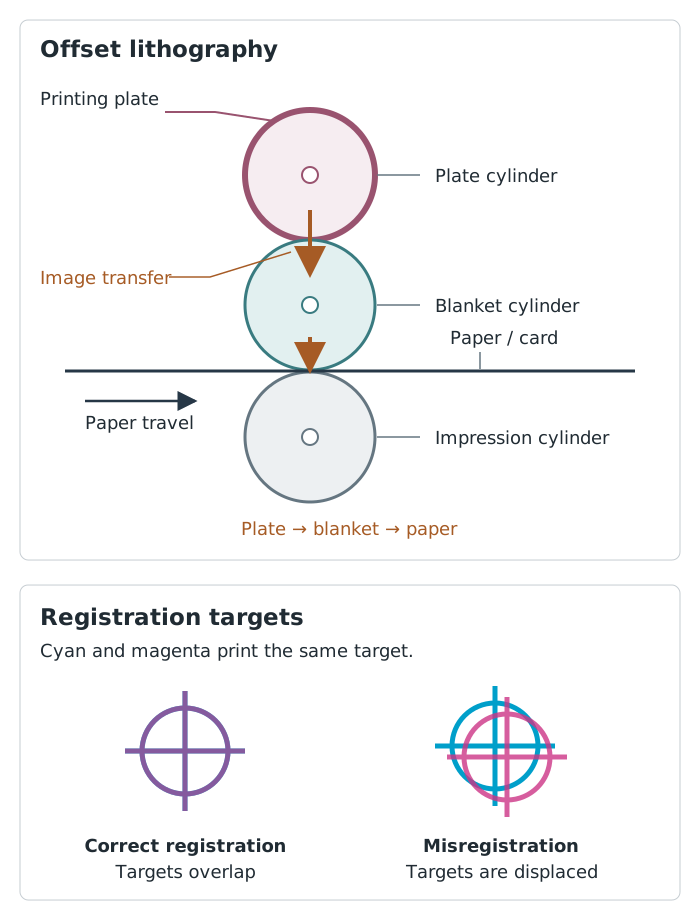
Offset printing transfers the image indirectly. Registration targets help check that the separate colours line up.
Material can enter the press in two ways:
During the run, operators check that the print matches the required quality, including whether colours remain correctly registered. These checks matter because a fault left uncorrected can be repeated across many copies.
Another commercial process is flexography, which uses a flexible printing plate and is suitable for high-speed packaging production. The printing method must suit the material, image and quantity required; finishing then turns the printed material into the usable product.
Cropping trims a printed sheet to its final size. A straight blade can remove unwanted borders, separate several items printed on one sheet, or produce even edges on a bound publication. Crop marks guide where the cuts should be made.
Die cutting produces a particular outline rather than simply a straight edge. A sharp steel cutting die is formed into the required shape and pressed through the material. Reusing the same die produces matching shapes, such as carton nets with their panels and tabs.
Folding bends the printed sheet into its required form. A leaflet may be folded to create separate panels and make it easier to distribute. A carton net is folded into a three-dimensional package. Heavy paper and card are often creased before folding: a crease provides a controlled fold line and helps reduce cracking of the printed surface.
Spirit varnishing applies a clear liquid coating made from a resin, such as shellac, dissolved in alcohol — the ‘spirit’. First, the printed sheet is allowed to dry and dust is removed. A thin, even coat of varnish is then applied; on a small scale, varnish can be brushed or sprayed onto the surface. The alcohol evaporates, leaving a hard resin film. This can give the print a glossy appearance and some protection against surface wear. The coating should be dry and no longer tacky before sheets are stacked. Unlike UV varnish, spirit varnish does not need ultraviolet light to cure.
UV varnishing applies a clear liquid coating which is cured using ultraviolet light. It improves the appearance and resilience of the printed surface, with gloss or matt finishes available. On an industrial line, the board travels on a conveyor, dust is removed, and spray nozzles apply a controlled coat. It then passes under UV lamps to cure the varnish and is removed for any final drying before handling or stacking.
When applying solvent-based varnishes, ventilation or extraction is needed to control fumes. Use the protective equipment specified for the product, and keep flammable finishes away from ignition sources. Industrial spraying uses enclosed booths with extraction.
Laminating bonds a clear plastic film onto the print. This helps protect against stains, smudges, moisture, wrinkles and tears. It is useful for printed items that will be handled repeatedly. Unlike varnishing, it adds a separate film rather than a liquid coating. Varnishing generally offers less protection than lamination, and a varnished surface can crack at folds.
Embossing and debossing change the surface shape of paper or card by pressing a design into it. Embossing produces a raised design; debossing produces a recessed design. Either can give a cover or package a tactile feature, such as a logo that can be felt as well as seen.
Before pages are bound, they must be gathered in the correct sequence. This is called collating. Binding then secures them into a usable publication.
Saddle stitching gathers folded sheets inside one another and staples them through the fold. It suits thin booklets and magazines.
Perfect binding glues the pages and cover together along the spine. The remaining edges are trimmed to give a neat finish. It is used for publications such as paperback books and thicker magazines.
Spiral or coil binding passes a plastic or wire coil through holes along one edge of the pages and covers. This is another way to hold a document together without gluing its spine.
A flyer may need printing and cropping but no folding or binding. A leaflet adds folds so that one sheet becomes several readable panels.
A magazine requires its page layouts to be prepared and imposed before printing, then its printed pages to be collated and bound. Saddle stitching suits a thin publication, while perfect binding suits a thicker one. A paperback book can use perfect binding, followed by trimming to produce even edges.
A cardboard package combines printed graphics with die cutting, folding and assembly. For example, artwork is positioned on a carton net, the net is printed and cut to shape, and its panels and tabs are folded and joined. A coating, laminate or embossed feature can be selected when the package needs extra protection or a particular appearance.
The important connection is that each operation has a purpose: pre-press prepares the design for accurate reproduction, printing communicates it, cutting and folding create its form, surface finishes affect its appearance and durability, and binding or assembly makes it usable.
Link a printing or finishing process to the product’s needs: name the process, explain what it does and explain why that helps the product.
Registration marks check alignment between printed colours; crop marks indicate where the sheet should be trimmed.
Distinguish layout from imposition: layout arranges elements within a page; imposition arranges pages on the printing sheet.
Embossing raises a design; debossing presses it below the surrounding surface.
Distinguish a varnish coating from lamination: lamination bonds a separate plastic film to the printed material.
For offset lithography, give the transfer sequence: printing plate → blanket → paper or card.
When explaining varnishing, describe the application and drying stages, not just the finished appearance. Spirit varnish dries as its solvent evaporates; UV varnish is cured by ultraviolet light.
It can see this note and what your specification asks for.
Answers are free with an account.
1 free note left this week
Get more free notesYour answer sets when this note comes back for review, or marks it complete.
Was this note helpful?
Log in to tell us whether it helped, or to report a problem.
Last updated
Pre-press
Work carried out before printing to prepare the artwork and printing information.
Grid
A framework of horizontal and vertical guidelines used to position and align text and images in a design.
Layout
The arrangement of text, images and other design elements within a page or printed design.
Imposition
The arrangement of pages on both sides of a printing sheet so that they appear in the correct sequence and orientation after folding and cutting.
On-press
The operations involved in running a printing press and transferring the image onto the material.
Finishing
An operation that gives printed material its final form, appearance or protection after the image has been printed.
Colour separation
The division of artwork into separate images for the inks used to print it, commonly cyan, magenta, yellow and black.
Registration mark
A printed target used to check that images printed in different colours line up accurately.
Offset lithography
A printing process in which an inked image transfers from a plate to a blanket cylinder and then onto paper or card.
Die cutting
Cutting paper or board to a specified shape using a shaped cutting die.
Spirit varnishing
Applying a clear coating of resin dissolved in alcohol to printed material; the alcohol evaporates, leaving a hard film that improves appearance and provides some protection.
UV varnishing
A clear liquid coating applied to printed material and cured using ultraviolet light.
Laminating
Bonding a clear plastic film to printed material to improve its protection and durability.
Embossing
Pressing paper or board to create a design raised above the surrounding surface.
Debossing
Pressing paper or board to create a design recessed below the surrounding surface.
Cropping
Trimming printed material to its required size, removing unwanted material around its edges.
Binding
Gathering and fastening pages together to form a book or booklet.
Put your knowledge into practice — try past paper questions for Design and Technology
Pre-press
Work carried out before printing to prepare the artwork and printing information.
Grid
A framework of horizontal and vertical guidelines used to position and align text and images in a design.
Layout
The arrangement of text, images and other design elements within a page or printed design.
Imposition
The arrangement of pages on both sides of a printing sheet so that they appear in the correct sequence and orientation after folding and cutting.
On-press
The operations involved in running a printing press and transferring the image onto the material.
Finishing
An operation that gives printed material its final form, appearance or protection after the image has been printed.
Colour separation
The division of artwork into separate images for the inks used to print it, commonly cyan, magenta, yellow and black.
Registration mark
A printed target used to check that images printed in different colours line up accurately.
Offset lithography
A printing process in which an inked image transfers from a plate to a blanket cylinder and then onto paper or card.
Die cutting
Cutting paper or board to a specified shape using a shaped cutting die.
Spirit varnishing
Applying a clear coating of resin dissolved in alcohol to printed material; the alcohol evaporates, leaving a hard film that improves appearance and provides some protection.
UV varnishing
A clear liquid coating applied to printed material and cured using ultraviolet light.
Laminating
Bonding a clear plastic film to printed material to improve its protection and durability.
Embossing
Pressing paper or board to create a design raised above the surrounding surface.
Debossing
Pressing paper or board to create a design recessed below the surrounding surface.
Cropping
Trimming printed material to its required size, removing unwanted material around its edges.
Binding
Gathering and fastening pages together to form a book or booklet.