

Loading…
Loading…
Loading…
Eduqas GCSE Design and Technology · C600
Eduqas C600 · Properties and Ecological Footprint Check the specification (PDF) (opens in a new tab)
Natural solid timber is wood cut from a tree and used as a solid piece. Its fibres form a grain: the direction and arrangement of those fibres influence both the appearance of the wood and how it behaves when worked.
Hardwoods come from broad-leaved trees, many of which lose their leaves in autumn. They generally grow more slowly than softwoods, so supplies take longer to replace and the timber is often more expensive. Beech, oak, mahogany, balsa and jelutong are hardwoods. The name does not guarantee hardness: balsa is particularly soft and is also a fast-growing exception to the general pattern.
Softwoods come from coniferous trees, usually associated with needles and cones. They generally grow faster and are more readily available, making them comparatively inexpensive. Scots pine, western red cedar and parana pine are examples. These are broad categories, so a designer must consider the properties of the particular timber rather than choose by category alone.
Natural timber is supplied in forms such as planks, boards, strips, square sections and dowels. After sawing, it needs seasoning — controlled drying before use. It can then be planed and cut to suitable sizes.
Physical properties describe how a material behaves; working properties describe how readily it can be cut, shaped, joined and finished. They are connected. A very hard timber may resist wear well but require more effort to shape.
Strength is the ability to withstand forces without failing. Toughness is resistance to breaking under impact. Hardness is resistance to indentation, scratching and surface wear. A furniture component might need strength to carry a load, toughness to survive knocks and hardness to resist damage to its surface.
Flexibility describes the ability to bend without breaking. It is not the opposite of strength: a component may need to bend and still withstand a load. Beech can be steam bent, allowing a manufacturer to produce curved parts rather than cut the whole curve from a larger piece. Thickness also matters: a thin sheet bends more readily than a thick panel of the same material.
Grain structure affects working as well as appearance. Solid timber is generally stronger along its grain than across it. Straight, fine grain can help produce a smooth finish. Changes in grain direction, particularly around knots, can make cutting and planing more difficult. Timber cannot be treated as a completely uniform material.
Absorbency matters when applying a finish and when a product may encounter moisture. A porous surface takes in liquid, which can prevent an even coating. MDF edges, for example, should be sealed before painting because they readily absorb paint. Moisture absorption can also make some manufactured boards swell.
Colour and surface finish affect the appearance of a product. Mahogany's red-brown colour and ability to polish well suit decorative furniture. A finish can also be functional: a hard-wearing sealing finish protects a floor, while oils and waxes enhance visible grain. Attractive appearance alone does not establish that a timber will withstand the intended use.
Beech has a light, sometimes pink-tinted colour and close, fine grain. It is hard, tough and durable, yet relatively easy to work and smooth to finish. These properties suit furniture, toys and tool handles exposed to repeated handling and knocks. Its ability to be steam bent is useful for curved components.
Oak is a brown hardwood valued for strength, toughness and durability. It polishes well and is used for high-quality furniture, doors, skirting and staircases; it also has applications in building beams and boats. Its strength and finished appearance are advantages, but it can be harder to work than an easily cut timber such as mahogany.
Mahogany is red-brown, with close grain. It cuts and polishes easily, making it useful for furniture, cabinet making, shop fittings and decorative veneers. It is relatively strong for its medium weight and absorbs shocks well; it is also used for boats and musical instruments. Its attractive finish and ease of working are benefits, but high cost is a disadvantage where a cheaper material would meet the same requirements. Its colour darkens with age, which matters when matching components or maintaining a particular appearance.
Balsa is pale, very light and soft, with fine grain and a velvety feel. It offers useful strength in relation to its low weight, making it suitable for models and model aircraft. Low weight is valuable in a flying model, but its softness makes it a poor choice where the surface must resist heavy wear or dents.
Jelutong is a tropical hardwood with a creamy-white colour and very fine grain. It is extremely lightweight compared with hardwoods such as mahogany and has useful strength for that low weight. It is relatively inexpensive and easy to carve and shape, so it suits model making. However, it can split and is prone to decay. Ease of shaping does not make it a suitable choice for an exposed outdoor component.
Scots pine is a medium-weight timber with straight grain and a yellowish to reddish colour. It is relatively strong, reasonably priced and easy to work, making it useful for roof timbers, skirting boards and other construction components. It is also used for poles and for pulp in paper and engineered-board manufacture. It can contain many knots, which interrupt the grain and complicate working. Timber intended for outdoor use needs suitable preservative treatment.
Western red cedar is lightweight, reddish-brown and fine-grained, with a soft texture. Its resistance to decay and low shrinkage are valuable outdoors: it is used for cladding, fence posts and decking. Low shrinkage helps components retain their shape, while low weight makes handling easier. It is more costly than pine and is not as strong, so it is not automatically the best choice where carrying a large load is the main requirement.
Parana pine has a bright golden colour with reddish streaks and a medium grain. It offers useful strength, is reasonably priced and is generally knot-free. The absence of knots helps provide a consistent appearance and avoids the working problems caused by disturbed grain around branches. It is used for staircases and furniture, but is not suitable for outdoor use. Despite its common name, it is not a true pine; it is still classified as a softwood.
These timbers illustrate why 'softwood' is not a complete material specification. Scots pine offers economical construction timber, western red cedar offers outdoor durability and low shrinkage, and parana pine offers relatively knot-free timber for indoor products.
Solid timber can provide an attractive natural grain, and the choice of species allows designers to select different colours, strengths and working characteristics. It can be cut and shaped into components, while selected species can be polished or bent to produce distinctive forms.
Its main limitation is variability. Grain direction and defects differ between pieces, so two boards of the same species need not perform identically. Moisture loss also causes shrinkage. Uneven shrinkage can distort a board or create splits, making accurate joints and flat components difficult to maintain. The size of a solid board is also limited by the tree from which it was cut.
Seasoning reduces moisture before manufacture, but careful selection remains important. A designer should consider the individual board as well as the usual properties of its species.
A timber defect is an irregularity that affects strength, durability, working, appearance or value. Some defects develop as the tree grows; others develop during drying or handling.
For a load-bearing component, a split or loose knot is more than a cosmetic problem. For a decorative panel, a sound knot might be acceptable if it does not compromise the required performance. Suitability depends on the defect's location and the demands placed on the component.
Manufactured boards are sheet materials made from wood layers, particles or fibres. They provide broad panels without needing a single wide plank. Many have a more consistent structure than solid timber, but their strength, flexibility and moisture resistance depend on their construction and grade.
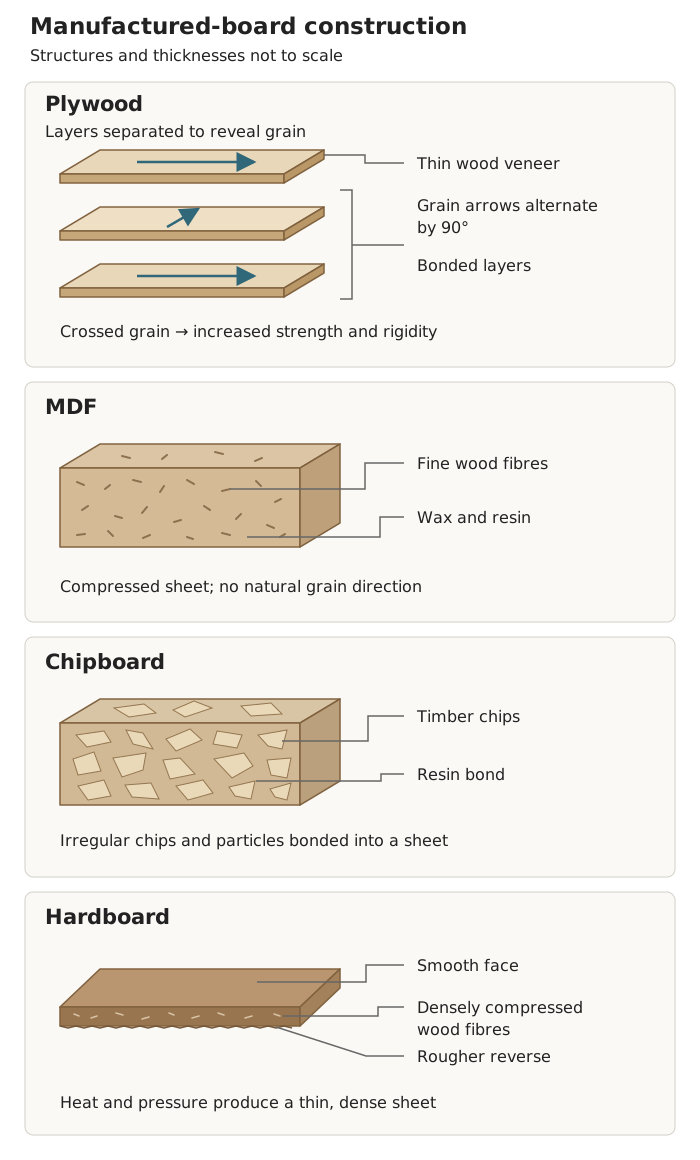
Plywood uses crossed layers, MDF and hardboard use fibres, and chipboard uses chips. Their structures influence strength, working and finishing.
The important distinction is between layers, fibres and chips. The structure helps explain why the boards work and perform differently.
Plywood consists of thin wood layers, or veneers, bonded with the grain of adjacent layers at right angles. The alternating directions increase strength and rigidity and reduce the dependence on a single grain direction. Plywood is relatively lightweight and reasonably priced, making it useful for furniture, flooring and building panels. A high-quality face veneer can provide an attractive natural-wood surface.
Its limitations include chipping at the edges when sawn and poor resistance to damp in standard interior grades. Such grades are intended for indoor use and can rot if exposed to unsuitable conditions. Specialist grades are different: marine plywood is used in boat construction, while flexible plywood is available for curved forms. A designer must select the grade as well as the material name.
MDF — medium density fibreboard — is made from small wood fibres mixed with wax and resin, then heated and compressed. It has no natural grain direction or knots and provides a smooth, consistent surface. It drills, shapes and glues readily, making it useful for models, doors, shelving and interior furniture. It is relatively heavy, which can be a disadvantage when a product must be easily moved.
MDF paints well when sealed, but its absorbency is a limitation: exposed edges should be sealed before painting. Standard MDF absorbs water and swells, so it is unsuitable for wet or exposed conditions. Moisture-resistant grades exist, but moisture resistance is not the same as waterproofing. Cutting and sanding produce fine dust that can irritate the eyes and respiratory system. Dust extraction and suitable eye and respiratory protection are necessary when working it.
Chipboard is made from small chips and particles of timber bonded into a dense sheet. It is cheap and is used for economical furniture and kitchen worktop cores. Its visible chips give a less attractive, rougher surface than fine-fibred MDF, so it is commonly covered with veneer, melamine or laminate.
Chipboard is weaker than plywood and MDF, and cut edges can crumble. It is not a good choice where repeated bending or high strength is required. It also swells when moisture reaches the core, making standard chipboard unsuitable for exterior use. A melamine worktop surface provides resistance to heat, scratches and water; these are benefits of the surface layer, not proof that the uncovered board has the same properties. Exposed edges remain vulnerable.
Hardboard is made from wood fibres compressed under heat and pressure into a thin, dense sheet. Common hardboard is brown, with one smooth face and a rougher reverse. It is inexpensive and does not have the grain-related splitting problems of solid timber. It is used for furniture backs, drawer bases, painting boards and templates; perforated hardboard, or pegboard, provides holes for hanging tools.
Its thinness makes it useful for lightweight backing panels and allows some bending, but it can snap if bent too far. It is not a substitute for a strong load-bearing panel. Standard hardboard absorbs moisture and can swell or distort, so it is unsuitable for outdoor use. Its smooth face can be painted or covered to improve appearance.
A veneer is a thin layer of real wood used as a decorative covering. It can give a manufactured board the appearance of an expensive timber without using a thick solid plank. However, the covering is delicate: excessive sanding can pass through it, and poor bonding can allow it to lift or bubble.
A useful material choice balances several requirements rather than identifying one 'best' timber. Beech is suitable for a robust toy because it is tough, hard-wearing and smooth to finish. Balsa is suitable for a model aircraft because low weight matters more than resistance to surface wear. Jelutong suits a carved model because it is lightweight and easy to shape, but its tendency to decay rules against exposed outdoor use.
For outdoor cladding, western red cedar's decay resistance and low shrinkage may justify its higher price. For economical construction components, Scots pine may be preferable, provided knots and any required treatment are considered.
For a panel, construction and finish matter together. Plywood offers strength and rigidity through crossed grain directions. MDF is easy to work and paint, provided its absorbent edges are prepared and dust is controlled. Chipboard can provide an economical worktop core, with a suitable surface layer supplying appearance and protection. Hardboard suits a thin backing panel rather than a heavily loaded shelf. The justification should connect the material's properties and limitations to what the product must do.
Link each property to a product requirement: beech is tough and hard-wearing, so it suits products exposed to knocks and repeated use.
Hardwood and softwood describe the tree category, not a guaranteed level of hardness. Balsa is a soft hardwood.
Distinguish strength, toughness and hardness rather than using them interchangeably.
Explain the alternating grain directions in plywood, not just that it has several layers.
Distinguish drying splits from shakes: shakes originate in the tree or during felling and may extend during drying.
When discussing a defect, explain its effect on strength, working or appearance. A sound knot may be decorative, whereas a loose knot can fall out.
Distinguish a board's core from its surface covering. A water-resistant laminate does not make an exposed chipboard core waterproof.
Qualify moisture-related claims: standard interior plywood and MDF differ from specialist moisture-resistant grades.
It can see this note and what your specification asks for.
Answers are free with an account.
1 free note left this week
Get more free notesYour answer sets when this note comes back for review, or marks it complete.
Was this note helpful?
Log in to tell us whether it helped, or to report a problem.
Last updated
Hardwood
Wood obtained from broad-leaved trees; the category does not mean that the wood is necessarily hard.
Softwood
Wood obtained from coniferous trees, which generally grow relatively quickly.
Solid timber
Wood cut from a tree and used as a solid piece, rather than broken down and reconstructed into a board.
Manufactured board
A sheet material made by bonding wood layers, particles or fibres together.
Grain
The direction and arrangement of fibres in wood, which influence its appearance, strength and ease of working.
Strength
The ability of a material to withstand forces without failing.
Toughness
The ability of a material to withstand impacts without breaking.
Hardness
Resistance to indentation, scratching and surface wear.
Flexibility
The ability of a material to bend without breaking.
Absorbency
The tendency of a material to take in liquid.
Seasoning
Controlled drying of timber before use to reduce its moisture content.
Knot
A region of timber where a branch joined the trunk, causing a local change in grain direction.
Shake
A separation in timber along growth rings or outwards from the centre, originating in the tree or during felling.
Veneer
A thin sheet of wood used as a layer in plywood or as a decorative covering.
Put your knowledge into practice — try past paper questions for Design and Technology
Hardwood
Wood obtained from broad-leaved trees; the category does not mean that the wood is necessarily hard.
Softwood
Wood obtained from coniferous trees, which generally grow relatively quickly.
Solid timber
Wood cut from a tree and used as a solid piece, rather than broken down and reconstructed into a board.
Manufactured board
A sheet material made by bonding wood layers, particles or fibres together.
Grain
The direction and arrangement of fibres in wood, which influence its appearance, strength and ease of working.
Strength
The ability of a material to withstand forces without failing.
Toughness
The ability of a material to withstand impacts without breaking.
Hardness
Resistance to indentation, scratching and surface wear.
Flexibility
The ability of a material to bend without breaking.
Absorbency
The tendency of a material to take in liquid.
Seasoning
Controlled drying of timber before use to reduce its moisture content.
Knot
A region of timber where a branch joined the trunk, causing a local change in grain direction.
Shake
A separation in timber along growth rings or outwards from the centre, originating in the tree or during felling.
Veneer
A thin sheet of wood used as a layer in plywood or as a decorative covering.
| Timber | Main properties and limitations | Typical uses |
|---|---|---|
| Beech | Hard, tough, fine grain; smooth finish; steam bends | Furniture, toys, tool handles |
| Oak | Strong, tough, durable; polishes well; harder to work | Quality furniture, doors, staircases, beams |
| Mahogany | Red-brown; easy to cut and polish; expensive; darkens with age | Furniture, cabinets, veneers, instruments |
| Balsa | Very light and soft; useful strength-to-weight properties | Models and model aircraft |
| Jelutong | Creamy-white, fine grain; light, easy to carve; can split and decay | Model making |
| Timber | Main properties and limitations | Typical uses |
|---|---|---|
| Scots pine | Straight grain; relatively strong, economical; often knotty; treat for outdoor use | Roof timbers, skirting, poles |
| Western red cedar | Lightweight, decay-resistant, low shrinkage; relatively costly and less strong than pine | Cladding, fence posts, decking |
| Parana pine | Golden with reddish streaks; generally knot-free; useful strength; unsuitable outdoors | Staircases, furniture |
| Board | Construction and strengths | Main limitations |
|---|---|---|
| Plywood | Crossed veneers at 90°; strong and rigid; panels and flooring | Can chip when sawn; interior grades vulnerable to damp; select the correct grade |
| MDF | Fine fibres, wax and resin; smooth, knot-free, easy to shape and paint | Heavy; standard grades swell when wet; absorbent edges; dust hazard |
| Chipboard | Bonded chips; cheap furniture and worktop core | Relatively weak; crumbly edges; swells when wet; commonly needs a covering |
| Hardboard | Compressed fibres; thin, cheap; smooth face for backing panels and drawer bases | Limited load-bearing strength; can snap when bent; moisture-sensitive |
Seal MDF edges before painting. Use dust extraction when machining MDF. A veneer supplies a real-wood appearance; a laminate can add surface protection, but neither changes the core into a different material.