

Loading…
Loading…
Loading…
Eduqas GCSE Design and Technology · C600
Eduqas C600 · Properties and Ecological Footprint Check the specification (PDF) (opens in a new tab)
A wooden chair begins with a material source and eventually reaches the end of its useful life. Decisions made along the way affect both the environment and people.
Its ecological footprint includes the resources and energy used, waste produced and damage to habitats. Its social footprint concerns effects on people and communities, including jobs, working conditions and livelihoods. These overlap: damage to a forest can harm wildlife, but unstable soil following tree removal can also threaten nearby homes.
Looking at both footprints helps us judge a product more carefully than simply calling timber a ‘natural’ material.
Deforestation is the clearing of forest for another land use. It is not caused only by demand for timber: forests may also be cleared to make space for farming or to gain access to other resources. Felling trees to obtain timber does not necessarily mean permanently clearing the forest; how the land is managed afterwards matters.
Removing forest destroys habitats used by plants and animals. Replacing trees can help maintain a supply of timber, but the loss of an existing habitat still needs to be considered. Permission to fell trees and plans for replacement are therefore important considerations, rather than proof that harvesting has no environmental impact.
Tree roots help hold soil together. When trees are removed, the soil can become less stable. During heavy rain, soil may be washed away or move downhill as a mudslide. This connects an ecological effect—damage to the land—with a social effect—danger and destruction in local communities. Clearing forest can also change the appearance of an area for its residents.
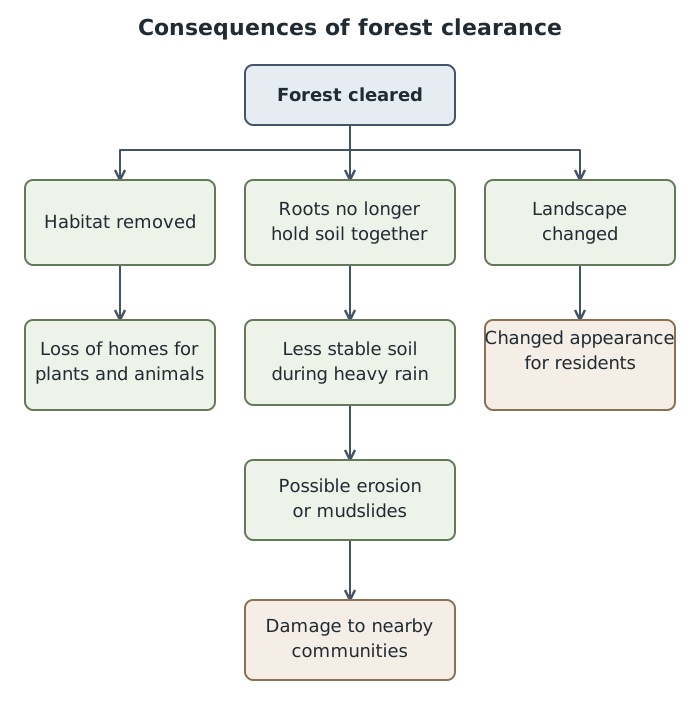
Forest clearance can affect wildlife, soil stability and nearby communities.
An evaluation should recognise why timber is wanted as well as the damage that obtaining it can cause. Timber supplies furniture and construction materials. Sustainable forestry can maintain timber supplies through managed harvesting and replanting while protecting biodiversity. For example, Scots pine is renewable when replacement trees are allowed to grow, but cutting and transporting it still use energy. Renewable does not mean impact-free.
Forestry and wood processing provide employment and income. Harvesting timber, processing it and making products can support rural communities, particularly when local people gain paid work and useful skills. This is a positive part of timber’s social footprint.
However, the quality of employment matters as well as the number of jobs. Logging is dangerous work, and forestry workers can face heavy physical workloads, noise and vibration. Short-term contracts, insecure employment and low pay can reduce the benefits of timber production. Safety training, suitable protection and fair working conditions help make these jobs more socially beneficial.
Forests also support the livelihoods of people living in and around them. Logging that restricts their access to forest resources or disregards land rights can harm those communities even while creating income for a timber business. Genuine local participation in decisions helps communities share the benefits and protect their interests.
A balanced judgement therefore asks both whether timber production provides useful employment and whether workers and forest-dependent communities are treated fairly. Simply stopping all production would overlook its benefits; simply pointing to jobs would overlook possible harm.
Life-cycle analysis, or LCA, examines environmental impacts across a material or product’s whole life, from obtaining raw materials to disposal, recycling or re-use. This is often described as looking from cradle to grave. It helps designers identify where the greatest impacts occur and prevents an improvement at one stage from hiding problems elsewhere.
Consider a birch plywood stool with a clear polyurethane varnish finish, manufactured in Sweden and supplied flat-packed. Its life-cycle analysis connects each stage to an environmental consequence.
These stages are connected: a design that is easy to dismantle may help both repair during use and material separation at the end of life. Recycling can reduce demand for new timber, but collection, transport and processing still have impacts.
Suppose two chairs perform the same function. One uses less timber but cannot be repaired when a part breaks. The other uses more timber initially but has replaceable parts. The first has an advantage in initial material use; the second may remain useful for longer and avoid the need for a replacement chair. A justified judgement needs to consider both, not assume that the lightest product must have the smallest overall footprint.
For the plywood stool, flat-packing is a useful transport improvement, but it does not remove the impacts of forestry, manufacture or disposal. A stronger overall approach combines managed timber supplies, low-waste manufacture, efficient transport, durability and opportunities for repair and recovery.
Life-cycle analysis therefore supports decisions about material use, manufacture, durability and disposal together. Social effects should also inform the final judgement, rather than assuming that a low environmental impact guarantees fair treatment of people.
A greener approach moves away from making, using and immediately discarding products. Designers can make longer-lasting products, manufacturers can reduce production waste, and consumers can maintain, repair and pass on items rather than throw them away.
For timber, re-use could mean selling a sound chair second-hand or using suitable offcuts in another product. Repair could mean replacing a damaged chair component instead of discarding the whole chair. Both keep existing products or materials useful.
Recycling is different: waste material is processed to make new products. This reduces demand for new raw materials and diverts material from disposal, although collection and processing still require resources. Recycling is valuable, but preventing unnecessary waste in the first place can avoid those additional processes.
These choices can be organised using the 6Rs as a design-thinking tool:
Changing society’s view of waste means treating unwanted products and materials as potentially useful resources rather than automatically as rubbish. Encouraging recycling requires more than asking people to change their habits. Collection systems and designs that help materials to be identified and separated also matter. Designers, manufacturers and users share responsibility for making a greener approach practical.
Raw materials → processing and manufacture → transport and distribution → use and maintenance → end of life.
For a plywood stool: consider forestry and veneer production, manufacturing energy and waste, transport and packaging, durability and repair, then re-use, recycling or disposal. Flat-packing improves transport efficiency; suitable recovered wood may become fibres for MDF. Finishes and recycling facilities affect recovery.
Compare products providing the same function. Weigh initial material use against durability, repairability and disposal; one favourable stage does not establish the overall result.
Link an impact to its cause: removing trees destroys habitats; losing roots can make soil less stable during heavy rain.
Distinguish re-use from recycling: re-use keeps a product or material in use, while recycling processes material into a new product.
When evaluating a timber product, consider its whole life rather than judging it only by whether wood is renewable.
Support a judgement with a specific design decision and its consequence, such as replaceable parts extending a chair’s useful life.
In a life-cycle analysis, connect each stage to the particular product and explain its environmental consequences rather than just listing stage names.
It can see this note and what your specification asks for.
Answers are free with an account.
1 free note left this week
Get more free notesYour answer sets when this note comes back for review, or marks it complete.
Was this note helpful?
Log in to tell us whether it helped, or to report a problem.
Last updated
Ecological footprint
The environmental effects associated with obtaining materials, making, using and disposing of a product, including resource use, waste and damage to habitats.
Social footprint
The effects that obtaining materials and making, using and disposing of a product have on people and communities, including employment, working conditions and livelihoods.
Deforestation
The clearing of forest so that the land can be used for another purpose.
Life-cycle analysis
An assessment of a material or product’s environmental impacts throughout its life, from obtaining raw materials to its end of life.
Re-use
Using a product or material again, for the same or a different purpose, without processing it into a new material.
Recycling
Processing waste materials so that they can be used to make new products.
Put your knowledge into practice — try past paper questions for Design and Technology
Ecological footprint
The environmental effects associated with obtaining materials, making, using and disposing of a product, including resource use, waste and damage to habitats.
Social footprint
The effects that obtaining materials and making, using and disposing of a product have on people and communities, including employment, working conditions and livelihoods.
Deforestation
The clearing of forest so that the land can be used for another purpose.
Life-cycle analysis
An assessment of a material or product’s environmental impacts throughout its life, from obtaining raw materials to its end of life.
Re-use
Using a product or material again, for the same or a different purpose, without processing it into a new material.
Recycling
Processing waste materials so that they can be used to make new products.
Reduce unnecessary material use first. Extend product life through maintenance, repair and re-use; recycle recoverable materials at end of life.
The 6Rs: reduce, refuse, re-use, repair, recycle, rethink.
Re-use retains an existing product or material; recycling processes material into new products. Material separation and collection systems help turn waste into a resource.