

Loading…
Loading…
Loading…
Eduqas GCSE Design and Technology · C600
Eduqas C600 · Impact of Design and Technology Check the specification (PDF) (opens in a new tab)
New and emerging technologies are recent developments that change how products can be designed, made or used. They can create opportunities for industry—the businesses involved in production—and enterprise, the activity of developing business opportunities. However, a technically impressive product will not necessarily succeed: it must offer something consumers want.
Market pull begins with demand. Consumers have a need or want, and a business responds by developing a product or improving an existing one. For example, suppose customers want a portable device that is easier to carry. Their demand gives the designer a reason to reduce its size and weight.
Technology push begins with a technical development. A new material, component or manufacturing method makes something possible that was previously difficult or impractical. Smaller electronic components, for example, allow electronics to be incorporated into wearable products.
These drivers can work together. Smaller components may make a wearable device possible, while consumer demand shapes which functions it should offer. The distinction is the starting point: demand pulls development towards a solution; technology pushes new possibilities into the market.
Consumer choice is the decision about which product to buy. Some consumers want the latest technology or upgraded functions, encouraging manufacturers to release improved versions. Technology therefore influences demand as well as responding to it.
Designers and manufacturers need to establish whether there is a genuine market for a proposed product. A new function creates a business opportunity only if enough customers value it. Consumer choice also brings responsibilities: buyers need accurate descriptions and products that are safe to use, rather than exaggerated promises about what the technology can achieve.
The product life cycle describes how sales change over time. It is a marketing tool, not an assessment of environmental damage. A typical graph has time on the horizontal axis and sales on the vertical axis.
There are four main stages:
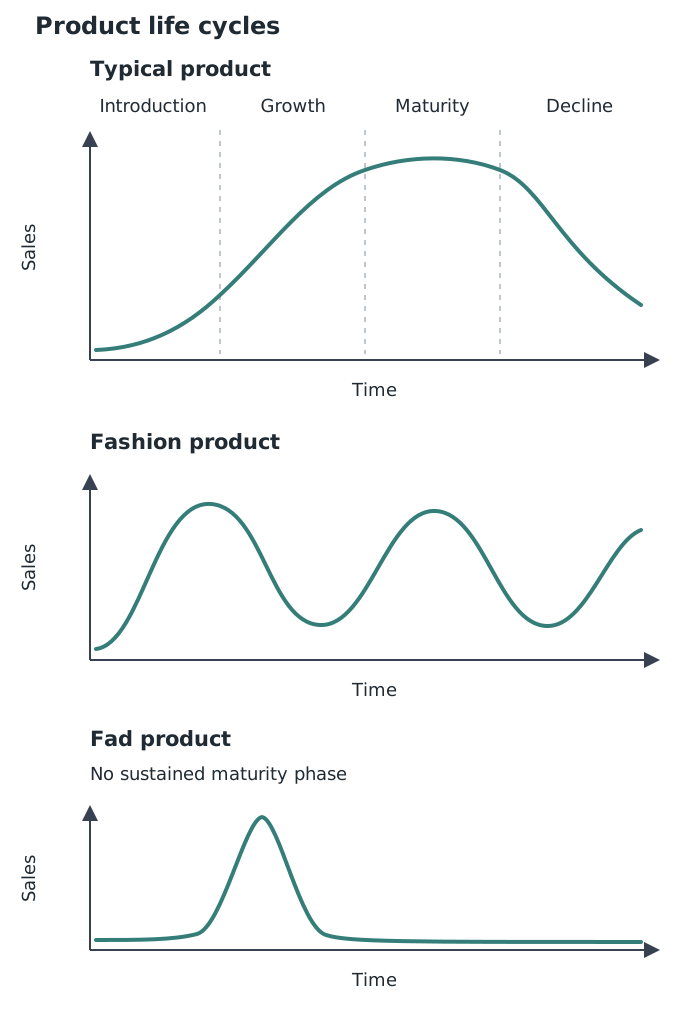
Sales patterns help manufacturers plan production. Fashion can return to popularity, while a fad rises and falls quickly.
Manufacturers use this pattern to make production decisions. Rising sales may justify increasing manufacture. Falling sales may suggest reducing or stopping production, improving the product, or replacing it with a new version. The graph helps a business respond to demand rather than continue making products that fewer people want.
Not every product follows the same shape. Fashion products can have an undulating pattern: sales rise and fall more than once as popularity returns. A fad product has a sharp rise followed by a sharp decline over a short period, without a sustained maturity phase. These differences matter because a business should not assume that a sudden increase in sales will last.
A product becomes obsolete when it is no longer desired and stops selling, or sells only at a discounted price. It need not be physically broken: a newer product may offer functions that make the older version less attractive.
Manufacturers can build in obsolescence by planning replacement with an upgraded or new product within a set time frame. Some products are also designed not to last. This can encourage repeat purchases and support business sales, but it can cost consumers more and increase the number of products discarded.
New technology therefore has a mixed relationship with sustainability. An improved product may be more efficient, but frequent replacement can undermine that benefit. Using fewer or recycled materials, reducing energy use and making products easier to repair can help extend their useful life. Sustainability means meeting today’s needs without compromising future generations’ needs; the newest product is not automatically the most sustainable choice.
Global production means organising manufacturing across countries. Communication technology and the internet help people and businesses coordinate activities over long distances. They also connect people more widely and increase awareness of other cultures.
For consumers, global manufacturing can offer greater product choice and lower prices. For businesses, it can provide opportunities to organise production in different locations. However, these benefits can come with environmental costs and the loss of manufacturing jobs in Western societies when production moves elsewhere.
The effects on workers are not automatically positive. Pressure to keep prices low can lead to exploitation in developing countries, including poor wages and working conditions. A low selling price therefore does not reveal whether the people making the product have been treated fairly.
A balanced judgement considers different groups. Consumers may welcome affordable products, while displaced workers face job losses and manufacturing workers elsewhere may face poor conditions. Better communication and cultural connections are benefits, but they do not cancel out these economic and ethical concerns.
The Consumer Rights Act 2015 protects consumers when they purchase goods, services and digital content, including online purchases and digital downloads. Goods must be of satisfactory quality, match their description and be fit for purpose.
These requirements have practical meanings. A product should meet a reasonable quality standard, do what it was sold to do and match the claims made about it. For example, a device sold with a particular function should actually provide that function. Where legal requirements are not met, consumers may be entitled to remedies such as repair or refund; the appropriate remedy depends on the circumstances.
Protection also concerns poor service, faulty or counterfeit goods and problems involving contracts or traders. It is not a promise that every product will satisfy every personal preference.
The Trade Descriptions Act addresses false descriptions of goods that mislead consumers. The key design-and-sale principle is that descriptions must be truthful: a business must not claim a material, feature or performance that the product does not have.
Consumer protection is not only about getting what was advertised. Manufacturers, importers, distributors and sellers have responsibilities for product safety and relevant labelling requirements.
In Great Britain, the General Product Safety Regulations 2005 require products to be safe in normal or reasonably foreseeable use. Northern Ireland has a different general product safety regime. Businesses must minimise risks, keep relevant technical records, provide appropriate labels and give instructions for safe use.
If a safety problem is discovered after sale, action may be needed: new instructions, modification or a recall requiring consumers to stop using and return the product. Under the Consumer Protection Act 1987, manufacturers and sometimes others in the supply chain can be liable for harm caused by unsafe products, including personal injury or damage to private property.
These duties connect design decisions to real consequences. Introducing a new technology does not remove the obligation to demonstrate that the finished product is safe.
Moral and ethical factors concern whether manufacturing, selling and using a product are fair and responsible. Some businesses put profit before workers’ wellbeing, accepting poor conditions, exploitation or child labour. Keeping manufacturing costs hidden can also conceal how little workers receive.
A more ethical manufacturer treats workers fairly, provides decent wages and working conditions, and is open about costs. Socially responsible businesses may also support environmental causes. During sale and use, truthful claims, safe products and a responsible response to discovered hazards protect consumers.
Evaluating innovation means weighing these responsibilities against its benefits. Smaller components and global communication can expand product possibilities, choice and business opportunities. Those advantages are stronger when products meet genuine needs, workers are treated fairly and unnecessary replacement and waste are reduced. A justified conclusion explains not only whether a technology is useful, but under what conditions its use is responsible.
Introduction → growth → maturity → decline
Sales are plotted against time. Manufacturers use the pattern to increase, reduce or stop production, improve products or introduce replacements.
Distinguish the starting point: market pull begins with consumer demand; technology push begins with a technical development.
On a product life cycle graph, check the axes: sales are plotted against time, not environmental impact.
Explain impacts through a chain of reasoning: a change, its consequence and who benefits or loses.
For an evaluation, weigh benefits against costs and justify a conclusion in the product context.
Consumer rights concern required standards, not simply whether a buyer likes a product. Distinguish faulty goods from a change of mind.
It can see this note and what your specification asks for.
Answers are free with an account.
1 free note left this week
Get more free notesYour answer sets when this note comes back for review, or marks it complete.
Was this note helpful?
Log in to tell us whether it helped, or to report a problem.
Last updated
Market pull
Demand from consumers that encourages businesses to develop a new product or improve an existing one.
Technology push
A development in materials, components or manufacturing methods that creates opportunities for new or improved products.
Consumer choice
The decisions consumers make about which products to buy, influenced by their needs, preferences and the technologies available.
Product life cycle
The pattern of a product’s sales over time, usually described through introduction, growth, maturity and decline.
Obsolescence
A product becoming no longer desired, so that it stops selling or sells only at a discounted price.
Built-in obsolescence
Deliberately limiting a product’s useful life or planning its replacement with a newer version within a set period.
Global production
The organisation of manufacturing across different countries rather than entirely within one country.
Globalisation
Increasing connections between countries through activities such as trade, production and communication.
Exploitation
Taking unfair advantage of people, for example through very low wages or poor working conditions.
Ethics
Principles used to judge whether decisions and behaviour are right, fair and responsible.
Consumer rights
Legal protections for people buying goods, services and digital content.
Sustainability
Meeting present needs without compromising the ability of future generations to meet their needs.
Put your knowledge into practice — try past paper questions for Design and Technology
Market pull
Demand from consumers that encourages businesses to develop a new product or improve an existing one.
Technology push
A development in materials, components or manufacturing methods that creates opportunities for new or improved products.
Consumer choice
The decisions consumers make about which products to buy, influenced by their needs, preferences and the technologies available.
Product life cycle
The pattern of a product’s sales over time, usually described through introduction, growth, maturity and decline.
Obsolescence
A product becoming no longer desired, so that it stops selling or sells only at a discounted price.
Built-in obsolescence
Deliberately limiting a product’s useful life or planning its replacement with a newer version within a set period.
Global production
The organisation of manufacturing across different countries rather than entirely within one country.
Globalisation
Increasing connections between countries through activities such as trade, production and communication.
Exploitation
Taking unfair advantage of people, for example through very low wages or poor working conditions.
Ethics
Principles used to judge whether decisions and behaviour are right, fair and responsible.
Consumer rights
Legal protections for people buying goods, services and digital content.
Sustainability
Meeting present needs without compromising the ability of future generations to meet their needs.
Benefits: greater choice, lower prices, stronger communication and cultural connections.
Costs: environmental impacts, possible job losses in Western societies and exploitation of workers in developing countries.
Ethical manufacture involves fair wages, decent working conditions and openness about costs. Longer-lasting, repairable products can reduce replacement and waste.
Weigh effects on businesses, consumers, workers and the environment. Explain who benefits, who bears the costs and the conditions needed for a responsible outcome.