

Loading…
Loading…
Loading…
Edexcel GCSE Religious Studies A · 1RA0
Edexcel 1RA0 · 4.2 Check the specification (PDF) (opens in a new tab)
A mosque, also called a masjid, is a Muslim place of worship. Its central activity is prayer, but many mosques also provide places to learn, meet others and receive support. These activities connect worship of Allah with everyday Muslim life.
When Muslims pray together, they stand in rows facing the same direction and follow an imam, the prayer leader. Sharing these actions helps express equality before Allah and membership of the ummah, the worldwide Muslim community. Friday congregational prayer, Jumu‘ah, also includes a sermon, or khutbah, through which worshippers receive religious teaching.
The mosque is not the only place where Muslims can pray. A Muslim praying elsewhere still faces Makkah, sometimes using a compass to identify the direction. This creates an important distinction: a mosque supports shared worship, but worship is not confined to the building.
The main prayer hall, or musalla, provides open floor space for standing, bowing and prostrating. Rather than rows of fixed seats, it usually has a carpeted floor. Carpet markings can help worshippers form rows and identify their prayer spaces. Praying side by side expresses their shared standing before Allah.
The qiblah is the direction towards the Ka‘bah in Makkah. The wall towards which worshippers face is therefore called the qiblah wall. Many mosques mark it with a mihrab, a niche or alcove. The mihrab is a directional aid, not something Muslims worship. The imam leads prayer at the front, facing the same direction as the congregation.
Near the mihrab is often a minbar, a raised platform used when delivering the khutbah. Its height helps the congregation see and hear the preacher. Speakers can also carry prayers and sermons to people elsewhere in the building.
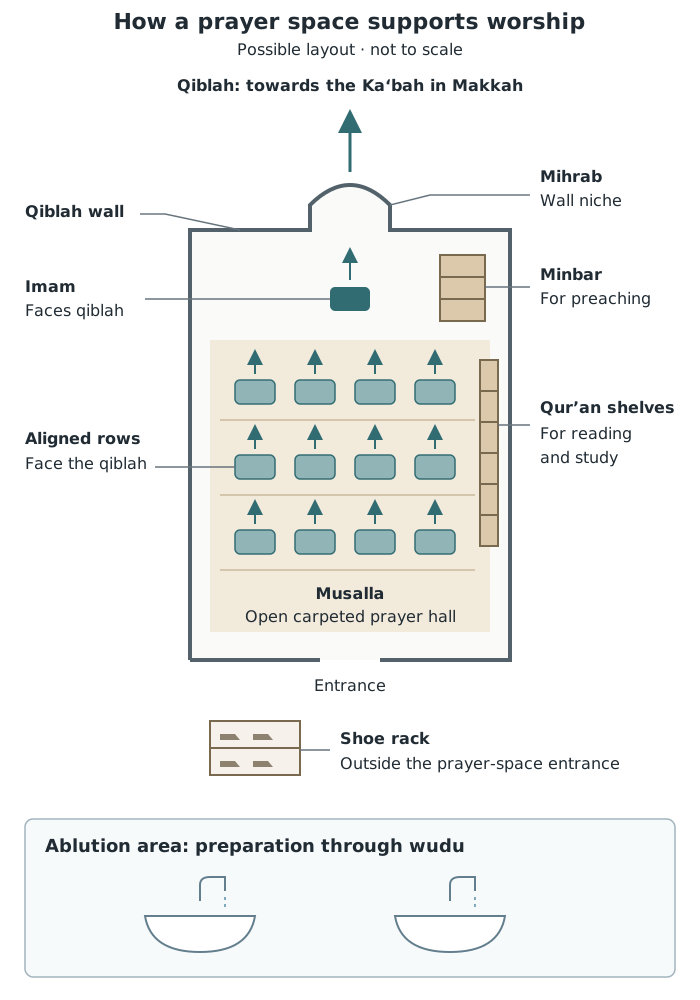
A possible prayer-space arrangement: the mihrab indicates the direction of prayer, while the minbar supports preaching. Mosque layouts vary.
Mosques commonly provide separate areas for men and women. These may be different rooms, a balcony, a partitioned space or arrangements with women behind the men. Supporters explain these arrangements in terms of modesty and avoiding distractions during the physical movements of prayer. The arrangement varies between mosques; a separate area can still allow worshippers to hear the imam and participate in congregational worship.
A hadith is a report of Muhammad’s words or actions. Sahih al-Bukhari is a collection of hadith. In Sahih al-Bukhari, Book 2, Number 39, al-Bara’ ibn ‘Azib describes Muhammad praying towards Jerusalem for sixteen or seventeen months after coming to Madinah. Muhammad wished to face the Ka‘bah in Makkah, and the first prayer he offered in that direction was the afternoon, or ‘Asr, prayer with a congregation.
A man who had prayed with Muhammad then passed another congregation bowing in a mosque. He told them that he had prayed with Muhammad facing Makkah. They immediately changed their direction towards the Ka‘bah. The account also recalls concern about Muslims who had died before the change. It cites Qur’an 2:143, reassuring them that Allah would not let their earlier faith and prayers be lost.
This account helps explain why the direction of prayer is central to mosque design: worshippers follow the direction established through Muhammad’s practice. Their immediate response expresses obedience, while facing one direction together expresses unity. It supports the importance of the qiblah, but does not require a decorated mihrab: the direction and the architectural feature marking it are different things.
Wudu is ritual washing before prayer when required. Ablution areas provide taps and basins so worshippers can prepare before entering the prayer space. Shoe racks help keep the prayer-hall floor clean: worshippers remove their shoes before stepping onto the carpet, where they will prostrate. Removing shoes serves cleanliness here; it should not be confused with wudu.
Prayer timetables or clock displays show when the five daily prayers and Friday prayer take place. They help organise worship around shared times. Shelves containing copies of the Qur’an allow people to read, learn and memorise its teachings. Other religious books support study and discussion.
These objects have different jobs. A carpet supports the movements and organisation of prayer; a timetable supports its timing; Qur’an copies support learning and reflection. Their importance comes from how they serve religious activities, not simply from being inside a mosque.
A minaret is a tower traditionally used by the muezzin, the person who delivers the adhan, or call to prayer. Its visibility makes the mosque recognisable, while the call reminds Muslims of prayer. Modern sound systems can amplify a live call without the muezzin climbing the tower.
A dome is another recognisable feature of many mosques. It can help voices carry through the prayer hall and allow air to circulate. However, Muslims do not all give it the same religious significance. Birmingham Central Mosque describes its dome primarily as a symbolic architectural feature with little religious significance. A dome should therefore not be treated as an object of worship.
Mosques avoid images or statues of Allah: Muslims believe Allah is unlike creation and that only Allah should be worshipped. Prayer halls also normally avoid human and animal figures. Some mosques use geometric patterns and Qur’anic writing instead. These can remind worshippers of their faith, although some Muslims prefer minimal decoration to prevent distraction.
Many Muslims value a beautiful, recognisable mosque as an expression of faith and a visible centre for their community. Birmingham Central Mosque, for example, has a dome, minarets, a decorated carpet and a mihrab. These features accompany practical facilities for worship and community life.
Some Salafi Muslims place greater emphasis on simplicity and following the practice of Muhammad and the earliest Muslim community. Many Salafi scholars discourage ornate decoration and question constructing a mihrab because it was not used by Muhammad or the Rightly Guided Caliphs. Their concern is not opposition to prayer in a mosque: it is whether later architectural additions distract from worship or lack religious justification.
This contrast shows why identifying a feature is not enough. The same decorated interior may be valued by some as an expression of faith and regarded by others as an unnecessary distraction.
Birmingham Central Mosque provides a concrete UK example of a mosque serving several needs. Its classrooms contain tables, chairs and whiteboards for children studying the Qur’an and Islamic topics. Its library provides religious literature in several languages and space for study. These facilities help pass faith and knowledge between generations.
Its community halls host marriages, lectures, meetings and visits by school groups. Counselling offices offer support, while mortuary facilities and funeral prayers help families following a death. A lift improves access to the prayer areas for people who cannot comfortably use stairs. These uses show how a mosque can support Muslims throughout life, rather than only during daily prayer.
One argument for the mosque’s central importance is that it brings worship, teaching and practical support together. Regular meetings can strengthen relationships, while congregational prayer makes the unity of the ummah visible. A well-equipped mosque can therefore help people practise and understand their religion.
A contrasting argument is that the quality of worship matters more than the size or beauty of a building. Muslims can pray outside a mosque, and advocates of simple design argue that expensive or elaborate features are not what makes worship meaningful. This challenges the necessity of elaborate architecture, rather than the value of gathering for prayer.
A justified conclusion can distinguish the two: the mosque may be highly important as a centre of shared religious life, while particular architectural features are less important than the worship, learning and care they support.
Muhammad prayed towards Jerusalem for sixteen or seventeen months in Madinah, then towards the Ka‘bah. On hearing of the change, another congregation immediately turned towards the Ka‘bah during prayer.
Significance: obedience to Muhammad’s example and a shared prayer direction. This supports the importance of the qiblah, not the necessity of an ornate mihrab. Earlier prayers remained valid, with reassurance from Qur’an 2:143.
Some Muslims value beautiful, recognisable mosque buildings. Others, including many Salafi scholars, favour simplicity and question later additions such as mihrabs. Decoration may express faith or distract from worship, depending on the viewpoint.
Separate prayer areas vary in layout; modesty and avoiding distractions are reasons given for them.
Birmingham Central Mosque: prayer hall, classrooms, library, community halls, counselling, funeral facilities and accessible prayer areas.
Key judgement: distinguish the value of a mosque’s communal activities from the necessity of elaborate architecture.
Link each feature to its use and significance: the mihrab indicates the qiblah, helping worshippers face Makkah together.
Distinguish the mihrab, a niche indicating the direction of prayer, from the minbar, a raised platform used for preaching.
Explain differences between Muslims without treating one community’s practice as universal.
For an evaluation, weigh reasons on both sides and explain which are strongest. Distinguish the importance of communal worship from the importance of an elaborate building.
When using Sahih al-Bukhari 2:39, explain how the congregation’s change of prayer direction shows obedience and why the qiblah matters in mosque design.
It can see this note and what your specification asks for.
Answers are free with an account.
1 free note left this week
Get more free notesYour answer sets when this note comes back for review, or marks it complete.
Was this note helpful?
Log in to tell us whether it helped, or to report a problem.
Last updated
Mosque
A Muslim place of worship, also called a masjid, used especially for prayer and often for education and community activities.
Ummah
The Muslim community worldwide, united by faith in Allah.
Qiblah
The direction towards the Ka‘bah in Makkah which Muslims face when praying.
Mihrab
A niche or alcove in a mosque’s qiblah wall which indicates the direction of prayer.
Minbar
A raised platform or pulpit from which a preacher delivers a sermon in a mosque.
Imam
A person who leads Muslim congregational prayer; the term can have other meanings in Islam.
Musalla
The main prayer space or prayer hall in a mosque.
Wudu
Ritual washing performed before prayer when required.
Adhan
The Muslim call to prayer, delivered by a muezzin.
Jumu‘ah
The Friday congregational prayer, which includes a sermon called a khutbah.
Put your knowledge into practice — try past paper questions for Religious Studies A
Mosque
A Muslim place of worship, also called a masjid, used especially for prayer and often for education and community activities.
Ummah
The Muslim community worldwide, united by faith in Allah.
Qiblah
The direction towards the Ka‘bah in Makkah which Muslims face when praying.
Mihrab
A niche or alcove in a mosque’s qiblah wall which indicates the direction of prayer.
Minbar
A raised platform or pulpit from which a preacher delivers a sermon in a mosque.
Imam
A person who leads Muslim congregational prayer; the term can have other meanings in Islam.
Musalla
The main prayer space or prayer hall in a mosque.
Wudu
Ritual washing performed before prayer when required.
Adhan
The Muslim call to prayer, delivered by a muezzin.
Jumu‘ah
The Friday congregational prayer, which includes a sermon called a khutbah.