

Loading…
Loading…
Loading…
Edexcel GCSE Design and Technology · 1DT0
Edexcel 1DT0 · 6.2.4 Check the specification (PDF) (opens in a new tab)
A is made by joining fibres directly together, rather than interlacing yarns in a weave or forming knitted loops. Imagine loose fibres spread into a sheet: they need to be held together before the sheet can function as a fabric. Felting and bonding are two ways of doing this.
The construction affects how the fabric behaves, but the fibres matter too. Felted wool and a lightweight bonded synthetic sheet are both non-wovens, yet they suit very different products.
Wool comes from sheep. To make felted wool fabric, wool fibres are consolidated using moisture, heat and pressure. The fibres become closely matted together, producing a dense sheet rather than a fabric with separate woven yarns.
Felted wool is typically thick, soft and a good thermal insulator. It helps retain warmth, making it suitable for slippers, hats and jacket padding. Its softness also makes it comfortable where it touches the wearer.
Another useful property is that felt does not fray when cut. There are no woven yarns to unravel along the edge, so designers can cut shapes without needing a hem solely to prevent fraying.
These advantages also create limitations. A thick, dense fabric adds bulk, so felted wool is less suitable where a very thin, lightweight textile is required. Its warmth is useful for winter products but less desirable in clothing intended to keep the wearer cool. A material is not simply ‘good’ or ‘bad’: its suitability depends on what the product must do.
A fibre web is a sheet of loose fibres. In a bonded fabric, these fibres are joined using heat, chemicals or adhesive. This creates a usable fabric without first weaving or knitting yarns.
Bonded fabrics can be lightweight and strong for their weight. Non-woven production can also be quick and inexpensive, making bonded sheets useful for products such as cleaning wipes, face masks and disposable medical clothing.
Their generally poor stretch is a limitation where a product must extend and recover during movement. For example, a bonded sheet would be less suitable than a stretchy textile for close-fitting sportswear. The particular fibres and bonding method also affect the finished fabric: being non-woven does not mean that every sheet has identical performance.
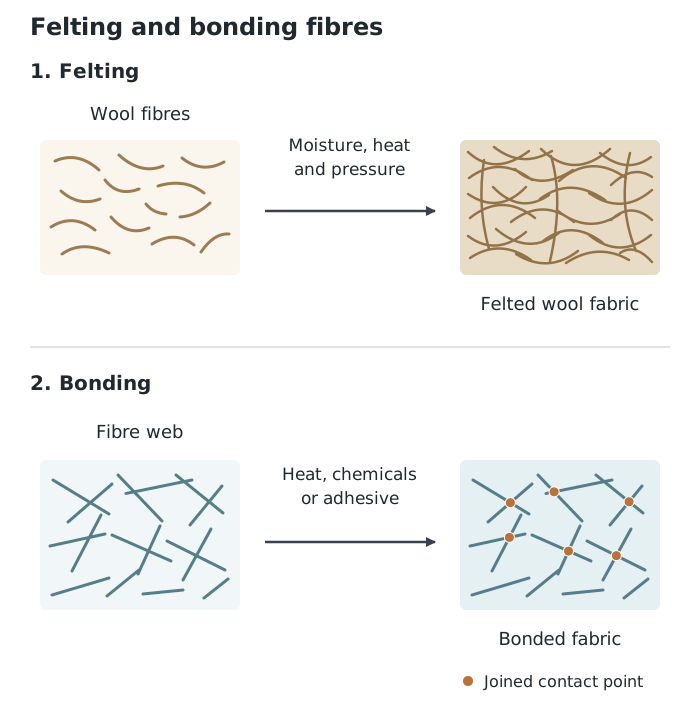
Both methods make fabric directly from fibres, without weaving or knitting yarns.
Start with the product’s requirements, then connect them to the material’s properties. For warm slippers, felted wool offers softness and insulation, while its bulk must be allowed for in the design. For a disposable cleaning wipe, a lightweight, inexpensive bonded sheet is more appropriate than thick wool felt.
Consider environmental consequences alongside performance. Wool is a natural animal fibre and is biodegradable. Synthetic fibres are manufactured from chemicals, commonly derived from oil. A bonded fabric’s environmental footprint therefore depends partly on the fibres used, while disposable products also create waste after a short period of use. Low manufacturing cost alone is not enough to justify a material choice.
Match property → product requirement, then consider a limitation and environmental impact. Fibre choice and construction both affect suitability.
Link a property to the product requirement: felted wool provides insulation, so it is suitable for warm slippers.
Distinguish the fibre from the fabric construction: wool is a fibre; felting is a way of making a non-woven fabric.
When selecting a textile, explain both why it suits the product and a relevant limitation. Bonded fabric’s poor stretch can be a disadvantage where freedom of movement is important.
It can see this note and what your specification asks for.
Answers are free with an account.
1 free note left this week
Get more free notesYour answer sets when this note comes back for review, or marks it complete.
Was this note helpful?
Log in to tell us whether it helped, or to report a problem.
Last updated
Non-woven textile
A fabric made by joining fibres directly together rather than weaving or knitting yarns.
Felted wool fabric
A dense non-woven fabric made by consolidating wool fibres using moisture, heat and pressure.
Bonded fabric
A sheet of fibres joined together using heat, chemicals or adhesive, without weaving or knitting.
Fibre web
A layer of loose fibres arranged into a sheet before they are consolidated or bonded into fabric.
Thermal insulation
The ability of a material to reduce heat transfer, helping to retain warmth.
Put your knowledge into practice — try past paper questions for Design and Technology
Non-woven textile
A fabric made by joining fibres directly together rather than weaving or knitting yarns.
Felted wool fabric
A dense non-woven fabric made by consolidating wool fibres using moisture, heat and pressure.
Bonded fabric
A sheet of fibres joined together using heat, chemicals or adhesive, without weaving or knitting.
Fibre web
A layer of loose fibres arranged into a sheet before they are consolidated or bonded into fabric.
Thermal insulation
The ability of a material to reduce heat transfer, helping to retain warmth.