

Loading…
Loading…
Loading…
Edexcel GCSE Design and Technology · 1DT0
Edexcel 1DT0 · 4.4.2 Check the specification (PDF) (opens in a new tab)
A polymer product may bend too much even though it does not break. Strength is the ability to withstand forces without failing; stiffness is resistance to deformation under a load. Reinforcement improves a product’s ability to carry loads, while stiffening helps it retain its shape. A technique can improve both, but the two properties are not interchangeable.
Designers can change the structure, improve how parts are joined, or modify the polymer itself. For example, a thin polymer casing might need internal ribs rather than thicker walls everywhere. A frame that sways sideways might need a diagonal brace rather than a different polymer.
A frame structure is a skeleton of connected members, such as polymer rods or tubes. Loads pass through these members and their joints towards the supports. This allows a product to support a load without being a solid block of material.
The position of the members matters: they must support the areas where forces act. The joints matter too, because a strong member is of little use if its connection separates or moves excessively. Frames can use material efficiently, but an open frame does not provide a continuous surface, and poorly secured joints can weaken the whole structure.
Imagine four rods connected as a rectangle with joints that can rotate. Pushing sideways can turn the rectangle into a parallelogram without changing the lengths of the rods. This sideways distortion is called racking.
Adding a diagonal brace divides the rectangle into two triangles. A triangle cannot change shape without changing a side length or a connection failing. The brace therefore resists racking by carrying a pulling or pushing force, rather than allowing the joints simply to rotate.
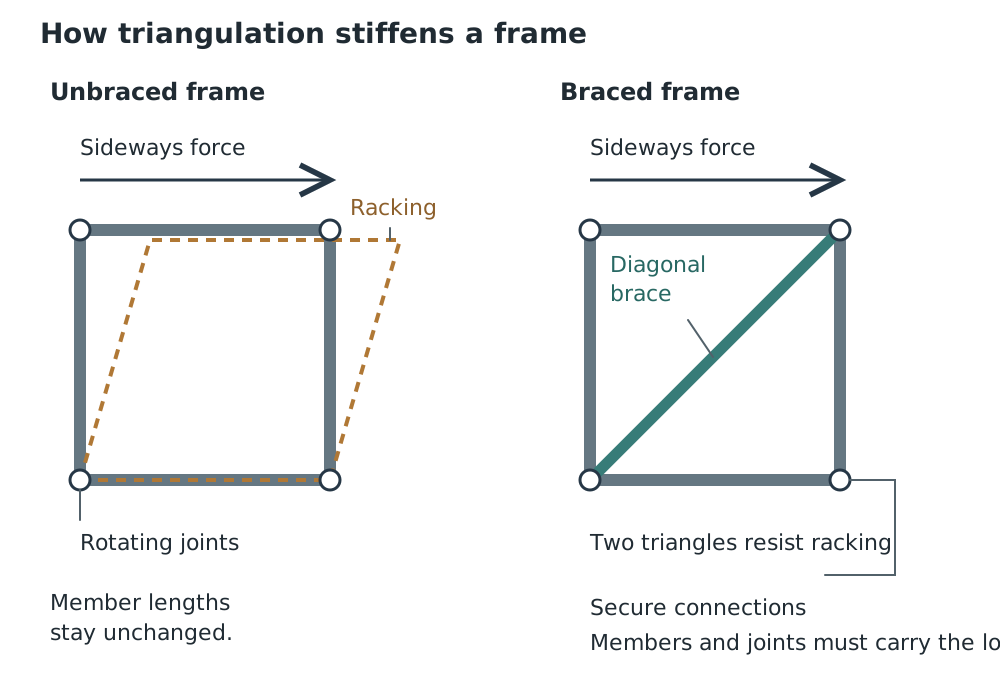
A diagonal brace divides a rectangular frame into triangles, resisting sideways racking.
Triangulation is useful when a frame must resist sideways movement. It adds relatively little material compared with filling the whole opening, but the brace takes up space and needs secure connections. It does not make the structure indestructible: the members and joints must still withstand the forces acting on them.
A flat polymer wall can flex under a load. Ribs, sometimes arranged as internal webbing, project from the wall and support it. They increase the depth of the structure locally and help distribute forces through the component. Injection-moulded polymer casings, such as plug casings, can use internal webbing to stiffen thin walls.
Bending or folding a suitable polymer sheet into a deeper cross-sectional shape can also improve its resistance to bending. A flat strip and a channel-shaped strip do not respond to a load in the same way, even if they use similar amounts of material. Thermoforming polymers can be softened with heat and formed into suitable shapes; thermosetting polymers cannot be reshaped this way after curing.
These approaches can avoid making every wall thicker. However, the ribs or folds must be positioned to resist the expected deformation, and the shape must remain suitable for the product’s function.
Fabrication makes components into the required shapes; assembly joins components into a product. Accurate shaping, well-fitting joints and a suitable joining process allow forces to pass through the structure without parts slipping or separating.
Bonding uses an adhesive selected for the materials, expected forces and environment. Solvent cement is suitable for some thermoplastics, while epoxy resin can bond many different materials. A bonded joint can spread forces over a broad area rather than relying on a small point of contact. The adhesive must be compatible with the particular polymer.
For a bonded assembly, prepare clean surfaces and key them if the adhesive instructions require it. Apply the adhesive as directed, align the parts and hold or clamp them without distorting them. Allow the specified curing time before applying a load. A joint is not ready merely because its surface looks dry: check that curing is complete and the parts remain securely aligned. Follow the product’s safety instructions, avoid skin and eye contact, and use suitable ventilation or extraction.
Polymer welding joins suitable thermoplastics by softening and fusing their surfaces using heat, hot air, friction or ultrasonic vibration. Clean surfaces and suitable joint preparation improve strength. The joint must cool and set before it is loaded. Welding needs appropriate protective equipment, extraction, safe screening and trained supervision. It is not suitable for reheating and fusing cured thermosetting polymers.
Lamination bonds layers together to make a thicker, stronger or stiffer component. Layers are pressed together while the adhesive cures; a former can hold them in a curve. Even adhesive coverage and secure bonding are important because separated layers cannot work together effectively.
A fibre-reinforced polymer is a composite: reinforcing fibres are embedded in a polymer matrix. Glass or carbon fibres provide high tensile strength. The matrix holds them in position, protects them and transfers loads to them.
This differs from adding a brace to a finished frame: reinforcement is built into the material. It can be useful where the component needs improved mechanical performance throughout its structure. Its success still depends on the fibres being properly incorporated and bonded into the matrix.
Additives modify a polymer during manufacture, but they do not all make it rigid.
The best choice depends on the problem. A sideways-moving frame suggests triangulation; a flexing casing suggests ribs; a separating assembly suggests better joints; and a polymer with unsuitable properties may need reinforcement or additives. Improving structural integrity means choosing a method that addresses the actual weakness, not simply adding more material.
Choose the method to match the weakness: racking, wall flexing, joint failure or unsuitable material properties.
Link the technique to its effect: for example, a diagonal brace prevents a rectangular frame from racking, rather than simply making it ‘stronger’.
Distinguish strength from stiffness: resisting failure is not the same as resisting bending or deformation.
Choose joining processes that suit the particular polymer. Thermosetting polymers cannot be softened and fused by reheating.
Not every additive stiffens a polymer. Plasticisers increase flexibility; fillers and reinforcing fibres can increase stiffness.
When comparing methods, relate the benefit and limitation to the product’s loads, shape and intended use.
It can see this note and what your specification asks for.
Answers are free with an account.
1 free note left this week
Get more free notesYour answer sets when this note comes back for review, or marks it complete.
Was this note helpful?
Log in to tell us whether it helped, or to report a problem.
Last updated
Strength
The ability of a material or structure to withstand forces without failing.
Stiffness
The resistance of a material or structure to bending or other deformation under a load.
Frame structure
A load-bearing skeleton of connected members, such as rods or tubes.
Triangulation
The use of triangular arrangements, often made by adding diagonal braces, to prevent a frame from changing shape.
Racking
The sideways distortion of a frame, such as a rectangle changing into a parallelogram.
Rib
A projecting support within or behind a component that increases its resistance to bending.
Composite
A material made by combining different materials so that their properties work together, such as glass fibres embedded in a polymer resin.
Matrix
The continuous material in a composite that holds the reinforcement in position, protects it and transfers loads to it.
Additive
A substance incorporated into a polymer to alter its properties or performance.
Plasticiser
An additive that increases a polymer’s flexibility and reduces brittleness.
Put your knowledge into practice — try past paper questions for Design and Technology
Strength
The ability of a material or structure to withstand forces without failing.
Stiffness
The resistance of a material or structure to bending or other deformation under a load.
Frame structure
A load-bearing skeleton of connected members, such as rods or tubes.
Triangulation
The use of triangular arrangements, often made by adding diagonal braces, to prevent a frame from changing shape.
Racking
The sideways distortion of a frame, such as a rectangle changing into a parallelogram.
Rib
A projecting support within or behind a component that increases its resistance to bending.
Composite
A material made by combining different materials so that their properties work together, such as glass fibres embedded in a polymer resin.
Matrix
The continuous material in a composite that holds the reinforcement in position, protects it and transfers loads to it.
Additive
A substance incorporated into a polymer to alter its properties or performance.
Plasticiser
An additive that increases a polymer’s flexibility and reduces brittleness.