

Loading…
Loading…
Loading…
Edexcel GCSE Design and Technology · 1DT0
Edexcel 1DT0 · 1.5.2 Check the specification (PDF) (opens in a new tab)
A lever is a rigid member that turns about a fixed pivot called the fulcrum. The effort is the input force applied to it; the load is the output force or resistance it acts against. Both forces are measured in newtons (N).
Think of using a crowbar to lift an object. Your hand supplies the effort, the point where the bar rests supplies the fulcrum, and the object provides the load. Changing their positions changes how much force and movement the lever produces. A lever can make a large load easier to move, change the direction of movement, or produce a larger output movement from a small input movement.
The three classes of lever are distinguished by which of these three elements lies in the middle. The arrangement can be drawn either way round without changing its class.
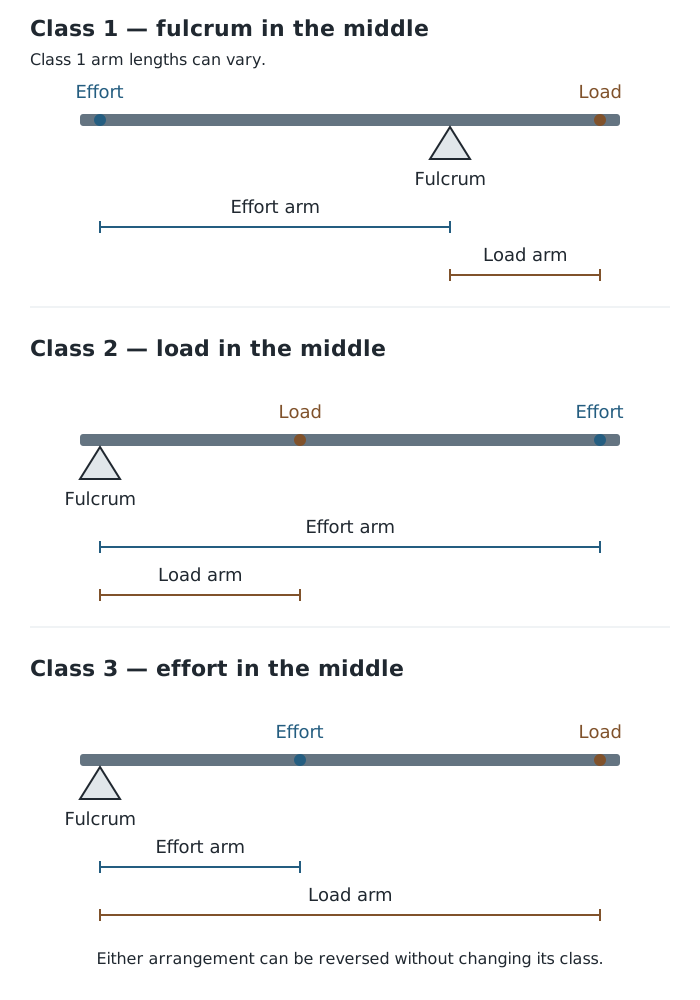
The element in the middle identifies the class. Both lever arms are measured from the fulcrum.
A class 1 lever has the fulcrum between the effort and the load. The effort and load points move in opposite directions: pushing one end down raises the other.
Scissors contain two class 1 levers. The central screw is the fulcrum, your fingers apply effort at the handles, and the material being cut provides resistance at the blades. Placing tougher material nearer the screw makes it easier to cut because the load is closer to the fulcrum while the effort remains farther away.
A crowbar used for lifting is another example. A long effort arm and a short load arm give force multiplication. Moving the fulcrum closer to the load increases this effect. However, class 1 does not automatically mean force multiplication: a shorter effort arm than load arm gives a smaller output force but a larger output movement.
A class 2 lever has the load between the fulcrum and the effort. The effort point is farther from the fulcrum than the load point, so the ideal lever multiplies force. The effort must move farther than the load, and the two points move in the same direction.
In a bottle opener, the fulcrum is where the opener bears against the cap, the load is where it hooks under the cap, and your hand applies effort farther along the handle. The longer handle makes the cap easier to lift.
A foot pump can also use a class 2 lever. The pedal pivots at one end, your foot supplies effort at the other, and the connection to the pump is between them. The pedal’s larger movement produces a smaller movement with greater force at the pump connection.
A class 3 lever has the effort between the fulcrum and the load. Its effort arm is shorter than its load arm. It therefore has a mechanical disadvantage: the effort must be greater than the output load. In return, the load moves farther and faster than the effort point. Both move in the same direction.
Tweezers show why this arrangement is useful. The joined end is the fulcrum, your fingers apply effort along the arms, and the load is at the tips. A small finger movement produces a larger movement at the tips.
The lifting arm of a hydraulic engine hoist is also a class 3 lever. It pivots at the top of the upright frame, the hydraulic piston pushes upward partway along the arm, and the engine hangs at its outer end. The long arm can reach over the car body, but the piston must provide a force greater than the engine’s load. Classification describes the lifting arm, not the hydraulic system supplying its effort.
Mechanical advantage (MA) tells you how many times the output load compares with the input effort:
An MA greater than 1 means force multiplication. An MA of 1 means equal input and output forces. An MA below 1 means a mechanical disadvantage. MA has no unit because it divides one force by another.
For example, suppose a lever moves a load of 240 N with an effort of 60 N. Its mechanical advantage is : the output load is four times the input effort.
You can rearrange the equation to find either force:
Suppose a lever has an MA of 3 and must move a load of 150 N. The required effort is . Alternatively, an effort of 40 N acting through a mechanism with an MA of 3 produces a load force of .
Force multiplication does not provide something for nothing. A smaller effort has to act through a greater distance to move the load through a smaller distance. Velocity ratio (VR) measures this trade-off:
Use corresponding distances from the same movement, expressed in the same units. For example, suppose the effort moves 200 mm while the load moves 40 mm. Then . The effort moves five times as far as the load. VR has no unit.
For a straight lever with parallel effort and load forces acting perpendicular to it, VR can also be found from its arm lengths:
Both arms are measured from the fulcrum. For example, an effort arm of 300 mm and a load arm of 100 mm give . In a class 2 lever, the effort arm extends past the load; in a class 3 lever, the load arm extends past the effort.
An ideal lever has no energy losses, so and its efficiency is 100%. Real mechanisms lose some input energy through friction and deformation. Their actual MA is lower than their VR.
Efficiency is the proportion of input work transferred into useful output work. It can be calculated from the two ratios:
Suppose a lever lifts a load of 240 N using an effort of 60 N. During the same movement, the effort travels 200 mm and the load travels 40 mm. Its MA is 4 and its VR is 5, so its efficiency is . This means 80% of the input work becomes useful output work.
These relationships help designers choose a suitable arrangement. A force-multiplying lever reduces the effort needed but requires more input travel. A class 3 lever sacrifices force to increase output movement or reach. Reducing friction improves efficiency, allowing more of the input work to perform the intended task.
| Class | Element in the middle | Main behaviour | Examples |
|---|---|---|---|
| 1 | Fulcrum | Can multiply force or increase movement; effort and load points move in opposite directions | Scissors, lifting crowbar |
| 2 | Load | Ideally multiplies force; effort moves farther than load | Bottle opener, foot-pump pedal |
| 3 | Effort | Mechanical disadvantage; load moves farther and faster | Tweezers, engine-hoist lifting arm |
For a straight lever with parallel forces perpendicular to it:
Identify the fulcrum, effort and load before classifying a lever. The component in the middle determines its class, even if the diagram is reversed.
Measure each lever arm from the fulcrum, not just between neighbouring labels. Only use arm lengths to find VR when the diagram’s geometry supports it.
Use matching units for distances before calculating VR. Load and effort are forces, measured in newtons (N), not kilograms.
Do not assume every class 1 lever multiplies force: this depends on the relative lengths of its arms.
MA and VR have no units. Multiply MA ÷ VR by 100 when efficiency is required as a percentage.
Only use MA = VR when the lever is assumed to be ideal. Real losses reduce MA and efficiency.
It can see this note and what your specification asks for.
Answers are free with an account.
1 free note left this week
Get more free notesYour answer sets when this note comes back for review, or marks it complete.
Was this note helpful?
Log in to tell us whether it helped, or to report a problem.
Last updated
Lever
A rigid member that turns about a fixed pivot to transmit or change force and movement.
Fulcrum
The fixed pivot about which a lever turns.
Effort
The input force applied to a mechanism, measured in newtons (N).
Load
The output force or resistance that a mechanism acts against, measured in newtons (N).
Effort arm
The distance from a lever’s fulcrum to the point where the effort is applied.
Load arm
The distance from a lever’s fulcrum to the point where the load acts.
Mechanical advantage
The ratio of output load to input effort: .
Velocity ratio
The ratio of the distance moved by the effort to the corresponding distance moved by the load: .
Efficiency
The proportion of input work transferred into useful output work, commonly expressed as a percentage. For a mechanism, .
Put your knowledge into practice — try past paper questions for Design and Technology
Lever
A rigid member that turns about a fixed pivot to transmit or change force and movement.
Fulcrum
The fixed pivot about which a lever turns.
Effort
The input force applied to a mechanism, measured in newtons (N).
Load
The output force or resistance that a mechanism acts against, measured in newtons (N).
Effort arm
The distance from a lever’s fulcrum to the point where the effort is applied.
Load arm
The distance from a lever’s fulcrum to the point where the load acts.
Mechanical advantage
The ratio of output load to input effort: .
Velocity ratio
The ratio of the distance moved by the effort to the corresponding distance moved by the load: .
Efficiency
The proportion of input work transferred into useful output work, commonly expressed as a percentage. For a mechanism, .