Loading…


Loading…
Loading…
Loading…
Edexcel GCSE Combined Science · 1SC0
Edexcel 1SC0 · Refraction and material interaction Check the specification (PDF) (opens in a new tab)
A wave can travel at different speeds in different substances. A substance through which a wave travels is called a medium. When a wave crosses a boundary into a medium where its speed is different, it undergoes refraction. If it approaches the boundary at an angle, its direction changes too.
Light passing from air into glass is a familiar example. It travels more slowly in glass, so an angled ray bends as it enters. A ray is an arrow showing the direction in which the wave travels.
To describe the bending, draw a normal: an imaginary line at right angles to the boundary where the ray meets it. Both the angle of incidence, before crossing, and the angle of refraction, after crossing, are measured from this line.
The direction of bending depends on the change in speed:
For example, light bends towards the normal when travelling from air into glass, and away from the normal when travelling from glass into air.
If the wave travels along the normal, it continues straight ahead. Its speed still changes, but there is no change in direction.
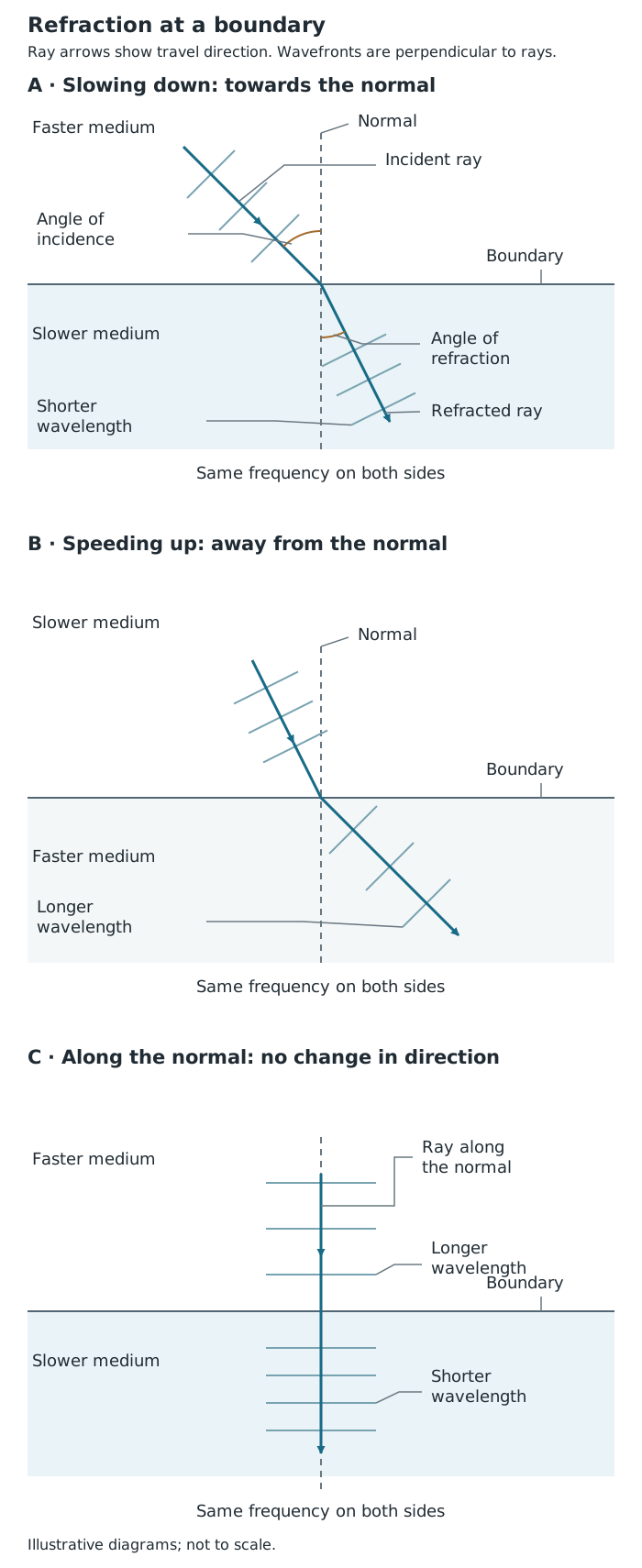
A wave bends towards the normal when it slows down and away from the normal when it speeds up. At normal incidence, it changes speed without turning.
A wavefront joins points at the same stage of a wave's vibration; a line along a crest is one example. The direction of wave travel is perpendicular to the wavefront.
When a wavefront reaches a boundary at an angle, one end enters the new medium first. If the wave travels more slowly there, that end slows while the rest is still moving faster in the original medium. This turns the wavefront, changing the direction of travel towards the normal. When the new medium allows the wave to travel faster, the first end speeds up instead, and the wave turns away from the normal.
At normal incidence, the whole wavefront reaches the boundary at the same time. All parts change speed together, so the wavefront does not turn.
The wave's frequency is the number of complete waves passing a point each second. Crossing a boundary does not change this rate: the source continues producing waves at the same frequency.
Wave speed, frequency and wavelength are linked by:
Since frequency stays constant, a decrease in speed means a decrease in wavelength. Successive wavefronts are therefore closer together in the slower medium. If the speed increases, the wavelength increases and the wavefronts are further apart.
A wave meeting a substance may be transmitted, passing through it; absorbed, transferring energy to it; reflected, returning into the original medium; or refracted, changing speed and potentially direction as it crosses the boundary.
These processes are not necessarily alternatives. For instance, some light can be reflected at a glass surface while the rest enters the glass and is transmitted through it. The transmitted light may also be refracted.
How a substance behaves depends on the wave's wavelength. Glass provides a useful example: it can transmit and refract visible light, absorb ultraviolet radiation and reflect infrared radiation. The amount of each interaction depends on the type of glass and the particular wavelength; glass does not treat every wavelength within these groups identically.
The important connection is that being transparent to visible light does not mean a material transmits all electromagnetic waves. The same substance can allow one range of wavelengths through while absorbing or reflecting another.
Get unlimited access to all revision notes, key terms, and exam tips.
A change in medium can change wave speed and direction.
For angled incidence, different parts of a wavefront change speed at different times, turning the wavefront.
Speed and wavelength change; frequency stays constant.
Lower speed means shorter wavelength; higher speed means longer wavelength.
A substance may transmit, absorb, reflect or refract waves differently at different wavelengths. More than one interaction can occur.
Glass can transmit/refract visible light, absorb ultraviolet and reflect infrared; its behaviour depends on the glass and the wavelength.
Get unlimited access to all revision notes, key terms, and exam tips.
Measure angles from the normal, not from the boundary.
Explain refraction by linking a change in wave speed to a change in direction; simply saying that the wave enters another material is not enough.
If a wave enters along the normal, its speed and wavelength can change without its direction changing.
Frequency stays constant during refraction. A lower speed means a shorter wavelength, not a lower frequency.
For wavelength-dependent interactions, compare how the same substance behaves for different wavelengths rather than assuming it treats all waves alike.
Medium
A substance through which a wave travels, such as air, water or glass.
Refraction
The change in a wave's speed as it crosses a boundary between media, which causes a change in direction unless it travels along the normal.
Normal
An imaginary line perpendicular to a boundary at the point where a wave meets it.
Wavefront
A line joining points on a wave that are at the same stage of their vibration, such as a line along a wave crest.
Transmission
The passage of a wave through a substance or across a boundary.
Absorption
The transfer of energy from a wave to a substance.
Reflection
The return of a wave into its original medium after it meets a boundary.
Put your knowledge into practice — try past paper questions for Combined Science
Medium
A substance through which a wave travels, such as air, water or glass.
Refraction
The change in a wave's speed as it crosses a boundary between media, which causes a change in direction unless it travels along the normal.
Normal
An imaginary line perpendicular to a boundary at the point where a wave meets it.
Wavefront
A line joining points on a wave that are at the same stage of their vibration, such as a line along a wave crest.
Transmission
The passage of a wave through a substance or across a boundary.
Absorption
The transfer of energy from a wave to a substance.
Reflection
The return of a wave into its original medium after it meets a boundary.