Loading…


Loading…
Loading…
Loading…
Edexcel GCSE Combined Science · 1SC0
Edexcel 1SC0 · Half-life and radiation hazards Check the specification (PDF) (opens in a new tab)
A radioactive source contains unstable nuclei that can decay and emit radiation. Its activity is the number of nuclear decays per second. Activity is measured in becquerels, symbol Bq: an activity of 800 Bq means that, on average, 800 nuclei decay each second.
As nuclei decay, fewer undecayed nuclei of the original radioactive isotope remain. There are therefore fewer nuclei available to decay, so the source’s activity decreases over time.
The decrease is not a fixed number of becquerels each second. The activity falls more rapidly at first, then more slowly as fewer undecayed nuclei remain. An activity–time graph has a downward curve that gradually becomes less steep.
It is impossible to predict when a particular unstable nucleus will decay. A nucleus might decay very soon or remain undecayed for a long time.
However, a source usually contains a very large number of nuclei. Although the individual events are random, their combined behaviour follows a predictable pattern. We can predict how the activity of a large sample will decrease without knowing which nuclei will decay next. Small samples and short measurements show greater random fluctuations.
The half-life of a radioactive isotope is the time taken for half its undecayed nuclei to decay. Equivalently, it is the time taken for the activity of a source to fall to half its value.
Each isotope has its own half-life. For a particular isotope, the half-life stays constant: halving the activity takes the same time whether the activity is initially high or already much lower.
For example, consider a source with an initial activity of 800 Bq and a half-life of 2 hours:
| Time / hours | Half-lives elapsed | Activity / Bq |
|---|---|---|
| 0 | 0 | 800 |
| 2 | 1 | 400 |
| 4 | 2 | 200 |
| 6 | 3 | 100 |
| 8 | 4 | 50 |
Each 2-hour interval halves the activity remaining. The decreases become smaller—400 Bq, then 200 Bq, then 100 Bq—but the time needed for each halving is unchanged.
The graph below shows this source’s predicted activity.
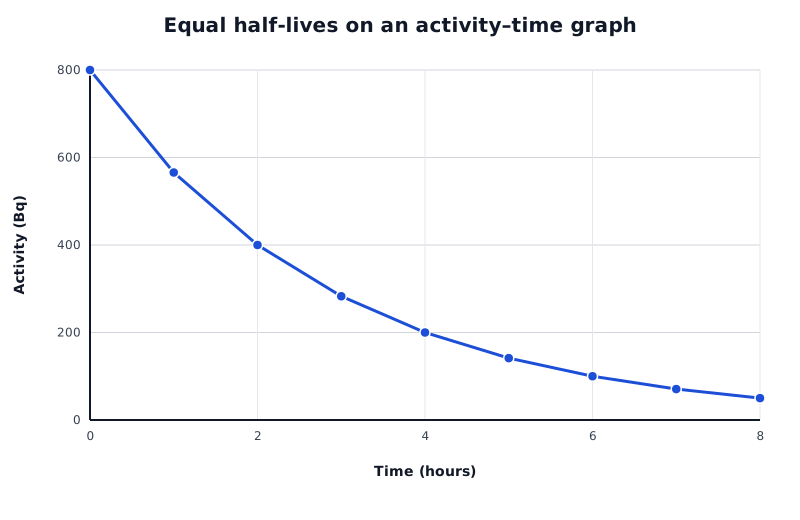
Data for a source with an initial activity of 800 Bq and a half-life of 2 hours. Successive halvings take equal times, while the curve becomes less steep.
Data for Equal half-lives on an activity–time graph
| Series | Time (hours) | Activity (Bq) |
|---|---|---|
| Predicted activity | 0 | 800 |
| Predicted activity | 1 | 565.69 |
| Predicted activity | 2 | 400 |
| Predicted activity | 3 | 282.84 |
| Predicted activity | 4 | 200 |
| Predicted activity | 5 | 141.42 |
| Predicted activity | 6 | 100 |
| Predicted activity | 7 | 70.71 |
| Predicted activity | 8 | 50 |
To read the half-life, choose an activity on the vertical axis, move horizontally to the curve, then vertically down to read the time. Repeat for half that activity and subtract the two times.
Here, 800 Bq occurs at 0 hours and 400 Bq at 2 hours, so the half-life is 2 hours. You can check this using another pair: 200 Bq occurs at 4 hours and 100 Bq at 6 hours. The interval is again 2 hours.
A graph of the number of undecayed nuclei against time can be read in exactly the same way: find how long the number takes to halve.
First work out how many half-lives have passed:
Then halve the starting activity or number of undecayed nuclei that many times. After one, two and three half-lives, the fractions remaining are , and respectively.
For a sample containing initially 80 000 undecayed nuclei, with a half-life of 15 minutes, 45 minutes represents half-lives. Repeated halving gives:
So 10 000 nuclei of the original isotope remain undecayed. The number that has decayed is , or of the initial number. These are predicted values for the sample, not a timetable for individual nuclei.
You can also work backwards to find a half-life. If a source’s activity falls from 1200 Bq to 300 Bq in 10 hours, the sequence shows two halvings. Its half-life is therefore hours.
Get unlimited access to all revision notes, key terms, and exam tips.
After 1, 2, 3 and 4 half-lives, the fractions remaining are , , and .
Get unlimited access to all revision notes, key terms, and exam tips.
Define half-life using half the undecayed nuclei or half the activity, not half the total number of atoms.
On a graph, find the time interval between an activity and half that activity. It need not start at time zero.
Distinguish the fraction remaining from the fraction that has decayed: subtract the fraction remaining from 1.
Activity is measured in Bq; detector count rate is measured in counts per second. They are not necessarily equal.
Activity
The number of nuclear decays per second in a radioactive source.
Becquerel
The unit of activity, symbol Bq. An activity of 1 Bq means one nuclear decay per second.
Half-life
The time taken for half the undecayed nuclei of a radioactive isotope to decay, or for the activity of a source to fall to half its value.
Isotope
An atom of a particular element with a particular number of neutrons. Isotopes of the same element have the same number of protons but different numbers of neutrons.
Put your knowledge into practice — try past paper questions for Combined Science
Activity
The number of nuclear decays per second in a radioactive source.
Becquerel
The unit of activity, symbol Bq. An activity of 1 Bq means one nuclear decay per second.
Half-life
The time taken for half the undecayed nuclei of a radioactive isotope to decay, or for the activity of a source to fall to half its value.
Isotope
An atom of a particular element with a particular number of neutrons. Isotopes of the same element have the same number of protons but different numbers of neutrons.