Loading…


Loading…
Loading…
Loading…
Edexcel GCSE Combined Science · 1SC0
Edexcel 1SC0 · Density and thermal properties Check the specification (PDF) (opens in a new tab)
Heating transfers energy to a system, such as water in a beaker. The energy stored within its particles is called internal energy. It includes kinetic energy associated with particle movement and potential energy associated with their positions and interactions.
Heating can produce two different results. If the substance remains in the same state, its particles move more vigorously: their average kinetic energy increases and its temperature rises. During melting or boiling, however, energy increases the particles’ potential energy rather than raising the temperature.
For example, ice can continue receiving energy while it melts at approximately 0 °C. The energy helps overcome attractions holding water molecules in the solid arrangement. It does not break the molecules themselves into atoms. The temperature remains approximately constant until all the ice has melted; further heating then raises the temperature of the liquid water.
Specific heat capacity is the energy needed to raise the temperature of 1 kg of a substance by 1 °C, without changing its state. Different substances have different specific heat capacities. A larger specific heat capacity means that more energy is needed for the same mass and temperature rise.
The relationship is:
Here, is the change in thermal energy in joules (J), is mass in kilograms (kg), is specific heat capacity in J/(kg °C), and is the temperature change in °C.
For heating, calculate by subtracting the initial temperature from the final temperature. Doubling the mass doubles the energy required for the same temperature rise. Doubling the temperature rise also doubles the energy required, provided the substance does not change state. For the same mass and energy input, a substance with a higher specific heat capacity has a smaller temperature rise.
To calculate an energy change, first find the temperature change, then multiply it by the mass in kilograms and the specific heat capacity.
Energy needed to warm water
In this example, 0.50 kg of liquid water is warmed from 20 °C to 40 °C without changing state. Use a specific heat capacity of 4200 J/(kg °C). Calculate the energy gained by the water.
The calculated energy is the increase in the water’s stored energy as its temperature rises. A heater may need to supply more energy than this if some energy heats the container or escapes to the surroundings.
If energy, mass and temperature change are measured, rearrange the equation to determine the material’s specific heat capacity:
Specific latent heat is the energy needed to change the state of 1 kg of a substance without changing its temperature. It is measured in J/kg.
The energy required is:
Here, is energy in joules, is the mass changing state in kilograms, and is the specific latent heat in J/kg. For a complete change of state, use the whole mass of the sample. Doubling the mass doubles the required energy. You can also rearrange the equation as or .
The value of depends on the substance and the change of state. Specific latent heat of fusion applies to melting or freezing; specific latent heat of vaporisation applies to boiling or condensation. Melting and boiling require energy transfers into the substance. Freezing and condensation transfer energy out.
For a melting calculation, convert the mass to kilograms and multiply by the specific latent heat of fusion. There is no temperature-change factor because the energy changes the state rather than the temperature.
Energy needed to melt ice
In this example, 200 g of ice at its melting point melts completely without changing temperature. Use a specific latent heat of fusion of 334000 J/kg. Calculate the energy required.
This energy melts the whole sample at its melting point; it does not warm the resulting liquid. If the ice initially starts below its melting point, energy must first be supplied to raise its temperature.
The distinction is the purpose of the energy transfer: specific heat capacity describes a temperature change without a state change, whereas specific latent heat describes a state change without a temperature change. This is why only the specific heat capacity equation contains a temperature change. If a process involves both warming a substance and changing its state, calculate the energy for each stage separately and add the amounts.
A heated system usually transfers some energy to cooler surroundings. Thermal insulation reduces the rate of this unwanted transfer; it does not stop it completely or supply energy itself.
Conduction transfers energy through a material. Materials with low thermal conductivity reduce this transfer. In a water-heating experiment, foam cladding around the beaker reduces energy transfer through its sides. The foam traps air, which is a poor thermal conductor. A thicker layer of suitable insulation generally reduces the transfer further.
Convection transfers energy through the movement of liquids or gases. Small pockets of trapped air prevent air from circulating freely, reducing convection as well as conduction. A lid helps prevent warm air escaping from above a heated beaker and reduces evaporation from the water’s surface.
The same principles keep buildings warm. Loft insulation traps air between fibres, reducing conduction and preventing free air circulation. Insulation filling a wall cavity also reduces conduction and convection. Draught prevention limits warm air escaping and cold air entering, so less energy is needed to maintain the indoor temperature.
Thermal radiation can transfer energy without moving matter. Reflective surfaces reflect thermal radiation, reducing the amount absorbed. The useful explanation always connects the design to the transfer pathway it reduces.
The investigation measures three quantities: the mass of water, its temperature rise, and the energy supplied by an immersion heater.
Use a balance, beaker, water, thermometer, immersion heater, power supply and joulemeter. Add insulating cladding and a lid to reduce energy loss, and stir the water to distribute energy evenly.
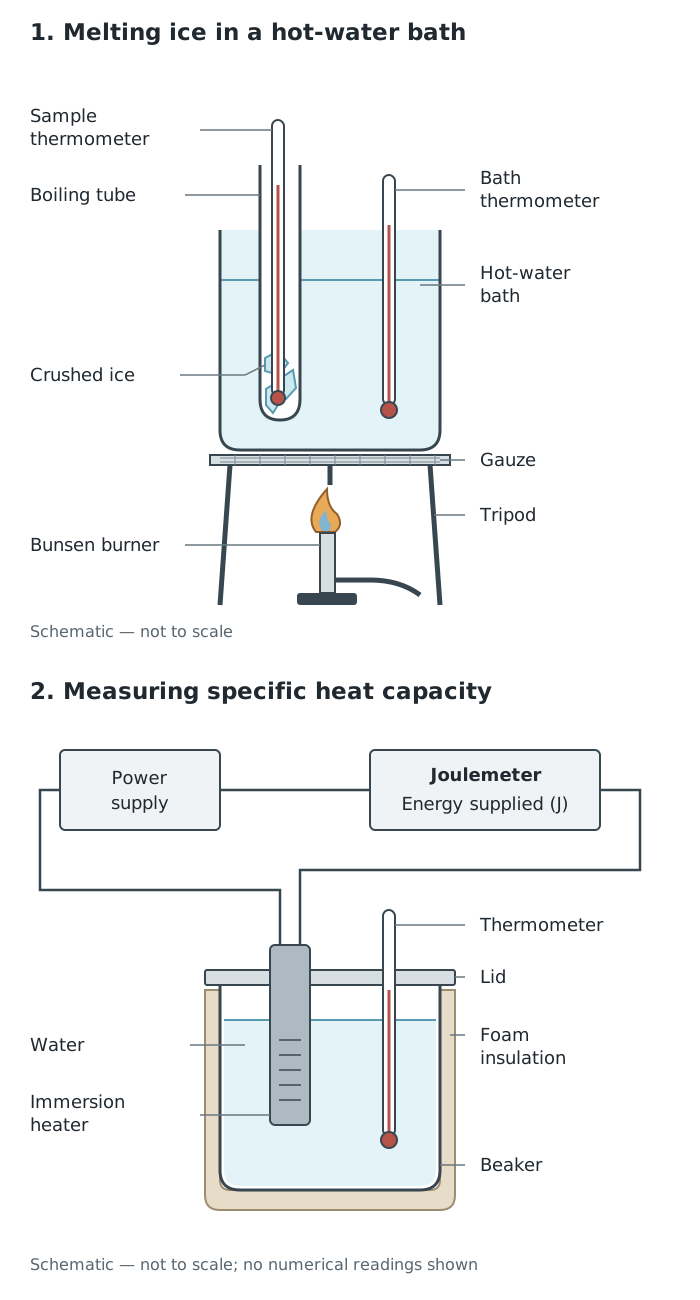
The melting-ice investigation uses a hot-water bath; the specific-heat-capacity investigation measures energy supplied to an insulated beaker of water.
The joulemeter measures electrical energy supplied to the heater, not just energy gained by the water. Some energy heats the apparatus or escapes to the surroundings. Treating all the supplied energy as energy gained by the water therefore tends to give an overestimate of its specific heat capacity: the energy used in the numerator is too large for the measured water temperature rise. Insulation and a lid reduce this problem, while stirring makes the temperature reading more representative of the whole sample.
Put crushed ice in a boiling tube and measure its initial temperature. Place the tube in a beaker of hot water supported on a tripod and gauze. Keep the water bath hot using a Bunsen burner, and monitor its temperature with a second thermometer so that it remains approximately constant.
Start a stopwatch when the tube enters the bath. Record the temperature of the ice every 30 seconds and note whether the sample contains solid ice, liquid water, or both. Continue until three minutes after all the ice has visibly melted.
Plot time on the horizontal axis and temperature on the vertical axis. The following constructed graph illustrates the expected pattern; it is not a set of measured results.
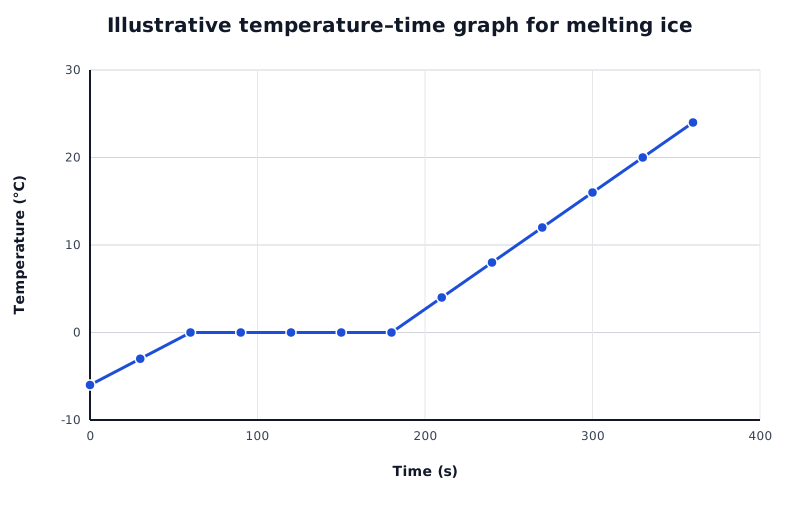
The plateau represents melting, followed by warming of the liquid water.
Data for Illustrative temperature–time graph for melting ice
| Series | Time (s) | Temperature (°C) |
|---|---|---|
| Illustrative sample temperature | 0 | -6 |
| Illustrative sample temperature | 30 | -3 |
| Illustrative sample temperature | 60 | 0 |
| Illustrative sample temperature | 90 | 0 |
| Illustrative sample temperature | 120 | 0 |
| Illustrative sample temperature | 150 | 0 |
| Illustrative sample temperature | 180 | 0 |
| Illustrative sample temperature | 210 | 4 |
| Illustrative sample temperature | 240 | 8 |
| Illustrative sample temperature | 270 | 12 |
| Illustrative sample temperature | 300 | 16 |
| Illustrative sample temperature | 330 | 20 |
| Illustrative sample temperature | 360 | 24 |
If the ice starts below 0 °C, its temperature first rises towards the melting point. During melting, the graph has an approximately horizontal plateau near 0 °C: ice and water coexist while energy changes the state. After the last ice melts, the liquid water’s temperature rises.
Actual readings may not form a perfectly flat plateau because of uneven temperatures and measurement limitations. Recording the physical state alongside temperature helps connect the graph to what is happening in the tube.
Hot water and hot glass can cause burns. Handle them carefully, keep hair and loose clothing away from the Bunsen flame, and turn off the gas when heating is finished.
Get unlimited access to all revision notes, key terms, and exam tips.
Temperature change:
: kg; : J/(kg °C); : °C; : J.
Use mass in kilograms in both thermal-energy equations. Convert grams to kilograms by dividing by 1000.
Calculate the temperature change as final temperature minus initial temperature; do not substitute the final temperature alone.
Choose ΔQ = mcΔθ for a temperature change and Q = mL for a change of state.
Include ‘without changing its temperature’ when defining specific latent heat.
A flat section of a heating graph does not mean that energy transfer has stopped: energy is being transferred while the substance changes state.
When explaining insulation, link the material or design to the energy-transfer pathway it reduces. High specific heat capacity is not the same property as low thermal conductivity.
Internal energy
The total kinetic energy and potential energy stored by the particles in a system.
Specific heat capacity
The energy needed to raise the temperature of 1 kg of a substance by 1 °C, without changing its state. Its unit is J/(kg °C).
Specific latent heat
The energy needed to change the state of 1 kg of a substance without changing its temperature. Its unit is J/kg.
Specific latent heat of fusion
The energy needed to change 1 kg of a substance from solid to liquid without changing its temperature.
Specific latent heat of vaporisation
The energy needed to change 1 kg of a substance from liquid to gas without changing its temperature.
Thermal insulation
A material or arrangement that reduces unwanted energy transfer between a system and its surroundings.
Plateau
A flat section of a graph. On a temperature–time graph for melting ice, it shows that the temperature remains approximately constant during melting.
Joulemeter
An instrument that measures energy transferred, in joules.
Put your knowledge into practice — try past paper questions for Combined Science
Internal energy
The total kinetic energy and potential energy stored by the particles in a system.
Specific heat capacity
The energy needed to raise the temperature of 1 kg of a substance by 1 °C, without changing its state. Its unit is J/(kg °C).
Specific latent heat
The energy needed to change the state of 1 kg of a substance without changing its temperature. Its unit is J/kg.
Specific latent heat of fusion
The energy needed to change 1 kg of a substance from solid to liquid without changing its temperature.
Specific latent heat of vaporisation
The energy needed to change 1 kg of a substance from liquid to gas without changing its temperature.
Thermal insulation
A material or arrangement that reduces unwanted energy transfer between a system and its surroundings.
Plateau
A flat section of a graph. On a temperature–time graph for melting ice, it shows that the temperature remains approximately constant during melting.
Joulemeter
An instrument that measures energy transferred, in joules.
Change of state:
: kg; : J/kg; : J.
Fusion: melting/freezing. Vaporisation: boiling/condensation. Reverse changes release energy.
Specific heat capacity: measure water mass, supplied energy with a joulemeter, and temperature rise. Stir, insulate and use a lid. Calculate . Energy lost to surroundings or gained by apparatus tends to make the calculated value too high.
Melting ice: heat crushed ice in a boiling tube using a hot-water bath. Record temperature every 30 seconds and the sample’s state; continue for three minutes after melting. Plot temperature against time. The plateau near 0 °C represents melting, not the end of energy transfer.
Get unlimited access to all revision notes, key terms, and exam tips.