Loading…


Loading…
Loading…
Loading…
Edexcel GCSE Combined Science · 1SC0
Edexcel 1SC0 Check the specification (PDF) (opens in a new tab)
A force is a push or pull arising from an interaction between objects. It can change an object's motion or shape and is measured in newtons (N). Every force has both a size and a direction: a 10 N downward force is different from a 10 N upward force.
Some interactions require contact. A book resting on a table experiences an upward normal contact force from the table. ‘Normal’ means perpendicular to the surface, so the normal force from a sloping surface is not vertically upward. Friction acts along the surfaces in contact and opposes their relative movement, or their tendency to slide. For example, friction opposes a box sliding across a floor.
Other interactions act across a distance through fields. A field is a region in which an object can experience a force without touching the object producing the field.
When Earth pulls on a book, the book also pulls on Earth. These two gravitational forces are equal in magnitude and opposite in direction. Similarly, when a table pushes upward on a book, the book pushes downward on the table with an equal force.
The crucial distinction is which object each force acts on. The two forces in an interaction pair act on different objects. They therefore do not cancel when you work out the resultant force on just one of those objects.
For a book resting on a table, the upward support force and downward weight both act on the book and balance. They are not an interaction pair: one comes from the table–book interaction and the other from the Earth–book interaction.
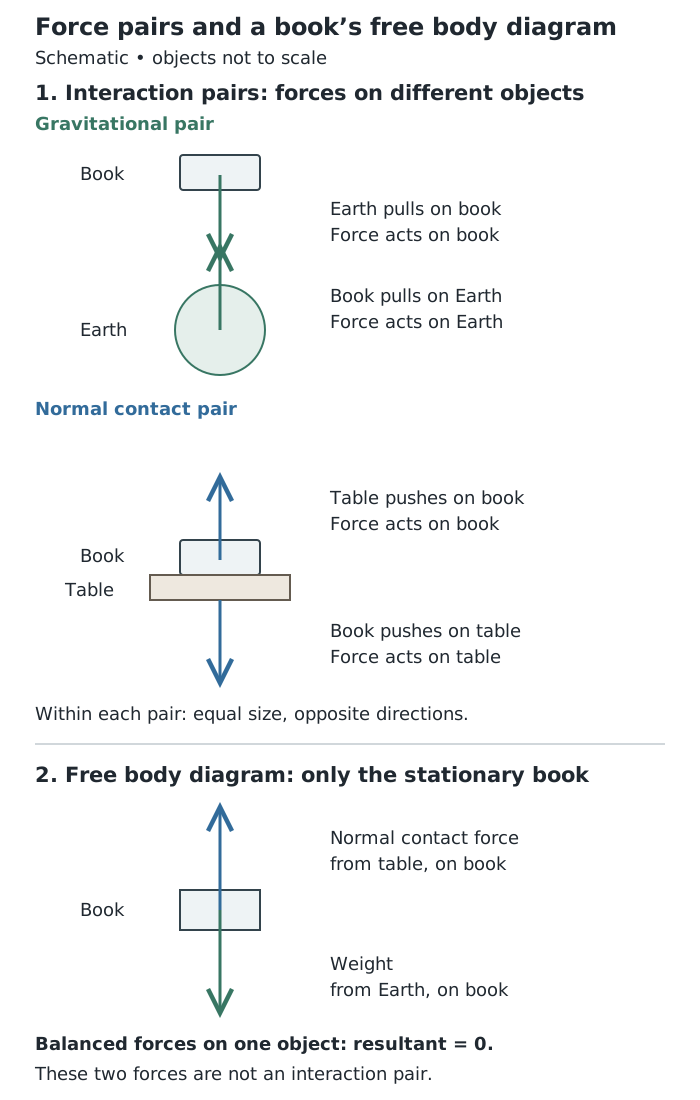
Interaction pairs act on different objects. The balanced forces in the book's free body diagram both act on the book.
A scalar has magnitude only. Mass, distance and speed are scalars: a mass of 5 kg does not need a direction to describe it.
A vector has magnitude and direction. Force, weight, displacement and velocity are vectors. A car travelling at 60 km/h west has a speed of 60 km/h, but its velocity also includes ‘west’. If it changes direction while keeping the same speed, its velocity changes.
Distance is the total length of a route travelled. Displacement describes the straight-line change from the starting position to the finishing position, including direction. Returning to your starting point gives zero displacement even though you have travelled a distance.
Vectors can be represented by arrows. The arrowhead shows direction, and the arrow's length represents magnitude. Equal and opposite forces are therefore shown by equal-length arrows pointing in opposite directions.
A free body diagram separates one chosen object from its surroundings so that you can examine all the external forces acting on it. It does not mean that the object has no external forces.
Start by choosing the object or system. Represent it by a simple shape or point, then draw and label the forces acting on it. Include both contact and non-contact forces, but leave out forces that the chosen object exerts on its surroundings.
For the book above, include its downward weight and the upward normal contact force. Do not include the downward force of the book on the table: that acts on the table, not the book.
For a car travelling up a slope, draw weight vertically downward, the normal contact force perpendicular to the slope, and the driving force up the slope. Any friction or drag opposing its uphill motion acts down the slope. On a diagram showing where forces act, weight acts through the centre of mass and the normal force acts at the contact surface.
For a system containing several objects, first decide what lies inside its boundary. Forces between objects within that system are internal; a free body diagram of the whole system shows forces exerted from outside it.
The resultant force, or net force, is the single force with the same overall effect as all the forces combined. Direction matters when combining forces.
Forces along the same line add if they point the same way and subtract if they point opposite ways. For a car with a 600 N driving force forward and a total resistance of 400 N backward, the resultant is 200 N forward. If resistance rises to 600 N, the resultant becomes zero.
When the resultant force is zero, the forces are balanced and the object is in equilibrium. There is no acceleration: a stationary object remains stationary, while a moving object continues at constant velocity.
A falling skydiver illustrates the difference. When weight is greater than upward air resistance, the resultant is downward and the skydiver speeds up. As speed increases, air resistance increases and the resultant becomes smaller. Eventually air resistance equals weight. The forces balance, but the skydiver is still moving downward at constant velocity.
When forces act in different directions, simply adding their magnitudes will not give the resultant. A scale drawing combines their directions as well as their sizes.
Choose a scale, draw the first force accurately, then draw the second force starting at the arrowhead of the first. Keep the second force's original direction: moving an arrow for the construction does not mean turning it. The resultant runs from the tail of the first arrow to the head of the last arrow.
For example, consider the forces 6 N right and 8 N upward. With a scale of 1 cm representing 2 N, draw a 3 cm arrow right, followed by a 4 cm arrow upward. The diagonal from the original starting point to the final arrowhead measures approximately 5 cm, representing a resultant of 10 N. A protractor gives its direction as approximately 53° above the rightward horizontal.
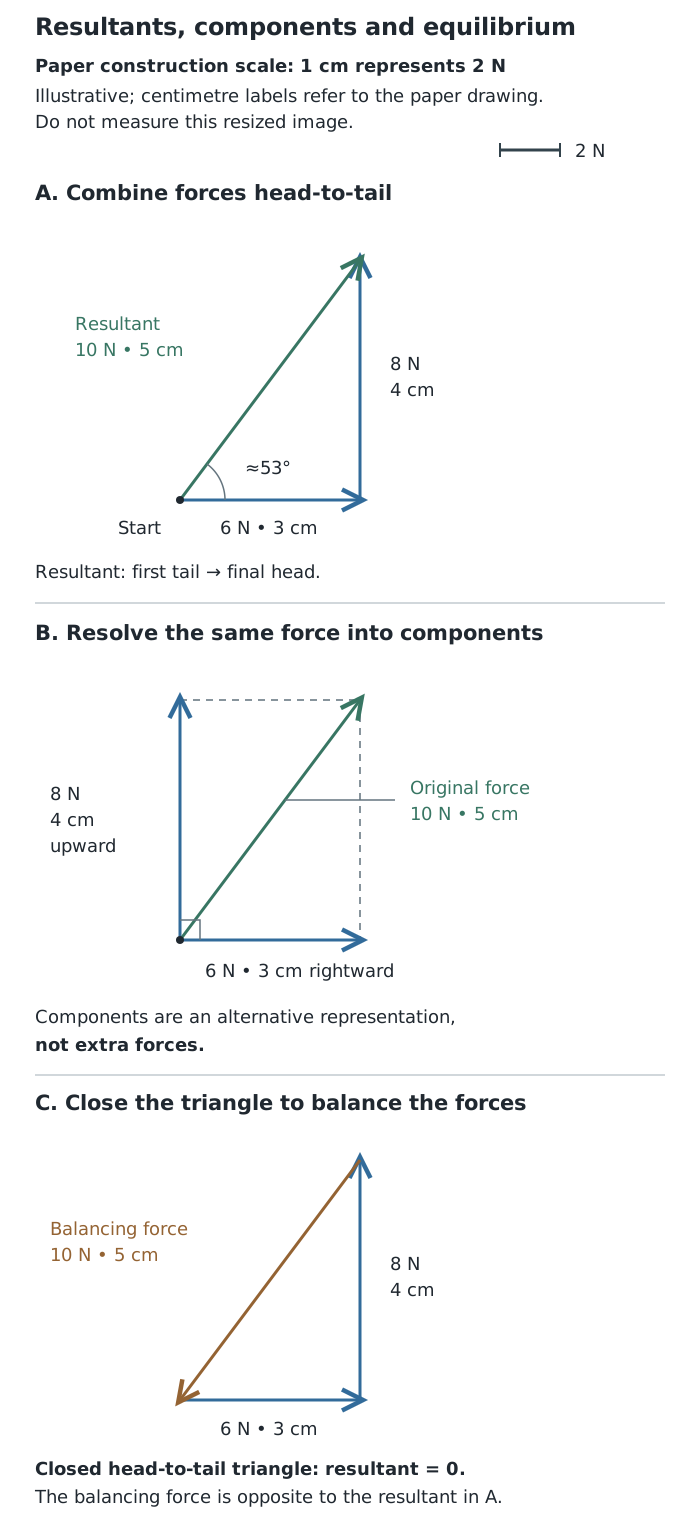
Scale constructions: combining forces, resolving a force, and closing a vector triangle to show equilibrium.
To represent equilibrium, the arrows must form a closed shape when placed head-to-tail. In this illustration, an additional 10 N force pointing exactly opposite to the diagonal resultant closes the triangle. It balances the combined effect of the other two forces.
Resolving a force reverses the process of combining forces: one force is represented by two component forces in chosen directions, usually horizontal and vertical. The components together have the same effect as the original force; they are not extra forces acting alongside it.
Draw the original force to scale at its correct angle. Through its tail, draw horizontal and vertical construction lines. Through its head, draw lines parallel to those directions to complete a rectangle. The horizontal and vertical sides from the original tail give the two components. Measure their lengths and use the scale to convert them into forces.
For the 10 N force at approximately 53° above the horizontal, a 5 cm diagonal at the same scale produces sides approximately 3 cm and 4 cm long. These represent a 6 N rightward component and an 8 N upward component. This is a scale-drawing method, not a trigonometric calculation.
When moving surfaces rub together, friction transfers energy to thermal stores, warming the surfaces and their surroundings. In machinery, this energy transfer is often unwanted because it reduces the energy available for useful movement.
Oil or grease between moving surfaces provides lubrication. For example, lubricating moving parts in a machine reduces friction between them, so less energy is transferred by heating and the machine operates more efficiently. Lubrication reduces friction; it does not eliminate every unwanted energy transfer.
Get unlimited access to all revision notes, key terms, and exam tips.
Same-line forces add in the same direction and subtract in opposite directions.
When identifying a force pair, name both objects: force of A on B and force of B on A. The forces act on different objects.
A free body diagram shows only forces acting on the chosen object, not forces that it exerts on other objects.
Use a ruler, sharp pencil and protractor for scale drawings. State the scale and convert measured lengths back into newtons.
For Higher Tier vector constructions, use scale drawings rather than trigonometry.
Balanced forces mean zero resultant force, not necessarily that the object is stationary.
Force
An interaction between objects that can change motion or shape. Force is a vector quantity measured in newtons (N).
Field
A region in which an object experiences a force because of its mass, electric charge or magnetic properties.
Scalar
A quantity with magnitude only, such as mass, distance or speed.
Vector
A quantity with both magnitude and direction, such as force, displacement or velocity.
Magnitude
The size of a quantity, without its direction.
Normal contact force
The supporting force exerted by a surface on an object, acting perpendicular to the surface.
Friction
A contact force that opposes relative movement, or the tendency to move, between surfaces.
Resultant force
The single force that has the same overall effect as all the forces acting on an object combined.
Free body diagram
A diagram showing all the external forces acting on one chosen object or system.
Equilibrium
The condition in which forces balance and the resultant force is zero, so there is no acceleration.
Component
One of the forces in chosen directions that together have the same effect as an original force.
Lubrication
The use of a substance such as oil or grease between moving surfaces to reduce friction and unwanted energy transfer.
Put your knowledge into practice — try past paper questions for Combined Science
Force
An interaction between objects that can change motion or shape. Force is a vector quantity measured in newtons (N).
Field
A region in which an object experiences a force because of its mass, electric charge or magnetic properties.
Scalar
A quantity with magnitude only, such as mass, distance or speed.
Vector
A quantity with both magnitude and direction, such as force, displacement or velocity.
Magnitude
The size of a quantity, without its direction.
Normal contact force
The supporting force exerted by a surface on an object, acting perpendicular to the surface.
Friction
A contact force that opposes relative movement, or the tendency to move, between surfaces.
Resultant force
The single force that has the same overall effect as all the forces acting on an object combined.
Free body diagram
A diagram showing all the external forces acting on one chosen object or system.
Equilibrium
The condition in which forces balance and the resultant force is zero, so there is no acceleration.
Component
One of the forces in chosen directions that together have the same effect as an original force.
Lubrication
The use of a substance such as oil or grease between moving surfaces to reduce friction and unwanted energy transfer.
Balanced forces mean no acceleration: rest or constant velocity. A non-zero resultant changes velocity.
Oil or grease reduces friction between moving surfaces → less unwanted transfer to thermal stores → greater efficiency.
Get unlimited access to all revision notes, key terms, and exam tips.