Loading…


Loading…
Loading…
Loading…
Edexcel GCSE Combined Science · 1SC0
Edexcel 1SC0 · Domestic electricity and power Check the specification (PDF) (opens in a new tab)
An electrical supply transfers energy to components in a circuit. A battery provides energy from its chemical store; the mains supply transfers energy electrically to connected appliances. Components then transfer that energy in different ways, such as producing movement or heating water.
Two circuit quantities help us describe this transfer. Current is the amount of charge flowing each second. Potential difference is the energy transferred per unit charge across a component. A larger current means more charge passes through each second; a larger potential difference means more energy is transferred by each unit of charge.
The electrical energy transferred is:
Here, is energy transferred in joules (J), is current in amperes (A), is potential difference in volts (V), and is time in seconds (s). For constant current and potential difference, running a device for twice as long transfers twice as much energy.
For example, suppose a component has a current of through it and a potential difference of across it for . The energy transferred is . This is the total energy transferred electrically to the component during that time.
Get unlimited access to all revision notes, key terms, and exam tips.
Convert time to seconds and power to watts before calculating energy in joules: 1 min = 60 s and 1 kW = 1000 W.
Choose the equation using the quantities given. Use P = IV for current and potential difference, or P = I²R for current and resistance.
In P = I²R, square the current before multiplying by the resistance.
Distinguish energy transferred, measured in joules, from power, measured in watts.
A power rating describes total energy transferred per second, not necessarily useful energy transferred per second.
Power
The amount of energy transferred per second, measured in watts (W).
Watt
The unit of power. One watt means one joule of energy is transferred each second: .
Current
The rate of flow of electric charge, measured in amperes (A).
Potential difference
The energy transferred per unit charge between two points in a circuit, measured in volts (V).
Resistance
A measure of how strongly a component opposes the flow of current, measured in ohms (Ω).
Power rating
The stated power of an appliance under its intended operating conditions, indicating how much energy it transfers each second.
Heating element
A component designed to become hot when current flows through it, transferring energy to its thermal store.
Put your knowledge into practice — try past paper questions for Combined Science
Power
The amount of energy transferred per second, measured in watts (W).
Watt
The unit of power. One watt means one joule of energy is transferred each second: .
Current
The rate of flow of electric charge, measured in amperes (A).
Potential difference
The energy transferred per unit charge between two points in a circuit, measured in volts (V).
Resistance
A measure of how strongly a component opposes the flow of current, measured in ohms (Ω).
Power rating
The stated power of an appliance under its intended operating conditions, indicating how much energy it transfers each second.
Heating element
A component designed to become hot when current flows through it, transferring energy to its thermal store.
Power is the energy transferred per second. It is a rate, rather than an amount of energy. A powerful appliance transfers energy quickly, but its total energy transfer also depends on how long it operates.
Power, , is measured in watts (W). One watt means one joule transferred each second:
One kilowatt is . A appliance therefore transfers each second while operating at that power.
For example, a device transferring in has a power of . Its average rate of energy transfer is each second.
Rearranging the power equation gives two useful relationships:
These show why a lower-power device can transfer the same total energy as a higher-power device if it operates for longer.
Since and , dividing the energy transferred by the time gives:
This connects power directly to the flow of charge. Current tells us how much charge passes each second, and potential difference tells us how much energy each unit of charge transfers. Multiplying them gives energy transferred each second.
At a fixed potential difference, doubling the current doubles the power. At a fixed current, doubling the potential difference doubles the power.
For a motor with across it and a current of , the electrical power input is . The motor receives electrically each second. Not all of this necessarily becomes useful movement: some energy is transferred to the surroundings by heating and sound.
Resistance describes how strongly a component opposes current. Using the circuit relationship , we can replace in :
Use this form when current and resistance are known. is resistance in ohms (), and the current must be squared.
For a resistor with resistance and current , its power is . Energy is transferred to the resistor at a rate of each second, producing heating.
For a fixed resistance, doubling the current makes the power four times as large because the current is squared. This helps explain why a large current can produce substantial heating.
Domestic appliances use electrical energy transfers to produce different useful effects. A battery-powered remote control receives energy electrically from the battery's chemical store. Many larger household appliances receive energy electrically from the a.c. mains supply.
A motor produces movement. In a washing machine, a motor rotates the drum, transferring energy to its kinetic store and moving the clothes. A vacuum cleaner uses a motor to move air and create suction. Motors also transfer some energy to the surroundings through heating and sound.
A heating element becomes hot when current flows through it. In a kettle, energy is transferred electrically to the element's thermal store and then by heating to the water's thermal store. In a toaster, hot elements transfer energy to the bread, increasing its temperature and toasting it. Heating that escapes to other surroundings is not useful for these tasks.
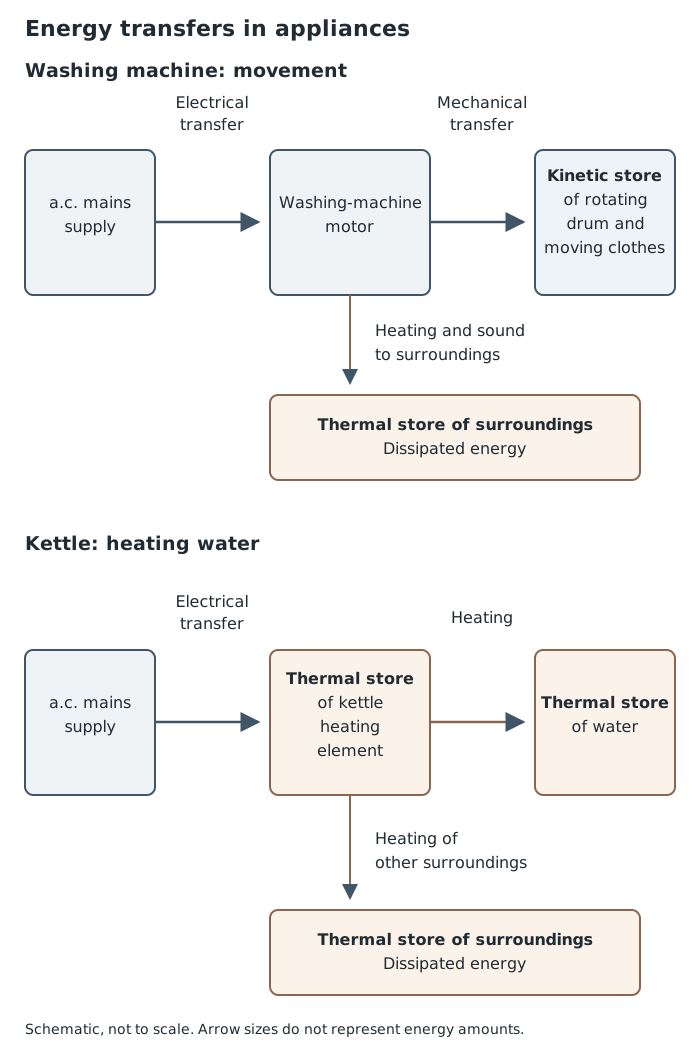
Electrical energy transfers produce movement in a washing machine and heating in a kettle. Some energy is also transferred to the surroundings.
These examples distinguish an energy store, such as a thermal or kinetic store, from a transfer pathway, such as electrical work or heating. Energy is transferred between stores; it is not used up.
A power rating tells us the rate at which an appliance transfers energy under its intended operating conditions. A kettle rated at transfers electrically each second when operating at that rating. This leads to changes in the thermal stores of the element, water and surroundings.
For the same operating time, an appliance with twice the power transfers twice as much energy. For the same energy transfer, an appliance with twice the power needs half as much time.
For example, a iron operating for one hour transfers the same total energy as a iron operating for half an hour. Using seconds, both transfer : and give the same result.
A higher power rating therefore means a faster total energy transfer, not automatically greater efficiency. When comparing how quickly two kettles heat the same amount of water, their useful heating rates matter as well as their electrical power inputs.
Units: in J, in W, in A, in V, in s and in .
Some energy is transferred to the surroundings rather than producing the intended useful effect.
A higher power rating means a faster total energy transfer.
Get unlimited access to all revision notes, key terms, and exam tips.