Loading…


Loading…
Loading…
Loading…
Edexcel GCSE Combined Science · 1SC0
Edexcel 1SC0 · Energy stores and transfers Check the specification (PDF) (opens in a new tab)
A device transfers energy to achieve a purpose. An electric motor lifting a load transfers energy usefully to the load’s gravitational potential energy store. However, some of the energy supplied also heats the motor and its surroundings or is transferred away by sound. These transfers are wasted because they do not help lift the load.
Energy is conserved: wasted energy has not disappeared. Instead, it often spreads out into the surroundings, increasing their thermal energy store. This spreading out is called energy dissipation. Once energy has spread among many surrounding objects, it is difficult to gather it again to do useful work. The total amount of energy is unchanged, but it is stored in less useful ways.
In real system changes, some energy is dissipated. For example, when a bat strikes a ball, some of the bat’s kinetic energy is transferred usefully to the ball’s kinetic energy store. Some increases the thermal energy stores of the bat and ball, and some is transferred away by sound. That sound eventually dissipates into the surroundings too.
Moving surfaces often rub against one another. Friction opposes their relative motion, and work done against friction increases the thermal energy stores of the surfaces. Their temperature rises, and energy is then transferred by heating to cooler surroundings.
For example, friction between a bicycle’s moving chain and gears can make them warmer. Energy that could have helped move the bicycle instead increases the thermal energy stores of the components and surroundings. The rider must supply more energy to maintain the same motion.
Whether heating is useful depends on the purpose. Heating the surroundings is unwanted for a lifting motor, but it is the intended output of a room heater. Similarly, a television’s light and sound are useful outputs, whereas heating its casing is usually unwanted. Dissipation and waste are therefore not identical: an energy transfer can serve its purpose before its energy spreads out.
Lubrication reduces friction between moving surfaces. Oil on a bicycle chain allows the parts to move with less friction, so less energy is transferred wastefully to their thermal energy stores. Lubrication is appropriate when moving parts rub together; it does not prevent energy escaping through a building’s walls.
Thermal insulation reduces unwanted energy transfer by heating. For example, loft insulation and cavity wall insulation reduce the rate at which energy leaves a warm building. Materials containing trapped air are useful because air is a poor thermal conductor. Less energy then needs to be supplied to maintain the indoor temperature.
The method must match the unwanted transfer. Lubrication tackles friction in machinery, whereas insulation slows heating transfers between regions at different temperatures. Neither method destroys the wasted energy: it reduces the amount transferred in the unwanted way.
When a building is warmer than the air outside, energy is transferred through its walls towards the cooler surroundings. Conduction is the transfer of energy through a material without the material as a whole moving.
For otherwise comparable walls and the same inside–outside temperature difference:
Thickness and thermal conductivity are separate properties. A thicker layer of the same material gives better insulation, while choosing a material with lower thermal conductivity can improve insulation without changing the thickness. Insulation slows cooling; it does not stop energy transfer completely.
Efficiency tells us what proportion of the energy supplied to a device is transferred usefully:
Both energies must be measured in the same units, such as joules. The units cancel, so efficiency has no unit. It can be expressed as a decimal between 0 and 1, or as a percentage by multiplying the decimal by 100.
For a device whose energy input is accounted for by useful and wasted outputs:
Consider a motor that receives 200 J of electrical energy. It transfers 150 J usefully to the gravitational potential energy store of a lifted load and dissipates the remaining 50 J through unwanted heating and sound.
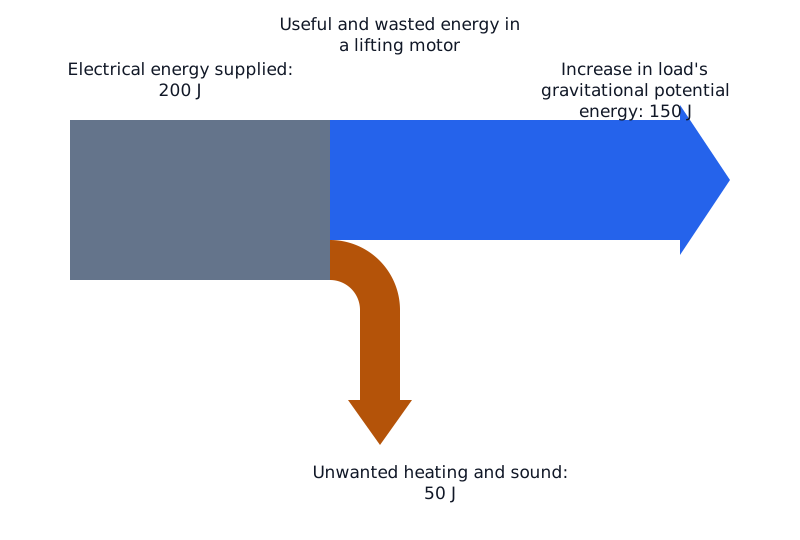
Energy split for a lifting motor. Arrow widths represent energy amounts; the useful and wasted outputs together equal the input.
Electrical energy supplied: 200 J. Increase in load's gravitational potential energy: 150 J. Unwanted heating and sound: 50 J. Wasted energy = 200 − 150 = 50 J. Efficiency = 150 ÷ 200 × 100% = 75%. Arrow shaft widths are proportional to energy.
Its efficiency is , or . This means three-quarters of the supplied energy achieves the intended purpose. If only the wasted energy had been given, the useful energy would first be found by subtraction: .
Efficiency increases when a greater proportion of the energy input is transferred usefully. A suitable modification reduces an unwanted transfer while preserving the device’s intended function.
For a lifting motor, lubricating moving parts or using bearings reduces friction and unwanted heating. For the same energy input, more energy can then be transferred usefully to the load.
Other modifications target different causes of waste:
Simply supplying more energy does not necessarily improve efficiency: the useful output must become a larger fraction of the total input.
Get unlimited access to all revision notes, key terms, and exam tips.
Efficiency is unitless. Multiply the ratio by 100 to express it as a percentage.
Reduce unwanted transfers so a greater fraction of the input is useful: lubricate or use bearings to reduce friction; streamline to reduce air resistance; use suitable lower-resistance components to reduce electrical heating; tighten loose parts to reduce vibration; insulate heating devices.
Get unlimited access to all revision notes, key terms, and exam tips.
Say energy is ‘dissipated to the surroundings’, not destroyed or simply lost.
Identify the intended purpose before deciding which energy transfers are useful or wasted.
If wasted energy is given, subtract it from the total input to find the useful energy before calculating efficiency.
Use the same units for both energies. Efficiency has no unit; multiply the ratio by 100 only when a percentage is required.
For an efficiency improvement, link the modification to the unwanted transfer it reduces, then explain why a greater proportion of the input becomes useful.
Energy dissipation
The spreading out of energy into the surroundings, usually increasing their thermal energy store, so that the energy becomes less useful.
Useful energy transfer
Energy transferred in a way that serves the intended purpose of a device or process.
Wasted energy transfer
Energy transferred in a way that does not serve the intended purpose of a device or process.
Efficiency
The ratio of useful energy transferred by a device to the total energy supplied to it.
Lubrication
The use of a substance, such as oil, between moving surfaces to reduce friction.
Thermal insulation
A material or arrangement that reduces unwanted energy transfer by heating.
Thermal conductivity
A measure of how readily a material transfers energy by conduction. A material with lower thermal conductivity is a better thermal insulator.
Put your knowledge into practice — try past paper questions for Combined Science
Energy dissipation
The spreading out of energy into the surroundings, usually increasing their thermal energy store, so that the energy becomes less useful.
Useful energy transfer
Energy transferred in a way that serves the intended purpose of a device or process.
Wasted energy transfer
Energy transferred in a way that does not serve the intended purpose of a device or process.
Efficiency
The ratio of useful energy transferred by a device to the total energy supplied to it.
Lubrication
The use of a substance, such as oil, between moving surfaces to reduce friction.
Thermal insulation
A material or arrangement that reduces unwanted energy transfer by heating.
Thermal conductivity
A measure of how readily a material transfers energy by conduction. A material with lower thermal conductivity is a better thermal insulator.