Loading…


Loading…
Loading…
Loading…
Edexcel GCSE Combined Science · 1SC0
Edexcel 1SC0 · Methods of separating and purifying substances Methods of separating and purifying substances Check the specification (PDF) (opens in a new tab)
Explain the distinction between the everyday use of the term 'pure' and its specific definition in chemistry regarding pure substances and mixtures.
Interpret melting point data to distinguish between pure substances, which have sharp melting points, and mixtures, which melt over a temperature range.
Explain which types of mixtures can be separated using specific experimental techniques: simple distillation, fractional distillation, filtration, crystallisation, and paper chromatography.
Describe and select the most appropriate experimental technique to separate a specific mixture based on the properties of its components.
Describe paper chromatography as a separation technique for mixtures of soluble substances, relying on a mobile phase solvent running through a stationary phase paper.
Interpret a paper chromatogram to distinguish between pure and impure substances, identify substances by comparison, and calculate Rf values.
Investigate the composition of inks using simple distillation and paper chromatography techniques.
Describe the processes required to make waste and ground water potable, including sedimentation, filtration, and chlorination.
Describe how sea water can be made potable using distillation.
Understand that water used in chemical analysis must be free from any dissolved salts to ensure accurate results.
Potable water is water that is safe to drink. It does not have to contain only water molecules: small amounts of dissolved salts can remain without making it unsafe. Chemically pure water, by contrast, contains only the compound water, .
Untreated water may contain insoluble particles, dissolved substances and harmful microorganisms. Some of these cannot be seen, so clear-looking water is not necessarily safe. The treatment needed depends on what the water contains.
Ground water is water held underground in rock layers called aquifers. Waste water is water that has already been used and may contain contaminants. To describe how these waters can be made potable, the key treatment stages are sedimentation, filtration and chlorination.
Large objects, such as leaves and twigs, can first be removed by screening: water passes through a grid or sieve that catches them.
During sedimentation, water is left still in a tank. Suspended insoluble particles settle to the bottom, forming sediment. The water above the sediment can then move on to the next stage. Chemicals may be added to help very small particles clump together so that they settle more easily.
During filtration, water passes through beds of sand and gravel. These trap smaller insoluble particles that did not settle. Sedimentation and filtration therefore remove solid material, but they do not remove dissolved salts.
Finally, during chlorination, chlorine is added to kill harmful bacteria and other microorganisms. This reduces the risk of diseases spread through contaminated drinking water. Chlorination comes after the solid-removal stages: its job is to disinfect the water, not to filter out particles.
These stages have different jobs. Allowing muddy water to settle may make it clearer, but clarity alone does not show that harmful microorganisms have been killed.
Sea water contains too much dissolved salt to drink safely. Removing those salts is called desalination. Ordinary filtration is unsuitable because the salts are dissolved rather than present as solid particles that a filter can trap.
Distillation separates the water from the dissolved salts. Sea water is heated so that water evaporates. The water vapour passes into a cooled condenser, where it loses energy and changes back into liquid water. This liquid is collected separately; the salts remain in the original container rather than travelling with the water vapour.
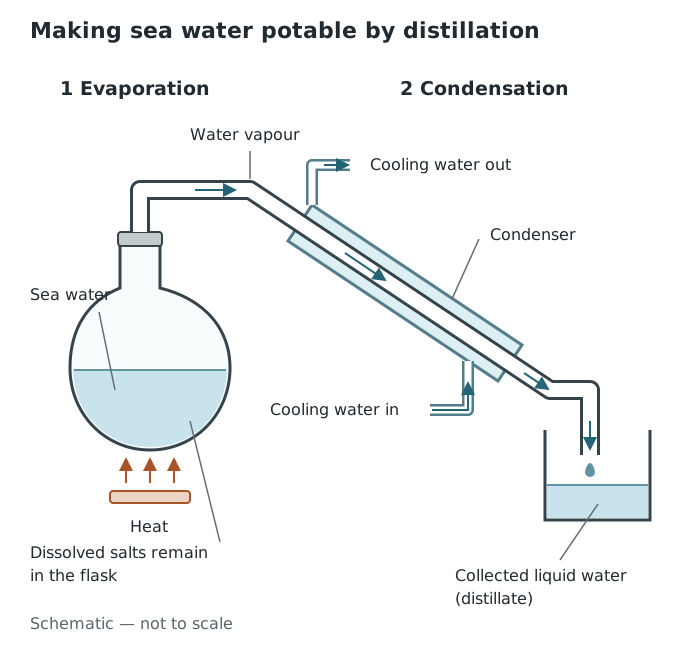
Distillation collects water by evaporation and condensation, leaving dissolved salts behind.
Both changes of state matter: evaporation separates water from the salt solution, while condensation allows the water to be collected. Distillation requires substantial energy to heat large volumes of water, making it an expensive way to produce drinking water.
Water used in chemical analysis must not contain any dissolved salts. Dissolved salts provide ions that could react with the substances being tested, producing a misleading result. For example, an observation might be caused by ions introduced with the water rather than by the sample itself.
Deionised water, which has had dissolved ions removed, is commonly used for analysis. Distillation can also separate water from dissolved salts. The important distinction is the purpose: drinking water must be safe to drink, whereas water used in analysis must not introduce dissolved salts that interfere with the test.
Get unlimited access to all revision notes, key terms, and exam tips.
Sedimentation → filtration → chlorination
Screening can first remove large debris. Filtration does not remove dissolved salts.
Distillation: heat → water evaporates → vapour is cooled → water condenses and is collected.
Dissolved salts remain in the original container. Heating large volumes requires substantial energy.
Get unlimited access to all revision notes, key terms, and exam tips.
For waste and ground water, name each stage and its purpose: sedimentation settles solids, filtration removes remaining solid particles, and chlorination kills microorganisms.
Filtration does not remove dissolved salts. Distillation separates water from dissolved salts by evaporation followed by condensation.
Potable means safe to drink, not chemically pure. Water for analysis must contain no dissolved salts.
Potable water
Water that is safe to drink; it need not be chemically pure.
Sedimentation
The settling of suspended, insoluble solid particles to form a sediment at the bottom of a liquid.
Filtration
The separation of insoluble solid particles from a liquid by passing the mixture through a filter.
Chlorination
The addition of chlorine to water to kill harmful bacteria and other microorganisms.
Distillation
A separation process in which a liquid is evaporated and its vapour is cooled and condensed, allowing the liquid to be collected.
Desalination
The removal of dissolved salts from sea water.
Deionised water
Water from which dissolved ions have been removed, used to avoid interference in chemical analysis.
Put your knowledge into practice — try past paper questions for Combined Science
Potable water
Water that is safe to drink; it need not be chemically pure.
Sedimentation
The settling of suspended, insoluble solid particles to form a sediment at the bottom of a liquid.
Filtration
The separation of insoluble solid particles from a liquid by passing the mixture through a filter.
Chlorination
The addition of chlorine to water to kill harmful bacteria and other microorganisms.
Distillation
A separation process in which a liquid is evaporated and its vapour is cooled and condensed, allowing the liquid to be collected.
Desalination
The removal of dissolved salts from sea water.
Deionised water
Water from which dissolved ions have been removed, used to avoid interference in chemical analysis.